The four essential instruments, how much to invest, and why a useful learning path matters more than an impressive workbench.
To build your first electronics lab, start with four instruments: a digital multimeter, a DC power supply, an oscilloscope, and a function generator, plus a breadboard, components, probes, and wires. Choose specifications for the low-voltage circuits you will build in the next six months, not for professional work, and upgrade when a real project demands more.
Building your first electronics lab is an exciting step, whether you are preparing for an electronics or computer engineering degree, already studying at university, or exploring electronics independently. Your own equipment allows you to build circuits, generate signals, measure real behavior, and troubleshoot problems whenever you have time. But before shopping for professional instruments, ask a more useful question: what equipment will you actually use in the next six months?
An electronics lab does not have to be expensive or permanent to be useful. A beginner needs enough capability to complete meaningful experiments, enough convenience to use the tools regularly, and a clear idea of what to learn next. Buying instruments that are far beyond your current needs may look impressive, but it does not automatically produce better engineering skills.
1. What Equipment Do You Need for a Home Electronics Lab?
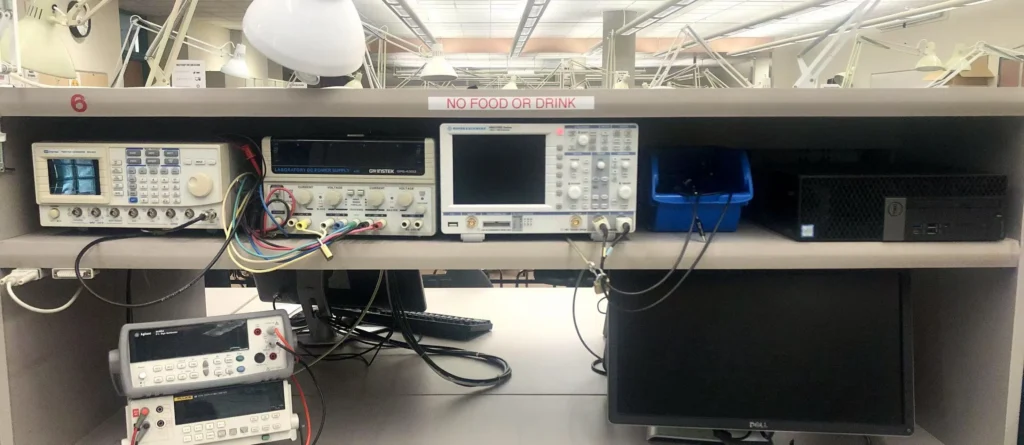
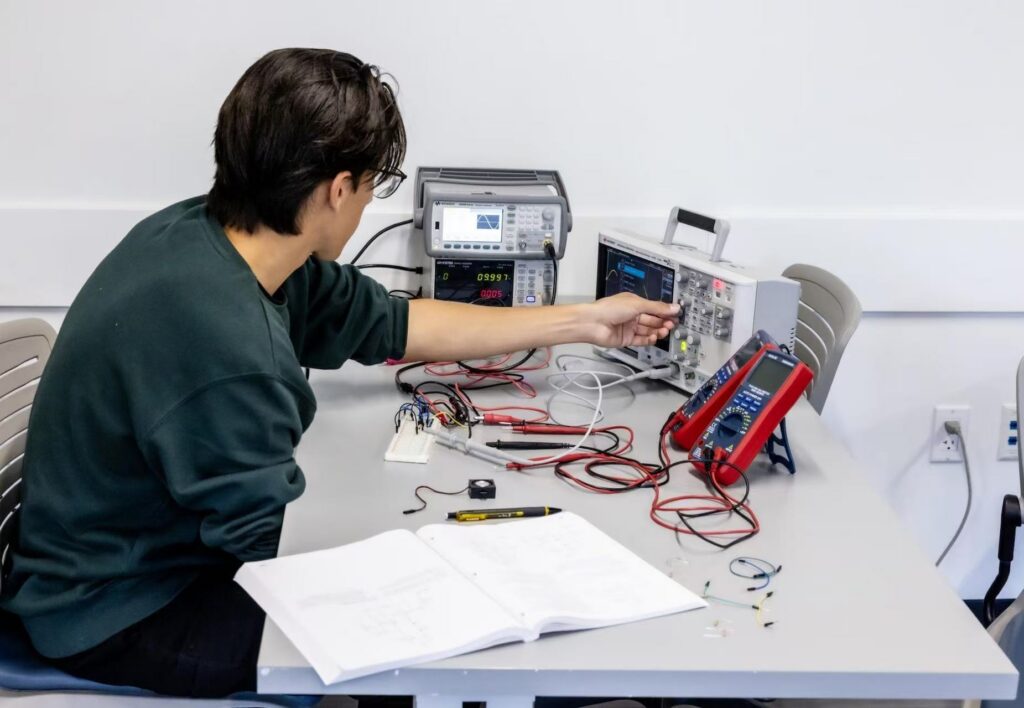
Four instrument categories form the foundation of most introductory electronics labs: a digital multimeter, DC power supply, oscilloscope, and function generator. They are complementary, not interchangeable. You also need a breadboard, components, probes, and connecting wires. A soldering station can come later, when your projects require permanent assembly.
| Instrument | What it does | Beginner priority |
|---|---|---|
| Digital multimeter | Measures voltage, current, resistance, and continuity | Reliable readings and appropriate safety rating |
| DC power supply | Provides controlled power to a circuit | Adjustable output and current limiting |
| Oscilloscope | Displays voltage changes over time | Two channels, usable triggering, and bandwidth |
| Function generator | Produces controlled test signals | Basic waveforms and practical frequency range |
Start with a digital multimeter: it helps answer basic questions about power, connections, and component values. A DC supply makes low-voltage experimentation repeatable. As you study changing signals, an oscilloscope reveals timing and waveform shape that a conventional meter cannot show. A function generator supplies known inputs so you can investigate filters, amplifiers, and digital circuits. Established manufacturers such as Rigol and Siglent offer benchtop instruments, but you do not need to choose a professional model in every category to begin learning.
Choose specifications around the circuits you intend to build. In particular, never assume a compact educational instrument is suitable for mains voltage, high-energy power electronics, or other hazardous measurements. Follow each instrument’s ratings and safety instructions.
2. Why Your First Electronics Lab Should Not Be Your Final One
As your skills improve, your measurement requirements will change. A student learning resistors, transistors, simple filters, and microcontrollers does not need the same instruments as an engineer developing high-speed interfaces, precision analog systems, or RF hardware. Eventually you may need more bandwidth, accuracy, channels, output power, or specialized measurement functions. That is a good reason to upgrade later, not a good reason to overspend today.
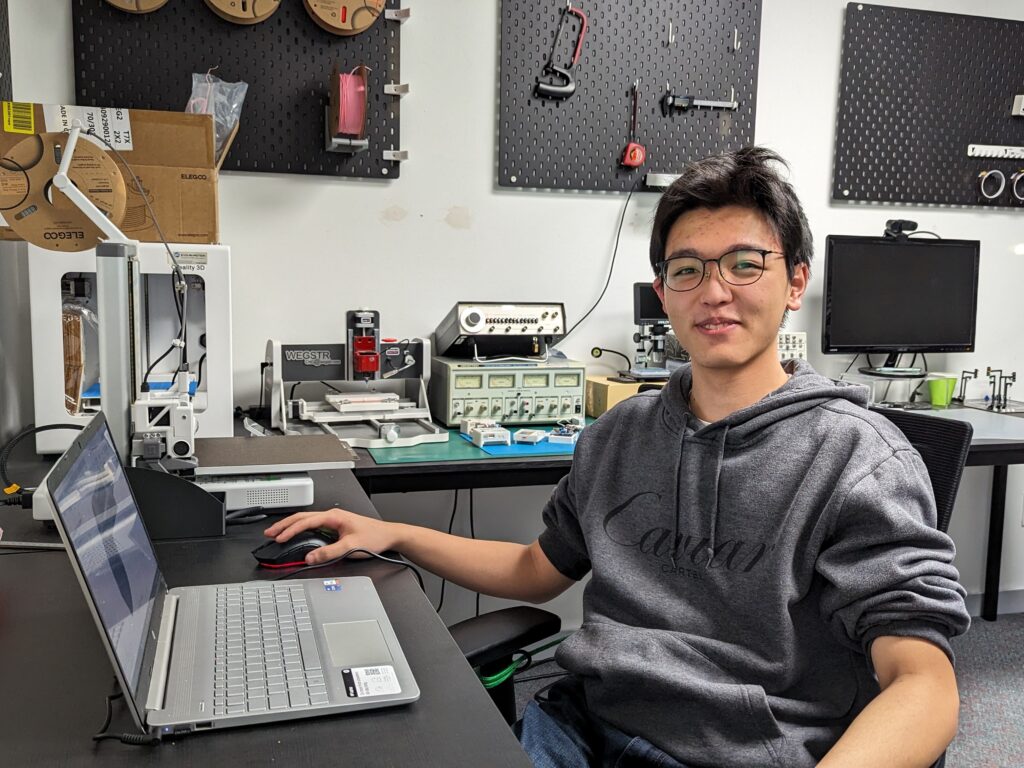
A traditional workbench also consumes space. Several benchtop instruments, cables, and accessories can be awkward in a dormitory or shared home. A portable setup lowers the effort required to start a short experiment: open the case, build the circuit, take measurements, and pack everything away. Accessibility matters because it turns occasional curiosity into repeatable practice.
3. The Bigger Beginner Problem: Buying Tools Without Knowing What to Build
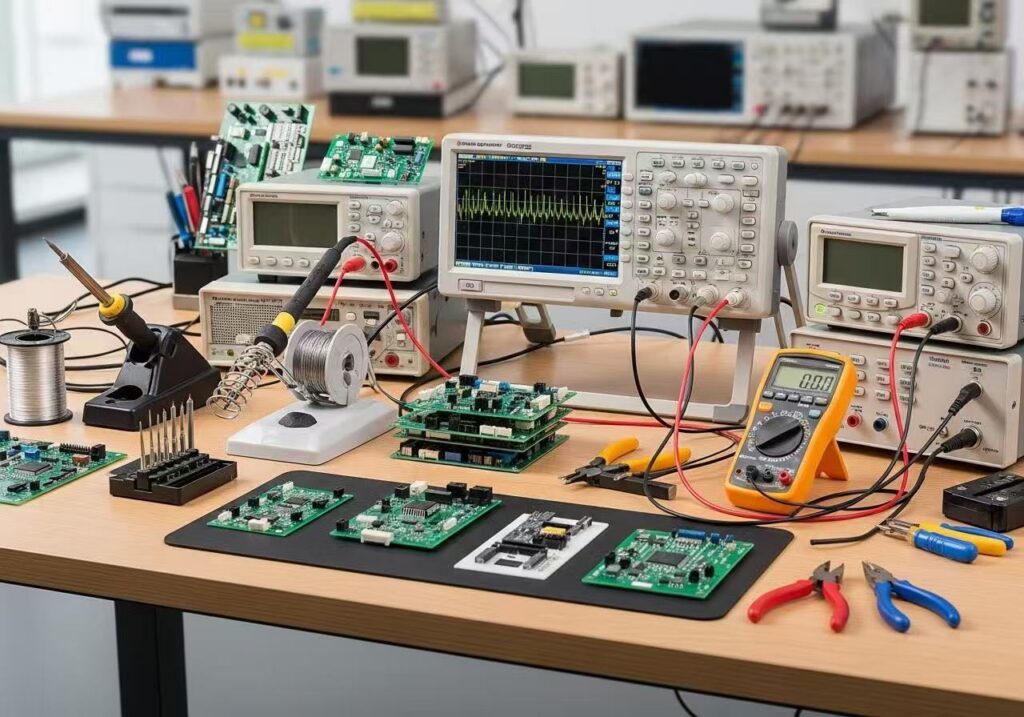
There is a familiar pattern in self-directed electronics learning. Someone buys a multimeter, oscilloscope, breadboards, and assorted components with real enthusiasm. After a few initial experiments, the equipment sits on a shelf. The problem is not necessarily motivation or hardware quality. It is the absence of a progression that connects concepts to useful experiments.
An oscilloscope does not teach you how to interpret a waveform by itself. A function generator does not explain how a filter responds to frequency. Beginners need a repeatable process: predict what should happen, build a circuit, measure what actually happens, diagnose discrepancies, and improve the design. That is how instruments become tools for learning rather than expensive accessories.
A good starting lab therefore combines hardware access, manageable experiments, and structured learning materials. It should be easy to use today, but also remain useful when projects become more demanding. The right question is not simply “Which oscilloscope should I buy?” It is “What will I learn to measure with it, and what will I build next?”
4. A Practical Alternative: Lab-on-the-Go and a Learning Path That Grows
This is the thinking behind EIM Technology’s Lab-on-the-Go. Rather than requiring students to assemble a full bench from separate instruments, it combines the core measurement functions in one portable case: a Zoolark two-channel oscilloscope and function generator, MEGO rechargeable adjustable breadboard power supply, VEGO digital multimeter, breadboard, basic components, cables, and introductory guidance. The product is currently listed at US$229 (CA$309 MSRP) on EIM’s website.
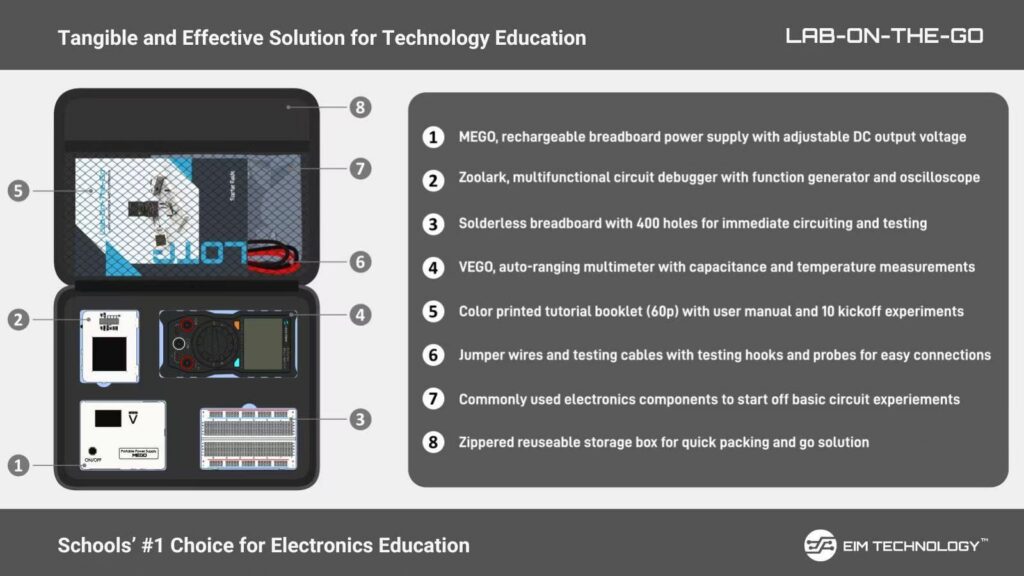
Its advantage is not superior performance to a professional laboratory. It is that the essential instruments are organized, portable, and accessible. You can build a circuit, power it, apply a signal, and observe the result without first constructing a permanent workbench. For a beginner, that lower starting friction can matter more than specifications that may not be used for years.
More importantly, the instruments are intended to remain useful across EIM’s evolving learning system. The current progression starts with Fundamental EE Starter (FE11), which introduces circuits, measurement, electronics, and microcontroller-based projects through hardware and guided materials. The next planned stage, Digital & Embedded, develops digital logic, microcontrollers, FPGA hardware, interfaces, and conversion between analog and digital signals. A later planned EE Systems stage brings analog circuits, signal chains, embedded control, and digital hardware into more complete systems. Both later stages are listed as coming soon on EIM’s Lab-on-the-Go page.
The important principle is continuity: keep the same measurement instruments while adding the learning hardware and projects appropriate to the next stage. Students do not need to buy another basic oscilloscope or multimeter simply because they move from introductory circuits to embedded systems. When their experiments finally exceed the capabilities of the portable instruments, they can upgrade with a clearer understanding of exactly what they need.
If you already have access to a suitable university laboratory and know how to use it, buying another kit may not be necessary. But if you want an accessible personal workspace and a structured route into electronics, a portable lab paired with purposeful projects can be a more sensible first investment than a collection of professional instruments chosen before your needs are clear.
Frequently Asked Questions
What are the four essential instruments for an electronics lab?
A digital multimeter, DC power supply, oscilloscope, and function generator. Breadboards, components, probes, and leads are also needed for experiments.
How much does a beginner home electronics lab cost?
Costs vary with specifications and whether you buy separate benchtop instruments or a compact integrated system. EIM currently lists Lab-on-the-Go at US$229 (CA$309 MSRP); check the product page for current pricing.
Do I need an expensive oscilloscope to learn electronics?
Usually not. Choose enough bandwidth, sample rate, channels, and triggering capability for your planned low-voltage experiments. Upgrade when a specific project requires it.
Can I learn electronics engineering at home?
Yes, many fundamentals can be learned at home with suitable low-voltage equipment and structured experiments. Advanced or hazardous work may require specialized facilities and supervision.
Will I need to replace my first electronics lab?
You may eventually need more capable instruments, but that does not make a beginner lab wasted money. Its purpose is to help you build the knowledge needed to make better equipment decisions later.
Start with a Lab You Will Actually Use
The best first electronics lab is not the one you will never outgrow. It is the one that helps you grow far enough to need something better. Start with equipment that matches your present projects, use it regularly, and let real engineering problems guide future upgrades. For an integrated starting point, explore EIM Lab-on-the-Go.

EIM TECHNOLOGY
Founder & Engineering Education Innovator
Daniel Cao is the Founder of EIM Technology and holds a Master of Applied Science in Engineering. With experience in engineering research, product development, PCB design, and technical education, he is the author of several books on electronics engineering. His work focuses on developing practical learning systems that integrate engineering hardware, lab instruments, curriculum, and project-based learning. Through EIM Technology, Daniel aims to make electronics and computer engineering more accessible and engaging, helping students build real experience in designing, measuring, testing, and troubleshooting electronic systems.