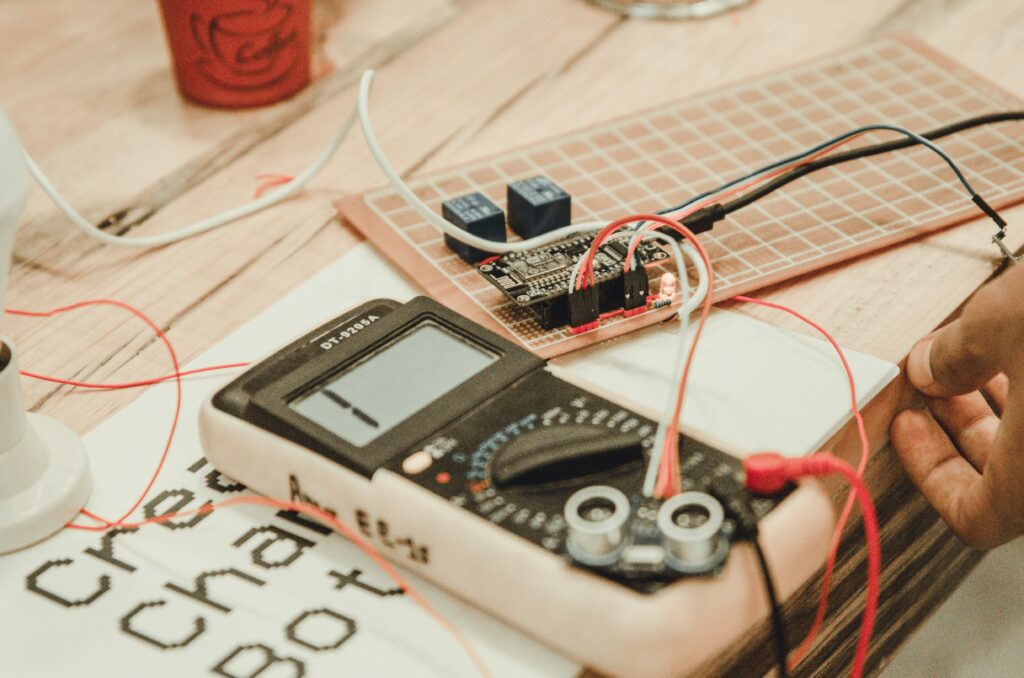
Yes, you can learn electronics engineering on your own, as long as you define the goal realistically. Self-study will not replace a full engineering degree, but a structured path through circuits, measurement, analog and digital foundations, and microcontrollers can take a motivated learner remarkably far, especially someone adding hardware capability to an existing technical skill set.
This is a realistic self-study roadmap for programmers, engineers, technical professionals, and independent learners who want to add real hardware capability without pretending that a few projects replace an engineering degree.
Software development has created an interesting expectation around technical education. Today, someone can learn Python, web development, data science, or fairly advanced software engineering without enrolling in a formal degree. A computer, an internet connection, documentation, online courses, open-source projects, and increasingly capable AI tools can take a motivated learner surprisingly far.
So it is reasonable to ask: Can you learn electronics engineering on your own? The short answer is yes. But the longer answer depends heavily on what you mean by “learn electronics engineering.”
If your goal is to replace an entire engineering degree through a few months of self-study and immediately qualify for highly specialized professional hardware-development roles, that is unrealistic for most people. If your goal is instead to understand how modern electronic systems work, build and troubleshoot real circuits, develop useful hardware projects, or add electronics to an existing technical skill set, self-study can take you remarkably far.
Do You Need to Become an Electronics Engineer to Benefit From Electronics Engineering?
There is a large space between knowing almost nothing about electronics and becoming a professional engineer specializing in hardware development. A mechanical or mechatronics engineer may want to understand sensors, motor control, microcontrollers, and electronic interfaces. A programmer may already know how to write software but want to build devices that interact with the physical world.
Someone working with physics, mathematics, signals, robotics, automation, or scientific instrumentation may need enough electronics knowledge to design experiments, understand hardware limitations, or prototype new systems. And some learners simply want to become capable technical hobbyists or hardware hackers who can build something considerably more sophisticated than connecting a few ready-made modules.
For all of these people, going back to university for another four-year degree may not make sense. The more useful question is: How much of the useful core of electronics engineering can you learn independently, without trying to reproduce an entire undergraduate degree? Quite a lot.
This is, in fact, the problem we built our learning system around.
At EIM Technology, we have been developing a structured path for people who want to learn the practical core of electronics and computer engineering without assembling a curriculum from random videos, modules, textbooks, and separately purchased instruments. Our Fundamental EE learning kits and Lab on the Go are designed around that goal.
But before we try to sell you that solution, it is worth being clear about why self-learning electronics is genuinely difficult, and why simply copying the software-learning model does not work.
Fundamental EE Starter, FE11
For learners who want a structured way to build that habit, the Fundamental EE Starter kit (FE11) follows one connected path through circuits, analog design, microcontrollers, PCBs, and guided projects, with an online learning platform alongside the hardware. AI can explain each concept along the way, while the kit keeps the learning grounded in real circuits.
Challenge #1: Electronics Eventually Has to Meet Physical Reality
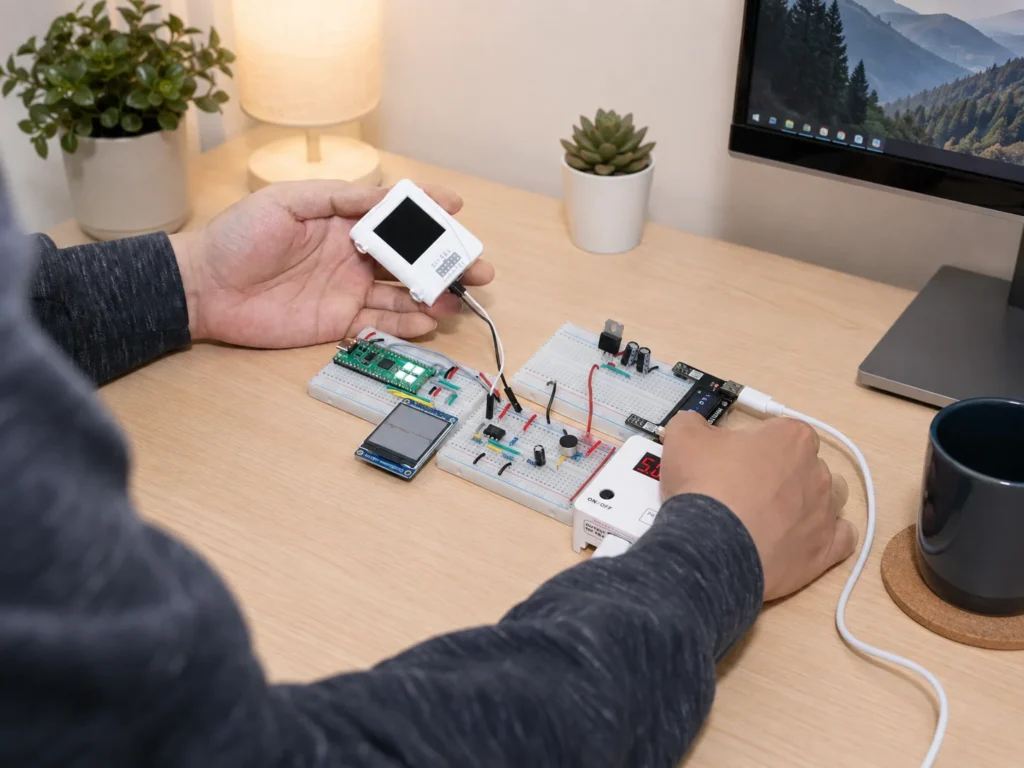
This is probably the biggest difference between learning electronics and learning programming. Software can be learned almost entirely inside a computer. You can write code, compile it, run it, debug it, read documentation, inspect open-source projects, and ask AI for help without leaving the digital environment.
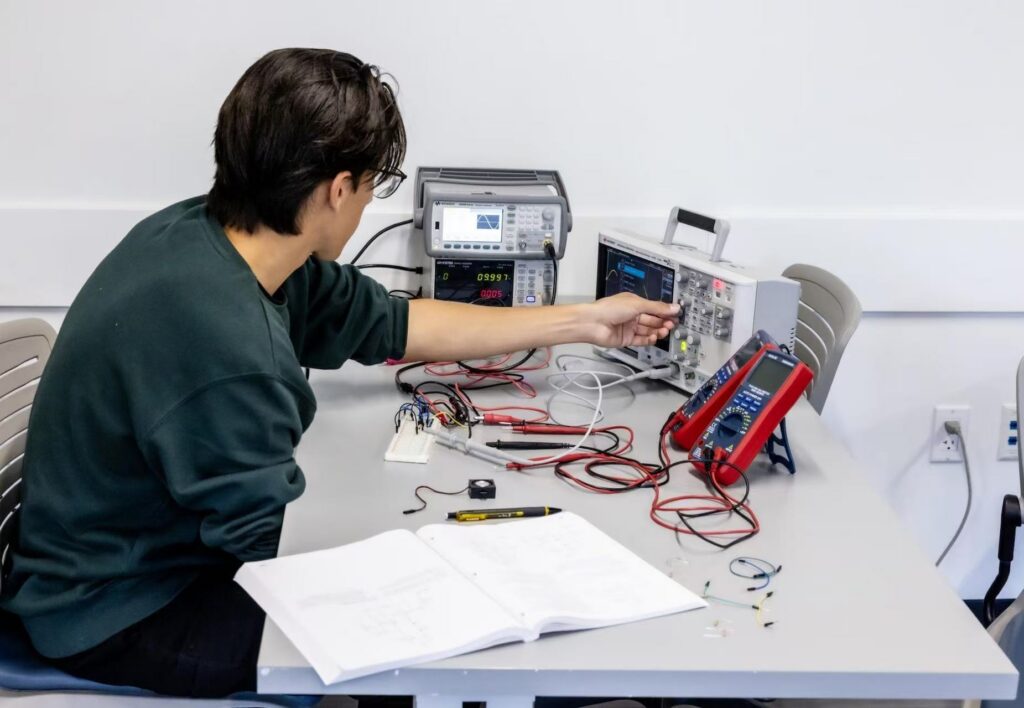
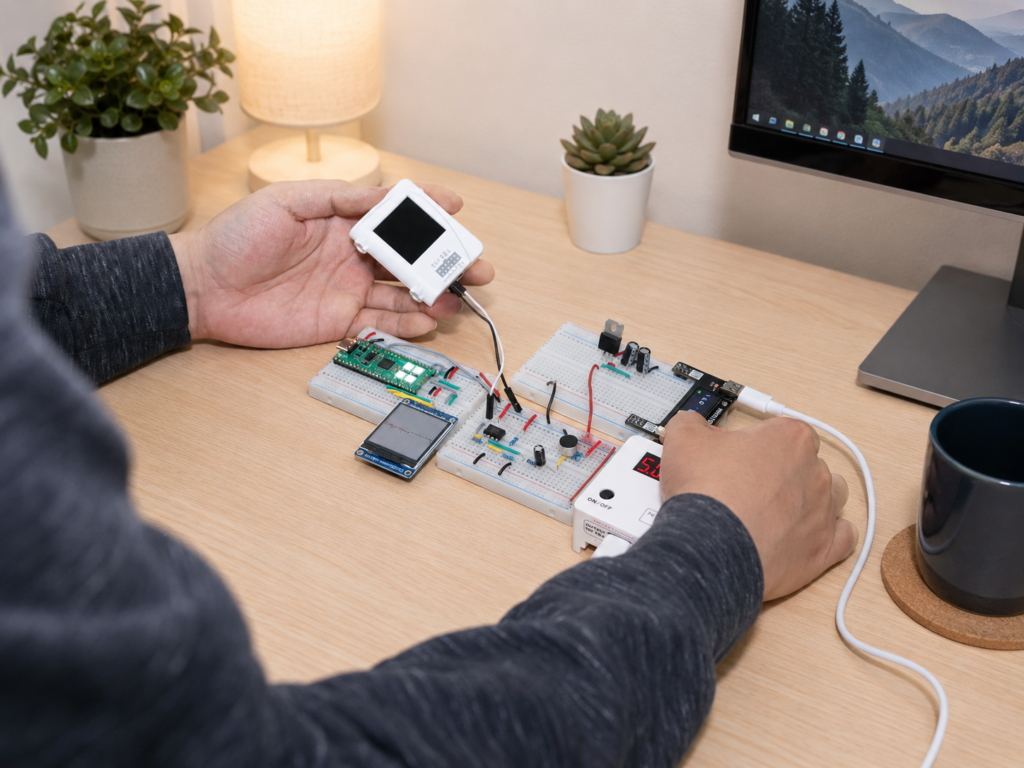
Electronics does not work that way. Eventually, you need a real circuit in front of you. You need to connect components, apply power, generate signals, measure voltage, observe waveforms, discover noise, make wiring mistakes, troubleshoot unexpected behaviour, and figure out why the circuit on your desk does not behave exactly like the diagram on your screen.
Simulation tools such as SPICE are extremely useful, but simulation is not a replacement for physical experimentation. You do not need a professional laboratory to begin, but you do need some way to cross the boundary between understanding electronics conceptually and interacting with actual electronics physically. Traditional engineering students have university laboratories. Independent learners usually do not.
Challenge #2: Buying Equipment Does Not Automatically Create a Laboratory
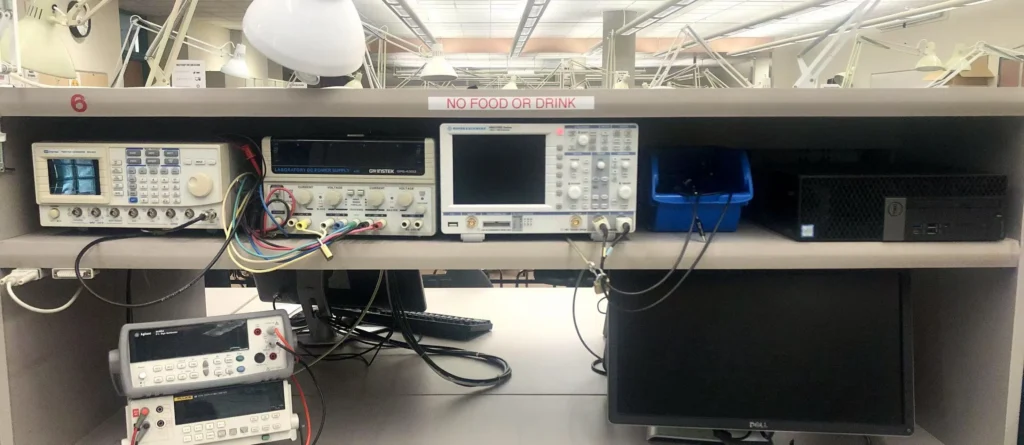
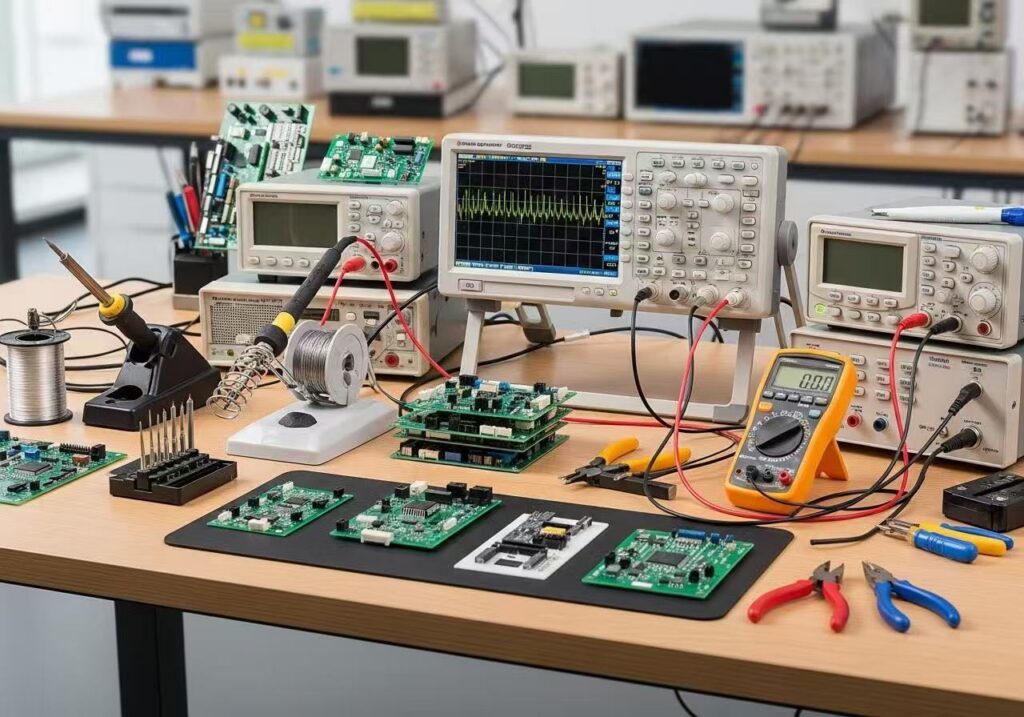
Technically, almost anyone can purchase electronics equipment today: a multimeter, oscilloscope, power supply, breadboards, components, development boards, sensors, and modules. But buying equipment is not the same as having a learning environment.
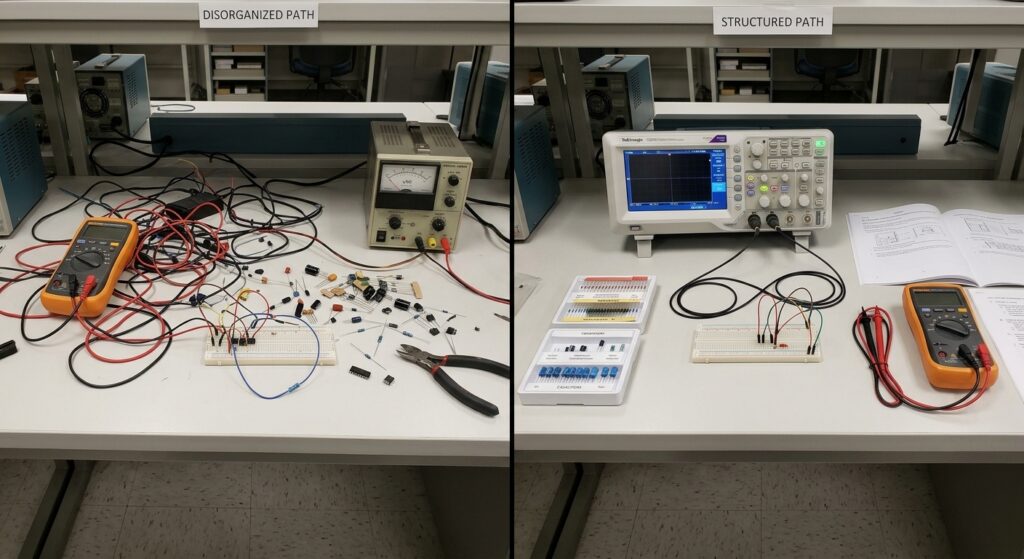
A beginner may spend hundreds or thousands of dollars collecting tools without understanding which ones are necessary, how they work together, or what experiments should be performed with them. One tutorial requires a development board. Another needs a different sensor. Then you discover that you need an oscilloscope. Another course assumes that you already understand op-amps.
Before long, you own a box full of electronics without having developed a coherent understanding of electronics. The problem is not access to information. The problem is structure.
Challenge #3: Beginners Often Learn Concepts Before They Understand Why They Matter
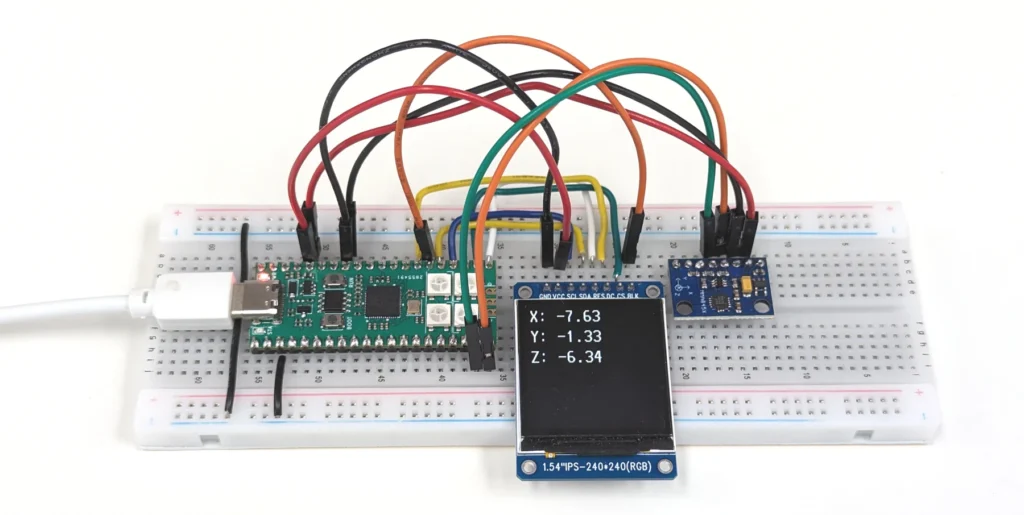
Electronics fundamentals can be extremely abstract when you encounter them for the first time. You may learn a circuit-analysis technique and spend pages manipulating equations without understanding where you will actually use it. You may study filters, frequency response, logic circuits, sampling, or semiconductor devices while having no mental picture of the systems these concepts eventually create.
The concepts are important. The problem is the order in which the learner experiences them. Build something. Observe what happens. Establish a mental model. Then return to the theory and understand why it behaved that way.
A filter becomes more meaningful when you can generate a signal, pass it through a real circuit, and observe the result. An ADC becomes more meaningful when you can measure an analog signal and display or process the sampled data. Digital logic becomes more meaningful when gates and registers eventually become counters, state machines, FPGA designs, and pieces of a computing system. Theory is not less important; it becomes easier to retain when the learner understands the problem it is trying to solve.
Challenge #4: Electronics Is Too Broad to Learn Randomly
Electronics is not one skill. Circuit fundamentals, analog electronics, semiconductor devices, digital logic, microcontrollers, embedded programming, signals, communication interfaces, PCB design, FPGA development, power electronics, and many other areas all belong somewhere in the landscape.
Trying to learn everything is impossible. Trying to learn randomly is inefficient. And trying to read several university textbooks cover to cover before building anything is unrealistic for most working adults.
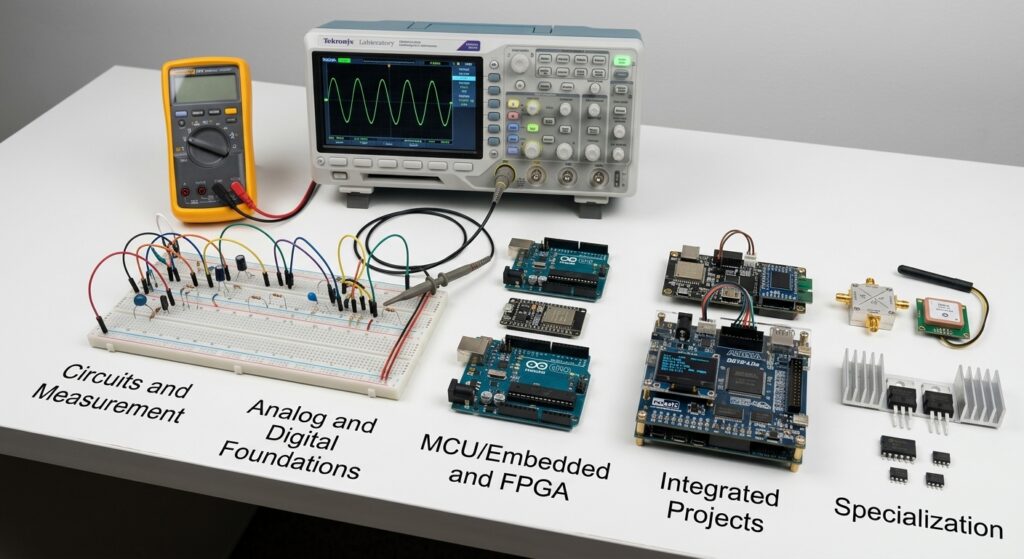
A better goal is to build a functional map of the field. Start with circuits and measurement. Learn enough analog electronics to understand real signals and basic signal conditioning. Learn digital logic so computing hardware stops looking like a black box. Add a microcontroller so software can interact with hardware. Then introduce more advanced programmable digital hardware, signal processing, communication, and integrated projects as needed.
At that point, specialization becomes much easier. You are no longer asking “What is electronics engineering?” You can start asking much better questions: Do I want to go deeper into embedded systems, FPGA, robotics, instrumentation, signal processing, PCB design, or analog electronics?
What Can a Serious Self-Learner Realistically Achieve?
A well-structured self-study program will not magically replace every part of an engineering degree. Formal engineering education provides substantial mathematics, theory, laboratories, design experience, faculty guidance, team projects, and access to specialized facilities. Some roles also require credentials or depth that cannot reasonably be compressed into a short independent-learning program.
But that is not the only useful definition of success. Within months rather than years, a motivated learner can realistically aim to understand the major building blocks of electronic systems; read and construct basic schematics; build and troubleshoot circuits; use fundamental laboratory instruments; work with analog and digital signals; program microcontrollers; understand the foundations of programmable digital hardware; and complete increasingly integrated projects.
For someone coming from software, mechanical engineering, mechatronics, physics, mathematics, robotics, or another adjacent field, this can create something especially valuable: a bridge between an existing specialization and physical electronic systems. You do not necessarily need a second degree. You may need a well-designed bridge.
This Is the Problem the Fundamental EE Learning Path Is Designed to Solve
At EIM Technology, we did not want to create another Arduino project box containing several modules and a collection of disconnected tutorials. Those products can be excellent for experimentation and hobby projects, but they solve a different problem. We also did not want to reproduce a four-year ECE curriculum in miniature.
Instead, our goal is to identify a practical core path through electronics and computer engineering and combine three things that are often separated in self-study: structured knowledge, real hardware, and laboratory measurement.
The learning path begins with Fundamental EE Starter (FE11), where learners establish basic circuit and electronics foundations while actually building and measuring what they study. From there, the system progresses into more advanced electronics, digital systems, microcontrollers, FPGA development, and integrated projects. Later projects deliberately combine these areas so that learners see how complete electronic systems are constructed.
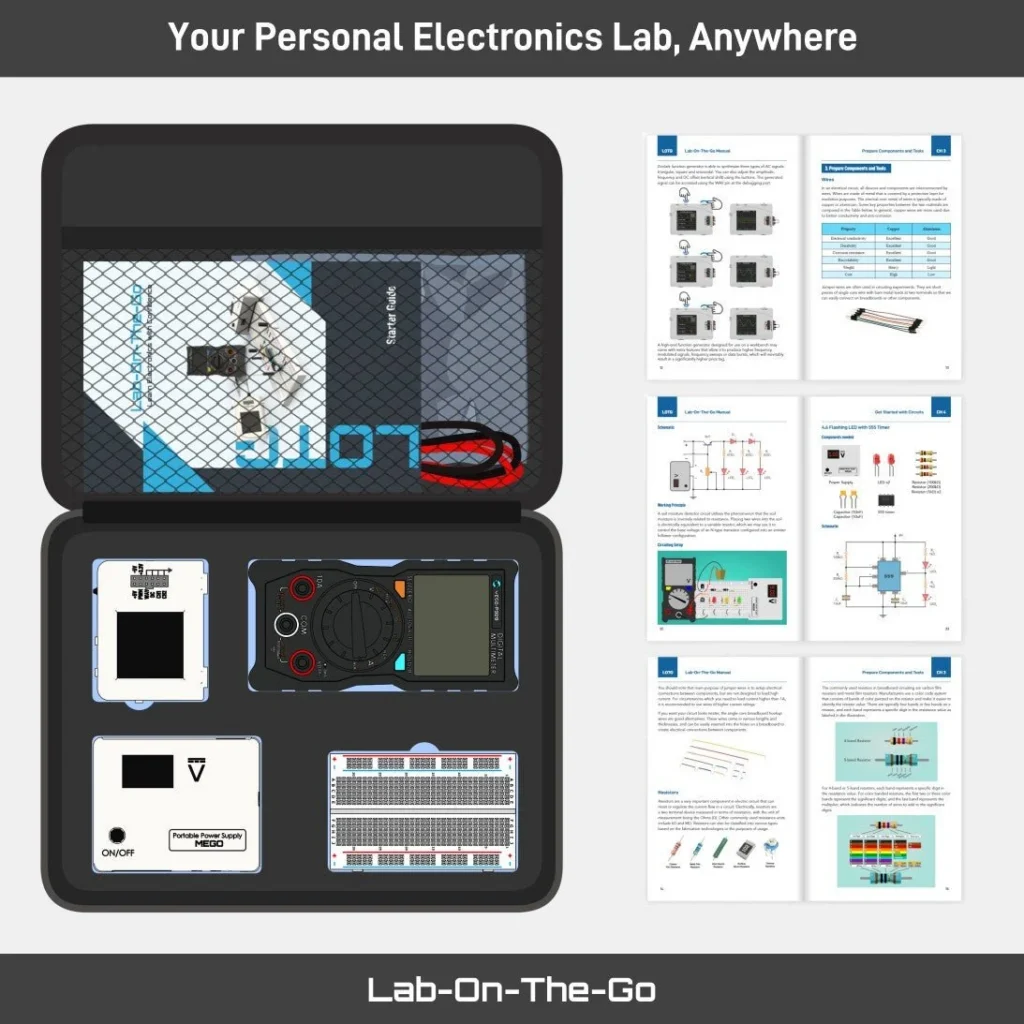
The accompanying Lab on the Go provides the measurement environment around that curriculum. The principle is simple: do not separate the textbook, the project kit, and the electronics laboratory. Make them part of the same learning path.
Lab-On-The-Go Electronics Tool Kit
The measuring step is where many learners get stuck, because it depends on instruments that are not always accessible outside a lab. A portable kit such as the Lab-On-The-Go puts a rechargeable power supply, a digital multimeter, and an oscilloscope with a function generator in one case, so a student can capture that unexpected waveform at their own desk and work through the loop at their own pace
How Should You Think About the Cost of Learning Electronics?
Building a traditional electronics bench piece by piece can become expensive surprisingly quickly. More importantly, purchasing equipment does not solve the curriculum problem. At the opposite extreme, enrolling in formal university courses provides structure and facilities but comes with a dramatically different commitment in tuition, prerequisites, schedules, and time.
A structured self-study system sits between those two extremes. For less than the cost of many individual university courses, a learner can own laboratory hardware, learning materials, components, development platforms, and project hardware that continue to support experimentation afterward. That does not make it a substitute for an engineering degree. It makes it a different tool for a different objective.
You may want to bring hardware into software projects, understand the electronics inside a mechanical or mechatronics system, work more effectively with robotics or instrumentation, or simply build real electronic systems and understand why they work. For those goals, electronics is absolutely something you can begin learning independently.

EIM TECHNOLOGY
Founder & Engineering Education Innovator
Daniel Cao is the Founder of EIM Technology and holds a Master of Applied Science in Engineering. With experience in engineering research, product development, PCB design, and technical education, he is the author of several books on electronics engineering. His work focuses on developing practical learning systems that integrate engineering hardware, lab instruments, curriculum, and project-based learning. Through EIM Technology, Daniel aims to make electronics and computer engineering more accessible and engaging, helping students build real experience in designing, measuring, testing, and troubleshooting electronic systems.