The best engineering kit for a teen is the one that matches what they want to do next. A 12-year-old who loves building should start with a mechanical or robotics kit. A teen of 14 or older who is curious about how circuits work gets more from a curriculum-based electronics kit with real components, a set learning sequence, and projects that build on each other.
Below are the four main types of kit, what a good kit of each type includes, a five-point check you can run on any kit before you buy, and an age guide.
What types of engineering kits are there for teens?
Engineering kits for teens fall into four groups.
| Kit type | What your teen does | What they learn | Best fit |
|---|---|---|---|
| Mechanical and building kits | Assembles models, gears, and moving structures, such as a hydraulic arm or a gear-driven vehicle | Forces, motion, design, and patience | Younger teens who like hands-on building |
| Robotics kits | Builds a robot and programs its movement, such as a line-following robot | Coding, sensors, motors, and, in advanced kits, control and mechanics | Teens who want quick, visible results, or older teens on a robotics team |
| Project-based maker kits | Builds circuits from diagrams and runs example code, such as a temperature display | Programming and digital control; circuit theory depends on the guide | Teens who already enjoy coding |
| Curriculum-based electronics kits | Builds circuits, measures them, then programs the same hardware, such as an audio spectrum display | Circuits, analog electronics, measurement, and microcontrollers | Teens 14 and older who are curious about electrical or computer engineering |
Maker kits and curriculum-based kits often contain similar parts: breadboards, resistors, LEDs, and a microcontroller board. The difference is the teaching. A maker kit shows what to build. A curriculum-based kit explains why it works and has your teen measure it.
None of these is better across the board. A block-coded robot is a great first step for a 12-year-old. A 16-year-old who has outgrown it can go further with advanced robotics, or with electronics fundamentals if they now want to know why the circuit inside the robot works.
What should the best kit of each type include?
- Mechanical and building kits: parts that can be rebuilt into new designs, not one fixed model.
- Robotics kits: a way to move from block coding to text coding, so the kit does not run out of challenge.
- Project-based maker kits: a printed or online guide that explains what each component does, not only where it goes.
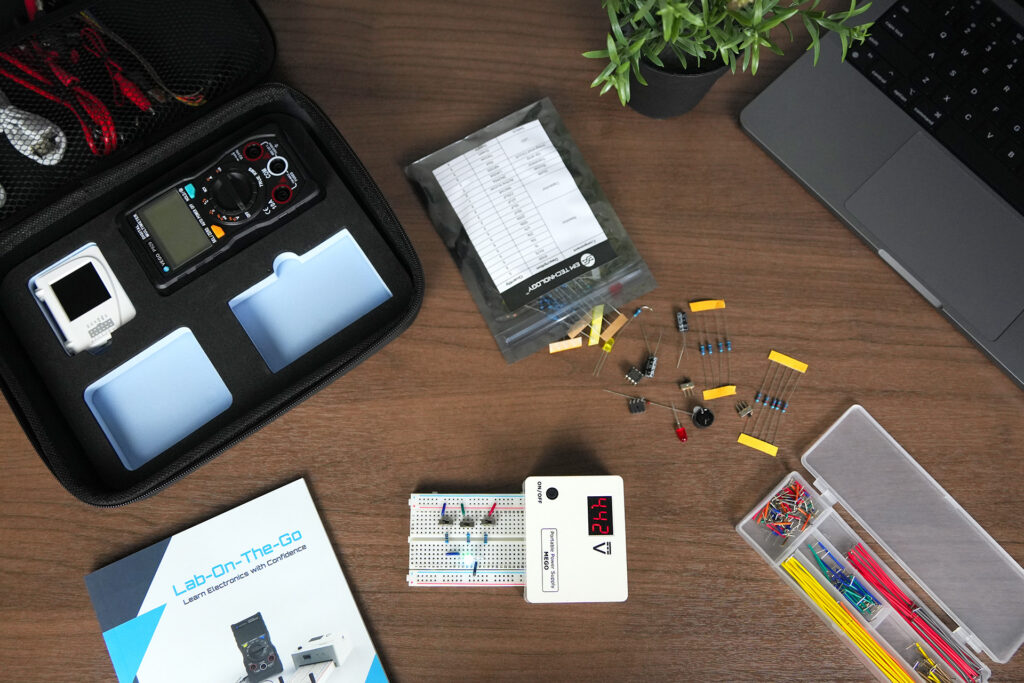
- Curriculum-based electronics kits: a set learning sequence, real components on a breadboard, a microcontroller for the programming stage, and a clear answer on measurement: either a meter is included, or the kit tells you which tool to add.
How do you choose the right engineering kit for your teen?
Run these five checks on any kit before you buy.
| Check | What a good kit has | Red flag |
|---|---|---|
| Fit | Matches what your teen already enjoys: building, coding, or asking how things work | Chosen only by the age on the box |
| Teaching | Explains the principle behind each build | Wiring steps with no explanation |
| Measurement | A way to check what the circuit is doing, or a clear note on which meter to add | Success means only "it lights up" |
| Next step | A harder project, a second kit, or a skill used in school | Nothing to do once the last project is done |
| Safety | Low-voltage battery or USB power, solderless breadboard to start | Mains-powered parts, or soldering with no guidance on ventilation and lead-free solder |
A teen who takes things apart wants to build. A teen who writes small programs wants to code. A teen who asks how something works is ready for electronics fundamentals.
Which engineering kit suits which age?
Treat age as a rough guide alongside the five checks above.
| Age | Typical starting point | Signs your teen is ready to move up |
|---|---|---|
| 12 to 13 | Mechanical, building, and beginner robotics kits, or a simple maker kit for teens who already code | Finishes kits quickly and starts modifying them |
| 14 to 15 | Robotics, maker kits, or a first curriculum-based electronics kit | Asks how the sensors and circuits work, not only what they do |
| 16 to 18 | Curriculum-based electronics kits, advanced robotics, and real measurement tools | Is considering electrical engineering, computer engineering, or physics after high school |
The Fundamental EE Starter (FE11) is recommended for ages 14 and up (Grade 9 and above). No previous electronics or programming experience is required. Basic algebra and introductory physics help.
What should a teen learn from an electronics kit?
If your teen is leaning toward electrical or computer engineering, a good electronics kit covers four things, in order.
- The principle. What voltage, current, and resistance are, and how they relate. For example, how two resistors split a voltage.
- The build. Placing those resistors on a breadboard and powering the circuit.
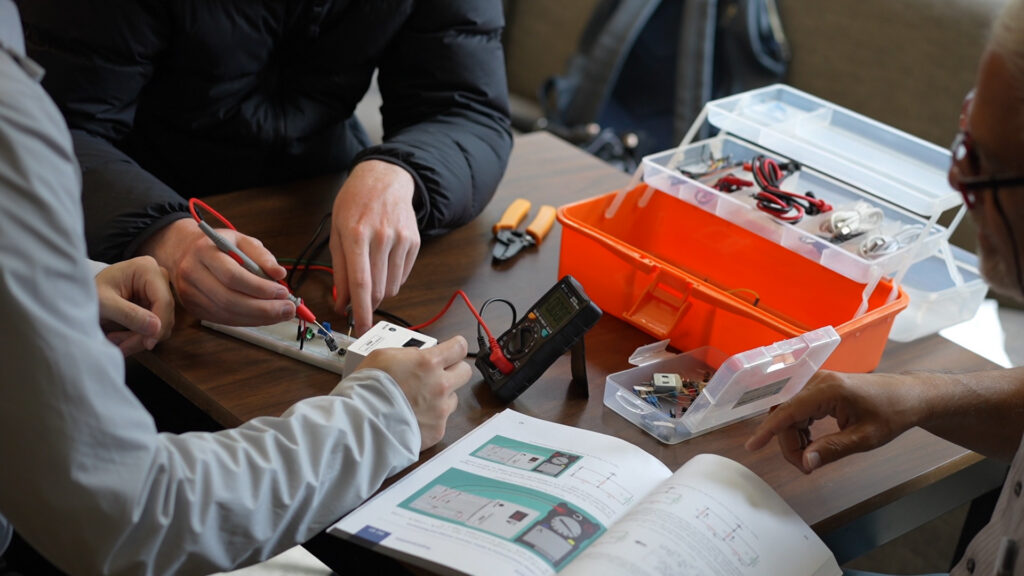
- The measurement. Measuring the voltage across each resistor with a multimeter and comparing it with the calculation. When the numbers disagree, working out why.
- The program. Using a microcontroller to read that voltage, or to drive an LED with a pulsed signal and watch the brightness change as the pulse width changes. A good course also teaches the limit: a microcontroller input only accepts a set voltage range (0 to 3.3 V on the RP2040), so a higher voltage must be scaled down first.
Kits that skip the principle and the measurement feel exciting at first, because something lights up or moves quickly. The understanding comes from the measurement step, when the result does not match the expectation and your teen has to find out why.
First circuits usually fail for ordinary reasons: a component one row off on the breadboard, an LED inserted backward, a missing ground connection, or the wrong resistor value. The fix is a method, not guesswork: check the layout by eye first, then, with the power off, use a meter’s continuity mode to confirm connections, then power up and measure voltages to confirm the circuit behaves as calculated. That method is the first real engineering skill a teen learns.
Why choose a curriculum-based kit instead of a box of parts?
A box of loose components is cheap, but it leaves your teen to work out what to build and in what order. The Fundamental EE Starter (FE11) gives them a path instead:
- A systematic curriculum. A printed lab manual and online learning materials take your teen through circuit principles, analog electronics, and measurement, then microcontroller programming.
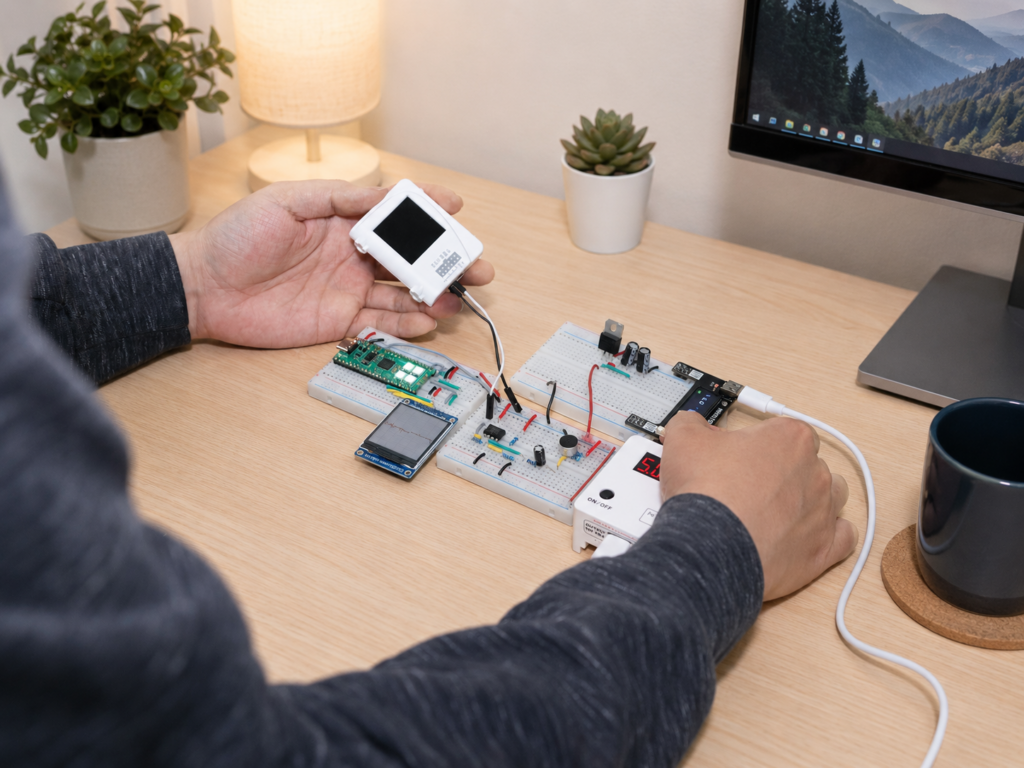
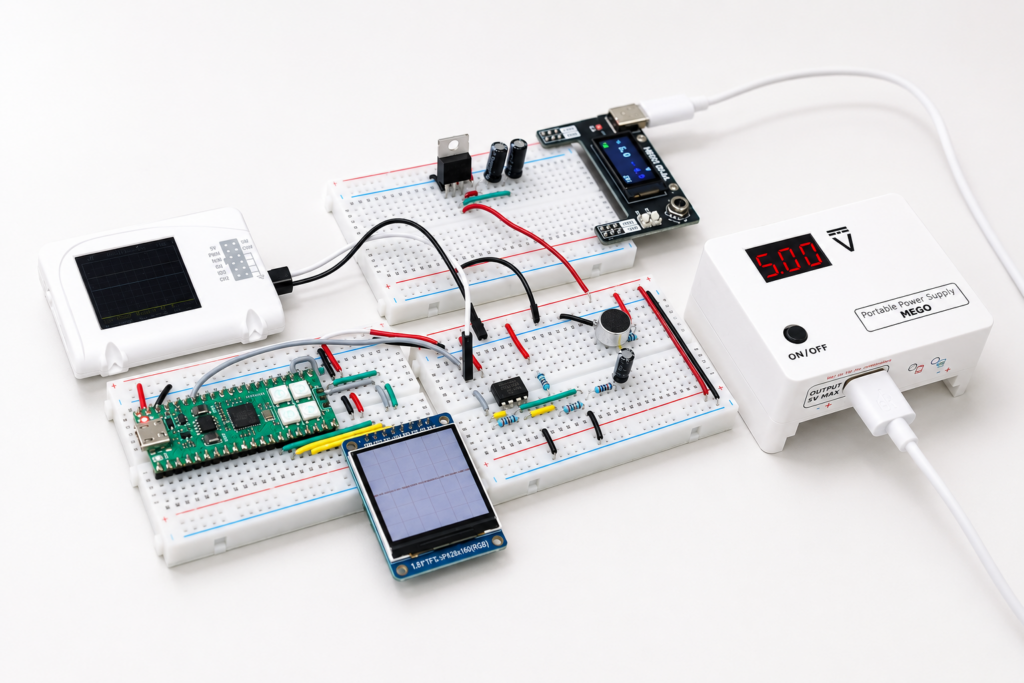
- Dedicated hardware in two sets. Breadboards with through-hole components and ICs for learning, plus an integrated, fully soldered surface-mount project PCB for durable applications. The kit also includes boards, a display, power components, and accessories.
- Real applications. The same platform runs projects such as an audio oscilloscope, a spectrum analyzer, a particle sandbox, and a breathing trainer, so your teen sees how separate topics connect into one working system.
- Programming with purpose. The embedded side uses the RP2040 microcontroller and MicroPython, so coding is used to acquire signals and control hardware, not learned on its own.
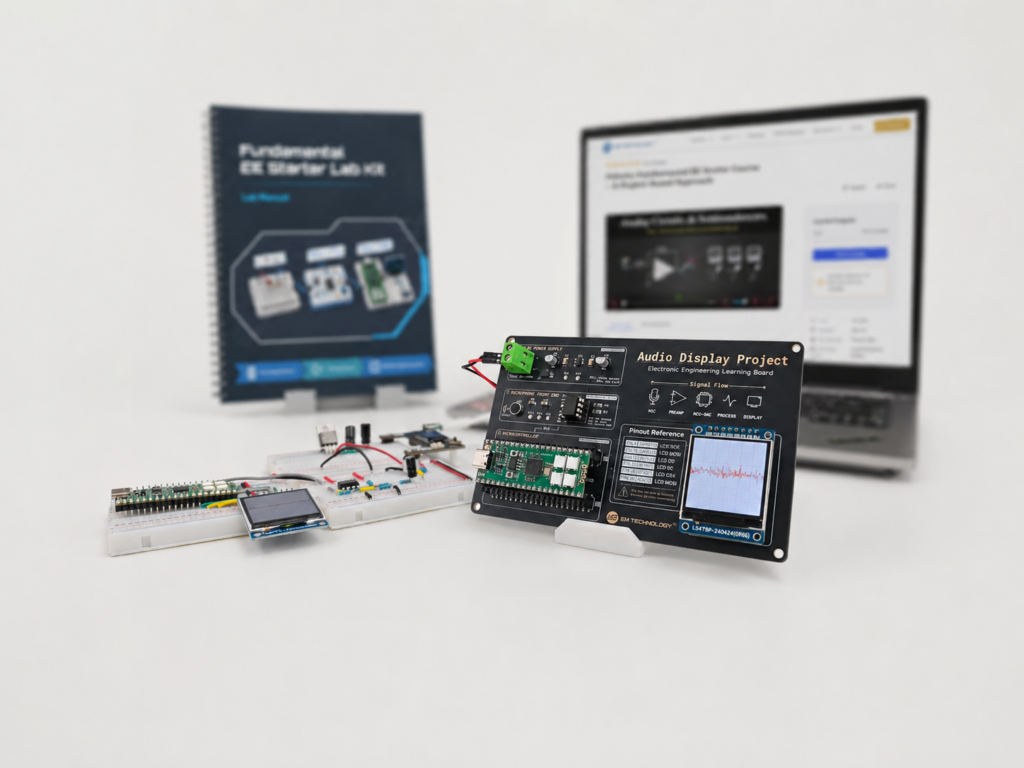
Fundamental EE Starter, FE11
For learners who want a structured way to build that habit, the Fundamental EE Starter kit (FE11) follows one connected path through circuits, analog design, microcontrollers, PCBs, and guided projects, with an online learning platform alongside the hardware. AI can explain each concept along the way, while the kit keeps the learning grounded in real circuits.
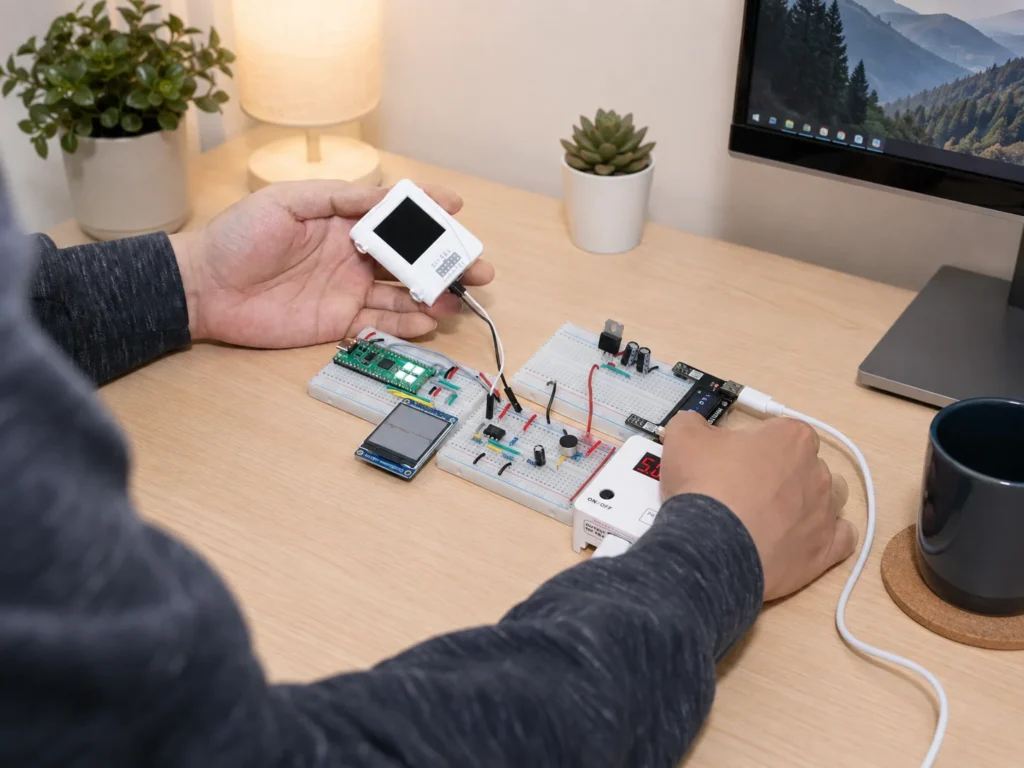
The FE11 course is self-paced, so your teen can work through it alongside school. EIM hardware is also used in university labs, STEM programs, and engineering workshops. Lab submissions are optional, and teens who want feedback can submit their results through the learning platform to the EIM engineering team.
What mistakes do parents make when buying an engineering kit?
- Buying for the age on the box instead of the teen. A capable 14-year-old can be bored by a kit made for their age group. A younger teen can be overwhelmed by a kit meant for engineering students. Start from what your teen already does.
- Choosing the kit with the most pieces. More components do not mean more learning. A smaller kit with a clear sequence teaches more than a large assortment with no path.
- Treating the kit as a one-time gift. The best kits have a next step. Check what your teen can move on to once they finish.
- Skipping measurement. A teen who is serious about electronics will want to see what a circuit is doing. Measurement is one of the four steps in the FE11 sequence: principle, build, measure, and program. For dedicated instruments, Lab-on-the-Go, sold separately, pairs with FE11 and adds oscilloscope, signal generator, power supply, and multimeter functions.
What can a teen do with the projects afterward?
A teen who builds real circuits and documents what they measured has the start of an engineering portfolio they can draw on for college and university applications. EIM’s STEM Pioneers, a quarterly student engineering magazine, features student projects and engineering stories.
For ideas on what to build next, see our guide to electrical engineering projects for students. If your teen is taking AP or IB courses, read Are AP and IB Enough to Prepare for Electrical and Computer Engineering?
Frequently asked questions
What is the best engineering kit for a 14-year-old?
A robotics kit for a 14-year-old who wants quick, visible results, and a curriculum-based electronics kit for one who wants to understand how circuits work. For the second group, the Fundamental EE Starter (FE11), recommended from age 14, teaches circuits, measurement, and microcontroller programming in one sequence.
Does my teen need coding experience for an electronics kit?
Not for FE11. No previous electronics or programming experience is required, even though the embedded projects use MicroPython.
Are engineering kits good gifts for teens?
Yes, if the kit matches the teen. A kit that fits their current interest and has a clear next step can stay in use for months. A kit that is too easy or too advanced may be set aside quickly. If you are shopping for a college engineering student instead, see our gift guide for engineers.
Can a teen learn electronics at home without a teacher?
Yes, with the right structure. A kit with a printed manual, online lessons, and projects in a set order lets a teen learn at their own pace. FE11 is self-paced, and optional lab submissions give teens a way to get feedback.
What comes after a beginner electronics kit?
Deeper work in digital hardware and embedded systems. FE11 is the foundation of the EIM learning path, and the next kit in the series, FE22 (digital and embedded), is launching soon.
Find the right first kit for your teen
If your teen is 14 or older and curious about how electronics work, the Fundamental EE Starter gives them real hardware, a structured curriculum, and projects that connect into one working system.

EIM TECHNOLOGY
Founder & Engineering Education Innovator
Daniel Cao is the Founder of EIM Technology and holds a Master of Applied Science in Engineering. With experience in engineering research, product development, PCB design, and technical education, he is the author of several books on electronics engineering. His work focuses on developing practical learning systems that integrate engineering hardware, lab instruments, curriculum, and project-based learning. Through EIM Technology, Daniel aims to make electronics and computer engineering more accessible and engaging, helping students build real experience in designing, measuring, testing, and troubleshooting electronic systems.