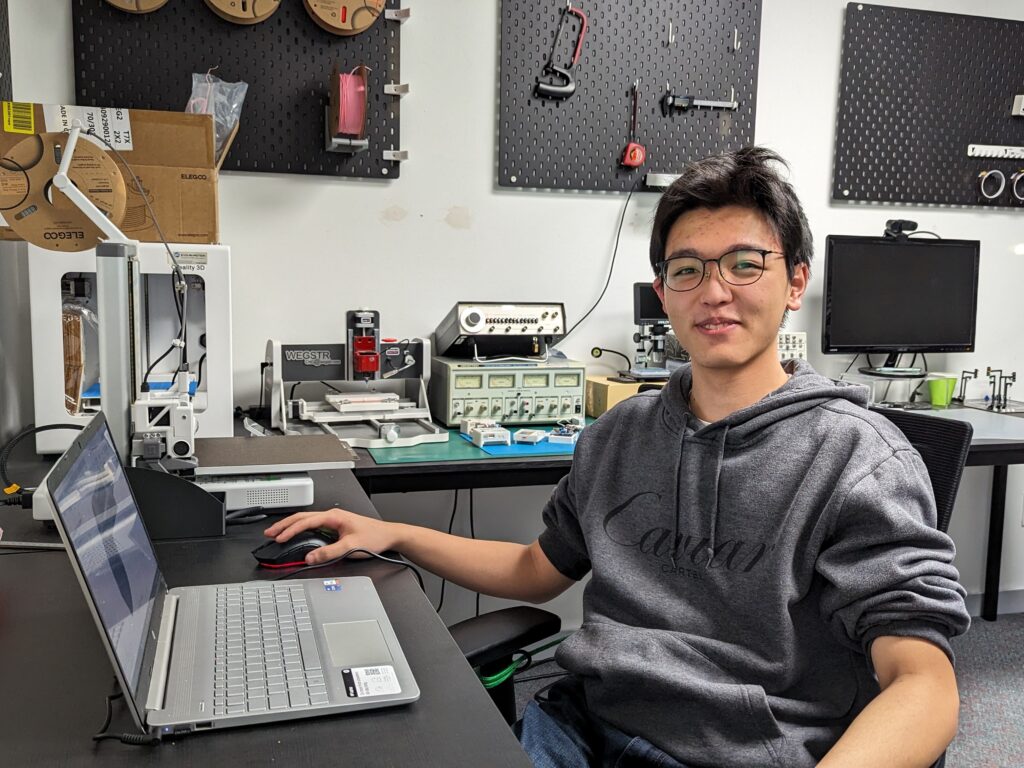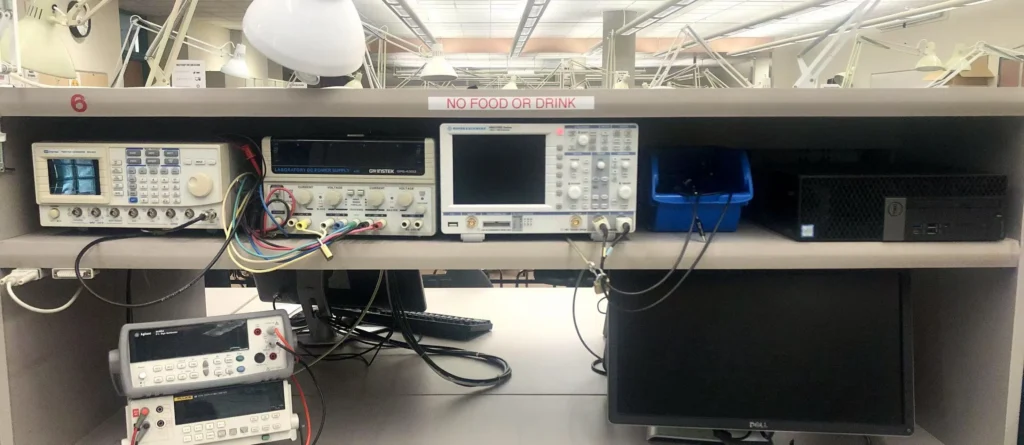
Before spending hundreds or thousands of dollars on an oscilloscope, understand what matters for learning electronics, and why your first measurement system may not need to be a professional benchtop instrument.
The best oscilloscope for a beginner is not the most powerful one you can afford. It is one with enough bandwidth, sample rate, channel count, and triggering for the circuits you are actually building, that is easy to use, and that sits alongside a power supply, a signal source, and a multimeter. For many students, a compact, integrated lab is a sensible first step.
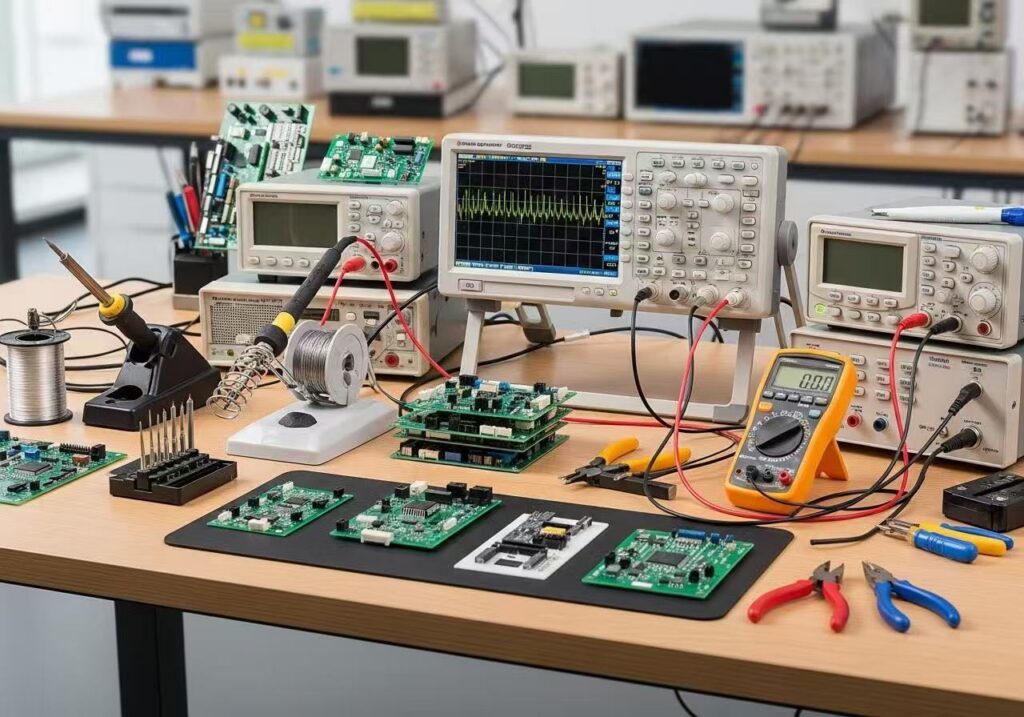
Figure 1. A conventional electronics workbench with multiple instruments.
An oscilloscope is one of the most important instruments in electronics engineering. Whether you are studying circuits at university, building embedded systems, troubleshooting electronic hardware, or developing professional products, sooner or later you will need to observe electrical signals that a regular multimeter cannot adequately describe.
But if you are just getting started, choosing your first oscilloscope can be surprisingly confusing. Browse any electronics equipment store and you will encounter specifications such as bandwidth, sample rate, memory depth, resolution, channel count, and triggering capabilities. Prices range from inexpensive portable devices to professional instruments costing thousands or even tens of thousands of dollars.
Naturally, it is tempting to assume that the more expensive instrument is the better investment. After all, if you are serious about electronics engineering, should you not buy something professional from the beginning? Not necessarily.
I consider an oscilloscope an excellent investment for anyone planning to develop meaningful electronics engineering skills. However, the best oscilloscope for a beginner is not necessarily the most capable instrument they can afford. It is the one that helps them learn, experiment, and understand what they are measuring.
1. What Does an Oscilloscope Do, and Which Specifications Matter?
A digital multimeter can tell you the voltage across a resistor or whether a connection is broken. An oscilloscope goes much further: it shows how voltage changes over time. This makes it possible to observe periodic waveforms, investigate digital signals, compare timing between two channels, identify unexpected noise, and understand how a circuit responds to changing inputs.
For example, when studying a simple RC filter, a multimeter might provide useful voltage measurements, but an oscilloscope allows you to see the input and output waveforms together. You can observe how the circuit changes signal amplitude and timing, then compare your measurements with what you learned in theory. This is where an oscilloscope becomes an exceptionally valuable educational tool: it connects mathematical descriptions and circuit diagrams with actual physical behavior.
| Specification | What it means | Why it matters |
|---|---|---|
| Bandwidth | Frequency range measured with specified amplitude accuracy | Fast signals and edges require adequate bandwidth |
| Sample rate | How often the input is digitized | Affects waveform capture fidelity |
| Memory depth | Number of stored samples | Helps capture longer records at useful detail |
| Channel count | Signals viewed simultaneously | Two channels help compare input and output |
| Triggering | Conditions used to capture a signal | Stabilizes waveforms and isolates events |
| Vertical resolution | Digital voltage quantization | Influences small-signal detail |
These are important engineering considerations, but their relevance depends on the application. A high-speed communication interface, switching transient, or sensitive analog measurement may demand much more from the instrument than a basic low-frequency circuit experiment. For a student learning introductory electronics, many projects involve simple analog circuits, basic digital signals, sensors, and microcontrollers. They do not automatically require a high-end benchtop oscilloscope.
What matters more is having enough capability to observe the signals involved, understanding the instrument’s limitations, and knowing how to interpret the results. A sophisticated oscilloscope cannot compensate for a lack of understanding about what should be measured or why.
Why I Would Not Recommend an Expensive Oscilloscope to Every Beginner
There is nothing wrong with purchasing a professional oscilloscope. If you know your requirements and expect to use it regularly, a high-quality benchtop model can serve you for years. The problem is purchasing one before you have developed the knowledge needed to evaluate it.
Suppose you are a first-year electronics or computer engineering student learning basic circuit analysis, resistors, capacitors, digital electronics, and introductory microcontroller projects. Your immediate objective is not professional product development. It is to understand circuit behavior and develop the habit of verifying ideas through measurement. Spending most of your budget on advanced features you rarely use may not be the most effective investment.
As your skills improve, your requirements will change. You may later specialize in analog electronics, embedded systems, power electronics, semiconductor devices, or high-speed digital design. Each field presents different measurement challenges. Buying expensive equipment early does not guarantee you will avoid upgrading later.
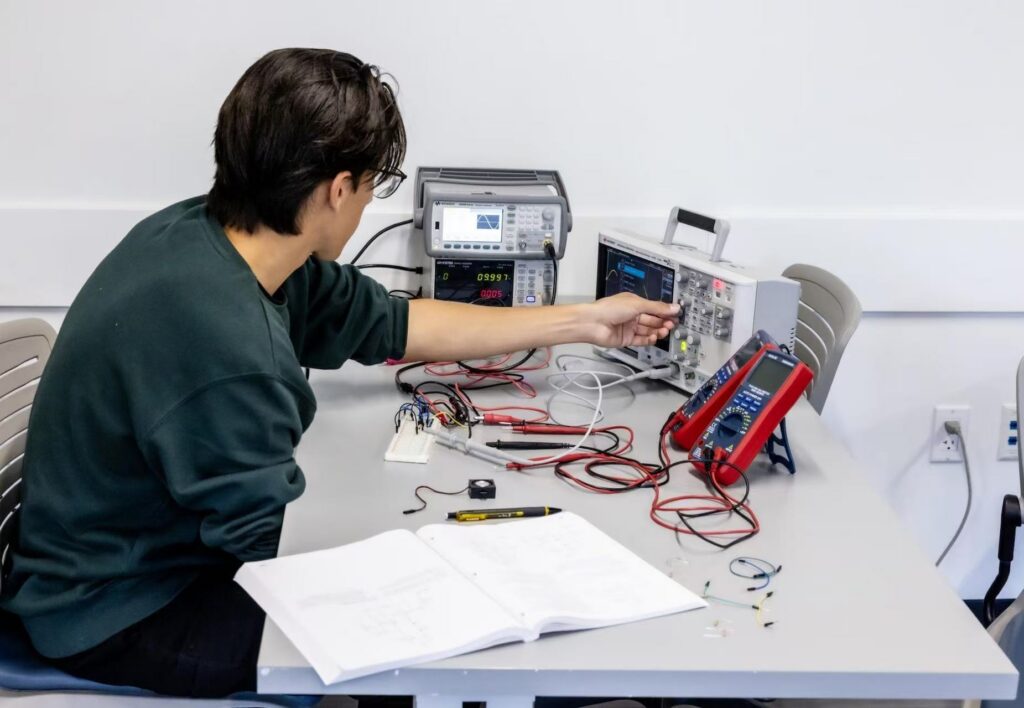
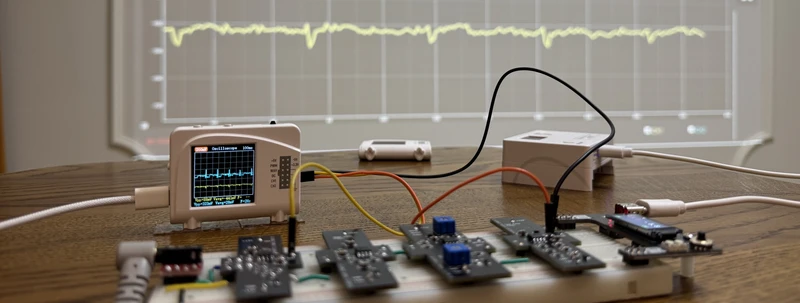
Figure 2. A student working with benchtop equipment and a breadboard.
There is another factor that deserves more attention: accessibility. A conventional benchtop oscilloscope is capable, but it requires space, power connections, appropriate probes, and an organized working area. For someone in a dormitory or learning at home, preparation can become a barrier. If you have twenty minutes to test a circuit, a compact measurement system you can take out immediately makes it more likely you will actually do the experiment.
Convenience may sound secondary when choosing technical equipment, but in education it influences how frequently the equipment gets used. Over months, the difference between experimenting regularly and postponing experiments can be substantial. The goal is to make measurement part of your normal learning routine.
3. Why an Oscilloscope Alone Is Not a Complete Learning Solution
An oscilloscope is a measurement instrument. It does not automatically give you a circuit to measure, a signal to investigate, or an understanding of what the waveform means. Consider an amplifier experiment: you may need a function generator to provide the input, a power supply to operate the circuit, and an oscilloscope to compare input and output. A multimeter helps verify DC operating conditions. An oscilloscope rarely works in isolation.
This is one reason beginners sometimes buy equipment enthusiastically and then struggle to use it. They have the tools, but not necessarily a sequence of meaningful problems to solve. Engineering skills develop when theory, experimentation, and measurement reinforce one another. You learn a concept, build something, observe the result, and investigate why actual behavior differs from your prediction.
A structured sequence of experiments can therefore be more valuable than additional instrument features. It also explains why an integrated measurement platform can make sense for someone starting from scratch.
4. A Different Approach: Start with an Accessible Measurement System
At EIM Technology, we developed Lab-on-the-Go around this idea. Instead of asking beginners to assemble a conventional electronics workbench from several separate instruments, we wanted to make essential measurement functions more accessible, portable, and practical for everyday learning.
One central instrument is Zoolark, a compact device combining an oscilloscope and function generator. These functions are frequently used together, so integrating them simplifies many introductory experiments. Lab-on-the-Go also includes a digital multimeter, adjustable rechargeable breadboard power supply, breadboard, test leads, electronic components, and accessories for building and testing circuits.
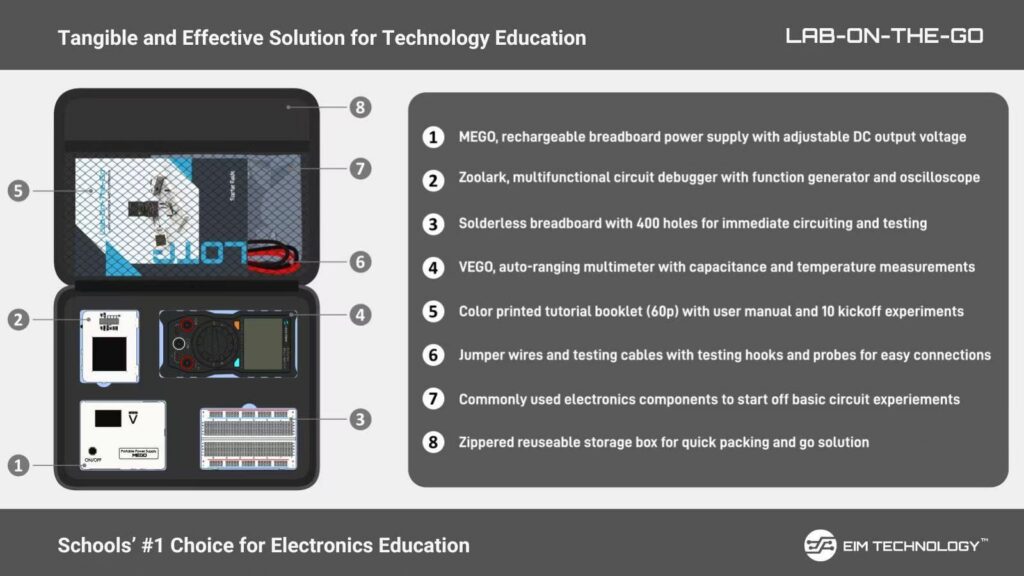
Figure 3. EIM Lab-on-the-Go kit overview, identifying Zoolark, the multimeter, power supply, breadboard, and accessories.
Zoolark is not intended to match professional benchtop oscilloscopes on every technical specification. Instruments for demanding R&D may provide far greater bandwidth, sampling performance, precision, triggering, and specialized features. That is not the competition we are trying to win.
For beginners, I see three advantages that matter more. First, cost: an integrated beginner laboratory avoids committing a large budget to multiple professional instruments before you know your needs. Second, accessibility: a compact system makes it easier to begin experiments in a suitable home or student workspace, while remaining within its rated electrical limits. Third, the learning environment: hardware is more useful when it supports a coherent sequence of experiments rather than sitting unused on a shelf.
At EIM, Lab-on-the-Go is part of a broader electronics and computer engineering learning environment. Introductory materials such as Fundamental EE Starter (FE11), paired with Lab-on-the-Go, provide opportunities to build circuits, generate signals, measure outcomes, and troubleshoot problems. The next stages of the pathway, Digital & Embedded and EE Systems, are listed as coming soon.
There is an even more interesting direction beyond using an oscilloscope. Through advanced digital and embedded systems study, learners can explore sampling, analog-to-digital conversion, digital processing, memory, and waveform visualization. With suitable hardware and sufficient experience, these ideas can be combined into a simplified oscilloscope-like educational project designed from scratch. This is a possible learning objective for later study. When you understand how an instrument works internally, sample rate, resolution, bandwidth, and memory depth stop being abstract numbers in a brochure. You begin to understand the engineering trade-offs behind them, and you are better equipped to choose a professional instrument when the time comes.
5. So, Which Oscilloscope Should You Buy First?
If you already work on demanding projects and know your requirements, investing in a professional oscilloscope may be entirely reasonable. Compare instruments based on the signals you need to measure, the probes required, and the features that will genuinely improve your work.
If you are learning electronics at home, preparing for an electronics or computer engineering degree, or exploring hardware engineering for the first time, I would approach it differently. Start with instruments that support the experiments you can perform today. Make sure you have the supporting tools to build, power, and test circuits, and follow a learning process that gives you regular opportunities to use them.
A compact system such as EIM Lab-on-the-Go is worth considering when portability, accessibility, and a structured learning environment matter more than advanced laboratory specifications. Eventually you may need a higher-performance oscilloscope. Upgrading is a natural part of developing as an engineer.
An oscilloscope can be an excellent long-term investment. But the most valuable first investment is developing the knowledge and experience to use one effectively.
Frequently Asked Questions
Do beginners really need an oscilloscope?
Not for every experiment. A multimeter is enough for many basic DC measurements. An oscilloscope becomes useful when studying time-varying signals, filters, amplifiers, and digital timing.
What oscilloscope specifications matter most for beginners?
Bandwidth, sample rate, channel count, triggering, and ease of use are sensible starting points. Required specifications depend on the signals being measured.
Is a portable oscilloscope good enough for learning electronics?
It can be suitable for many introductory low-voltage experiments if its measurement capabilities and input ratings match the application. It is not a universal replacement for professional equipment.
Should I buy an oscilloscope or a complete electronics lab kit?
If you already have a power supply, components, and other tools, a separate oscilloscope may make sense. Starting from scratch, an integrated lab can be more convenient.
Can I build my own oscilloscope as an electronics project?
Yes. A simplified educational oscilloscope can be built with suitable sampling, processing, and display hardware. Its performance and safety limitations differ from professional instruments.

EIM TECHNOLOGY
Founder & Engineering Education Innovator
Daniel Cao is the Founder of EIM Technology and holds a Master of Applied Science in Engineering. With experience in engineering research, product development, PCB design, and technical education, he is the author of several books on electronics engineering. His work focuses on developing practical learning systems that integrate engineering hardware, lab instruments, curriculum, and project-based learning. Through EIM Technology, Daniel aims to make electronics and computer engineering more accessible and engaging, helping students build real experience in designing, measuring, testing, and troubleshooting electronic systems.