For future engineers, incoming engineering students, and anyone who wants to give something more meaningful than another gadget.
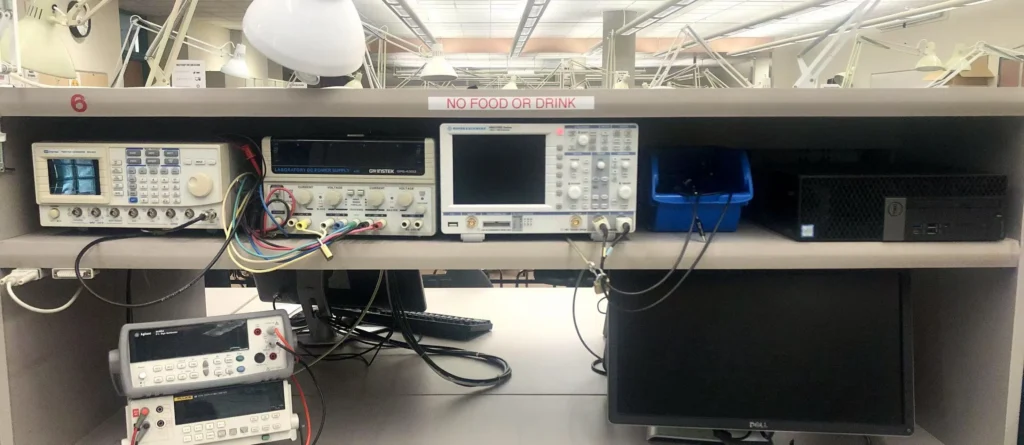
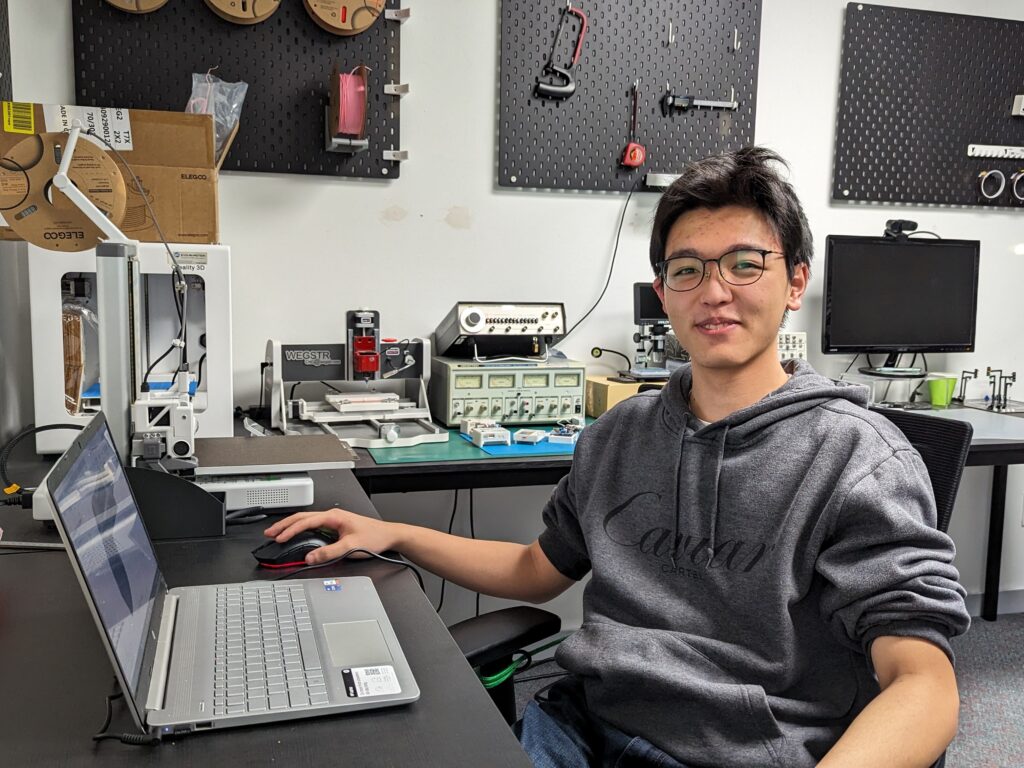
The best gift for an engineer depends on where they are in their journey. For experienced engineers, specialized equipment is risky to buy without knowing their work. For future engineers and engineering students heading into electronics, computer engineering, or robotics, one of the most useful gifts is a personal electronics laboratory: real instruments they can use outside scheduled university labs.
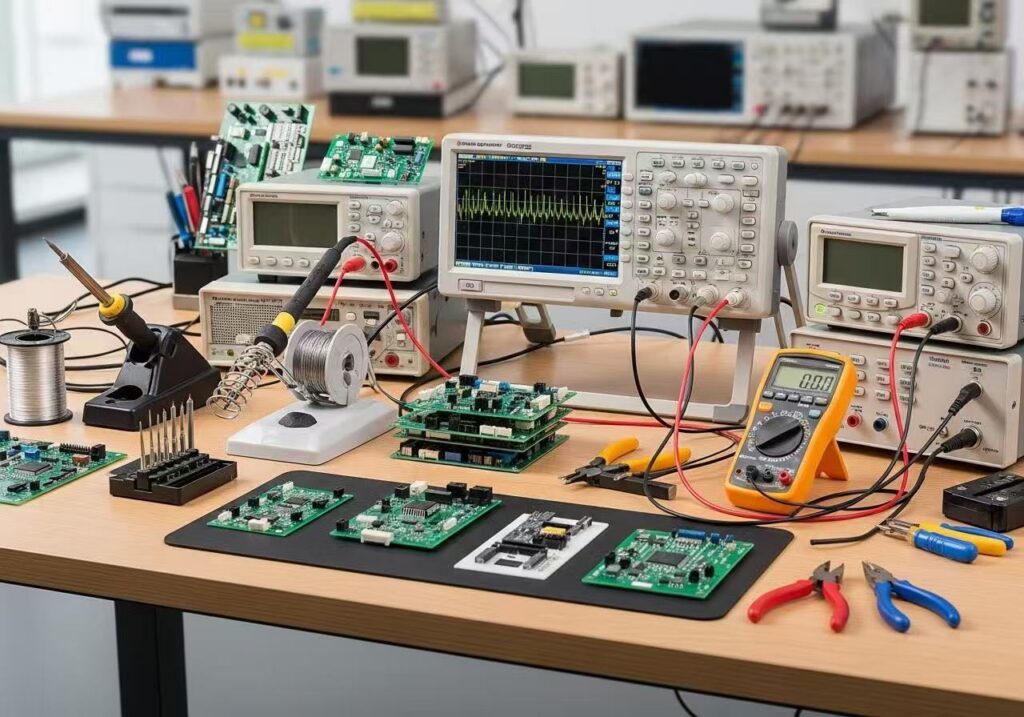
Choosing a gift for an engineer can be surprisingly difficult. Engineers are often curious, practical, and particular about the tools they use. A clever gadget might entertain them for a weekend. A personalized mug might earn a smile. But finding something they will genuinely appreciate, use, and remember? That requires a little more thought.
And perhaps there is an even more important question: Are you buying a gift for someone who is already an engineer, or someone who is about to become one?
For experienced professionals, the answer may be highly specialized. A mechanical engineer, software developer, and electronics designer can have very different interests and technical needs. Buying professional equipment without knowing those needs can be risky.
But for someone preparing to enter an engineering program, or currently navigating their first years at university, the opportunity is different.
You could give them something that helps them begin building the skills they will spend the next four or five years developing. Something that makes their university education more rewarding, gives them access to tools outside the classroom, and grows with their technical confidence.
That is why our recommendation for one of the best gifts for engineering students in 2026 is not another desk accessory or electronic novelty.
It is a personal electronics laboratory.
1. The Best Engineering Gifts Help Students Get More Out of University
An engineering degree is a substantial investment. In the United States and Canada, families may spend tens of thousands of dollars on tuition, housing, textbooks, and other educational expenses. But the value of that investment depends on more than the courses a student completes.
Universities offer laboratories, professors, technical clubs, research opportunities, and industry connections. Students who learn to take advantage of these resources can gain much more than academic knowledge.
The challenge is that many incoming students have limited experience with actual engineering equipment.
They may have excellent grades in mathematics and physics, yet never have used an oscilloscope, built a functioning electronic circuit, or investigated why a real system behaves differently from a theoretical model.
This gap matters, especially in electronics and computer engineering, where practical measurement and troubleshooting are essential parts of learning.
A personal electronics laboratory gives students a way to begin developing those skills before they enter university, or to strengthen them alongside their coursework.
Instead of waiting for a scheduled laboratory session, they can build a circuit, test an idea, observe a signal, and work through problems independently. When they later encounter similar concepts in lectures or university laboratories, they may already have a useful practical frame of reference.
This does not replace university laboratories or professional instruction. It makes students better prepared to engage with them.
The real value of an engineering gift is not that it saves tuition. It is that it can help students make better use of the education they are already investing in.
2. Give Them Something Most Engineering Students Do Not Have: Their Own Lab
Think about the resources available to a typical first-year engineering student.
They have textbooks, lecture notes, a laptop, and perhaps access to shared laboratory equipment during scheduled classes. Outside those hours, their ability to experiment with real electronics may be limited.
A student who owns a personal set of measurement instruments has another option.
They can investigate a circuit in the evening, revisit an experiment over the weekend, or continue working on a project without relying entirely on shared university facilities.
The distinction is not simply convenience. It changes how students can approach learning.
When instruments are readily available, experiments do not have to end when a scheduled laboratory period finishes. A confusing waveform becomes something to investigate rather than a problem to leave unresolved. A circuit that fails to behave as expected becomes an opportunity to practice debugging.
For students studying electronics engineering, computer engineering, embedded systems, robotics, or related fields, this kind of access can be particularly valuable.
A personal laboratory is not a guarantee of better grades or a future internship. But it removes a practical barrier between curiosity and experimentation.
And that can be a meaningful advantage.
3. A Thoughtful Gift Shows That You Understand What Engineering Really Means
There is something special about receiving a gift that reflects not just what you like, but who you are becoming.
For a student about to begin an engineering degree, that distinction matters.
A generic technology gift says, “I know you like electronics.”
A personal engineering laboratory says something more specific: “I know you are serious about becoming an engineer, and I want to support you in that journey.”
That is a very different message.
Engineering is not simply about using advanced technology. It is about understanding how things work, designing solutions, making measurements, and solving problems when reality refuses to follow the plan.
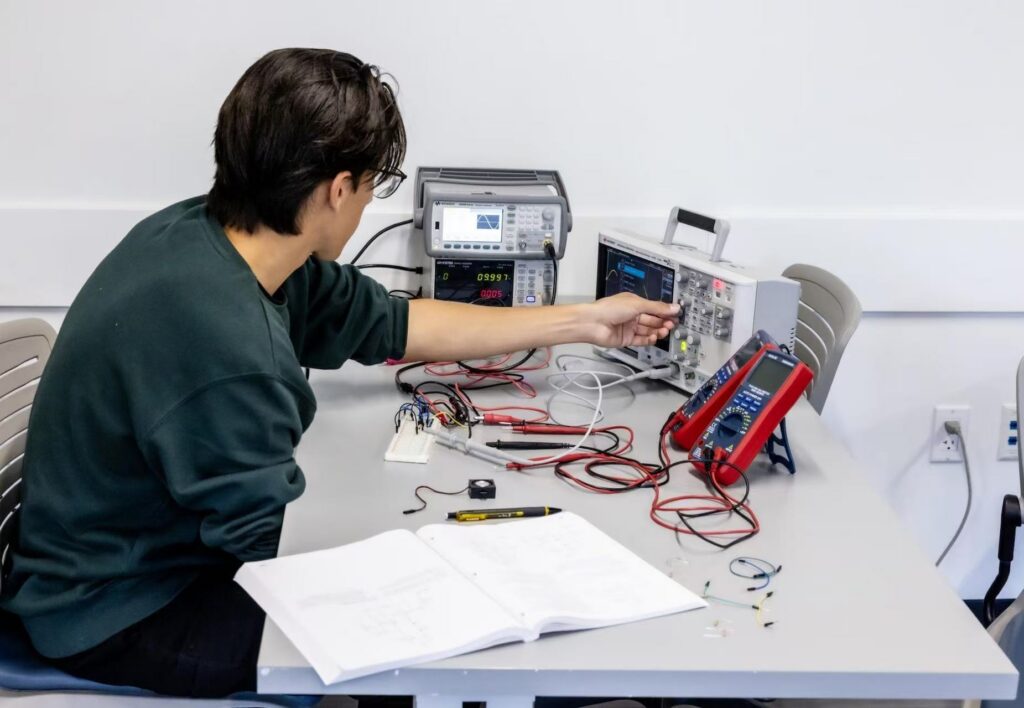
An oscilloscope may not look as exciting as the latest consumer gadget to someone unfamiliar with engineering. But to a student interested in electronics, it opens a window into something previously invisible: the actual behavior of electrical signals.
A multimeter turns assumptions into measurements. A power supply makes experimentation possible. A function generator lets students apply controlled signals and observe the results.
These are not decorative representations of engineering. They are tools engineers actually learn to use.
That makes an electronics laboratory a particularly thoughtful graduation gift, birthday present, or university send-off gift for someone entering an electronics-related engineering program.
It is practical, personal, and closely connected to the future they have chosen.
4. Our Pick for 2026: EIM Lab-on-the-Go
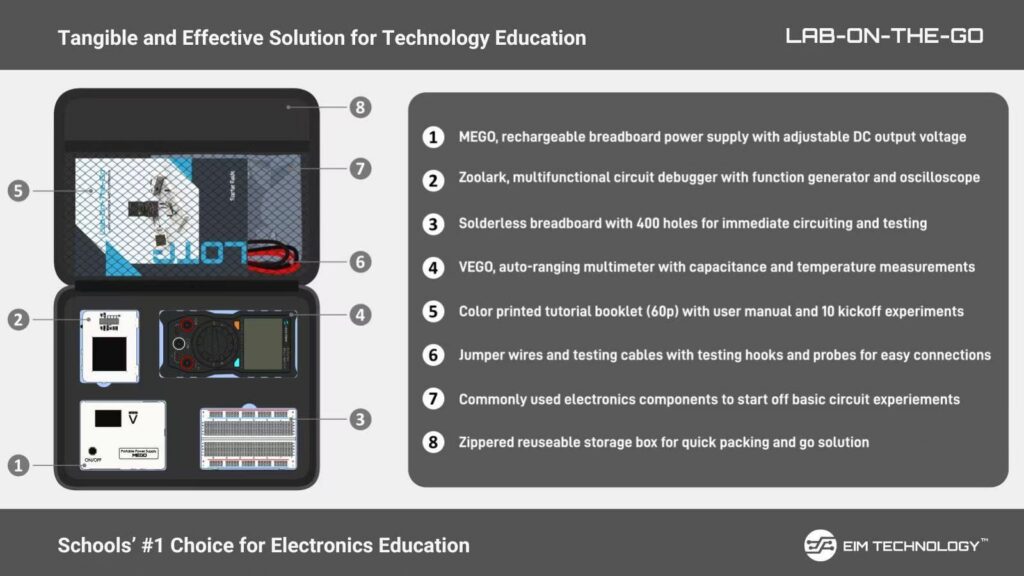
EIM Lab-on-the-Go: US$229 (CA$309 MSRP) at the time of writing.
Explore Lab-on-the-Go: Official Product Page
At EIM Technology, we developed Lab-on-the-Go around a straightforward idea: students should not need a full professional workbench to begin learning how real electronic circuits behave.
Lab-on-the-Go brings together several essential instruments in one portable system. Instead of buying separate equipment and figuring out how to assemble a suitable beginner’s laboratory, students can begin with a coordinated set of tools.
The kit includes:
| Instrument | What it allows students to do |
|---|---|
| Two-channel oscilloscope | Observe electrical waveforms and signal behavior |
| Function generator | Generate controlled signals for circuit experiments |
| Digital multimeter | Measure voltage, current, resistance, and other electrical quantities |
| Rechargeable power supply | Power compatible low-voltage circuits and breadboard experiments |
| Breadboard, components, and accessories | Build and test introductory circuits |
A carrying case and quick-start guidance make the system easier to transport and begin using. The individual instruments are designed to work together as a practical learning environment.
The important distinction is that Lab-on-the-Go is not designed to compete with high-end professional laboratory equipment.
It is designed to make essential electronics experimentation more accessible.
Students can use it to explore introductory circuits, compare input and output signals, investigate filters, test components, and develop measurement habits that remain relevant as their studies become more advanced.
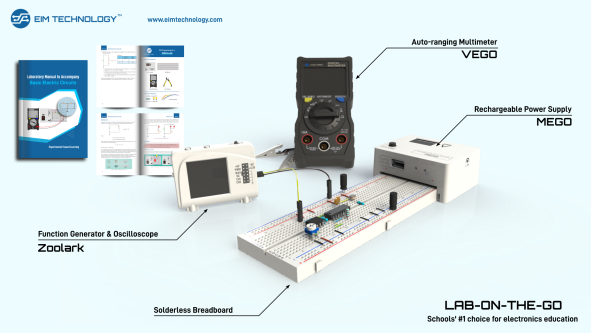
At US$229, it occupies an interesting position in the engineering gift market. It is a substantial, purposeful gift without requiring the budget or technical complexity of a professional electronics workbench. Check the product page for current pricing and shipping.
For a parent, relative, or friend who wants to give something more memorable than a conventional gadget, that combination of practical usefulness and accessibility is compelling.
5. A Gift They Can Grow With, Until One Day They No Longer Need It
Most gifts are designed around the moment they are received.
Some are used for a few months. Others remain on a shelf, gradually forgotten as interests and priorities change.
A good engineering gift should have a different ambition.
Imagine a student receiving their first personal electronics laboratory shortly before starting university.
During the first year, they might use it to understand voltage, current, basic components, and simple circuits. Concepts that once existed only in equations begin to take physical form.
In the second year, they may encounter more complex electronics, signals, digital systems, and embedded hardware. The same instruments can help them examine waveforms, test circuits, and troubleshoot projects.
Later, as their interests become more specialized, they might work with microcontrollers, sensors, amplifiers, or digital hardware. Their personal lab can remain a useful companion for experiments within its technical capabilities.
Not every engineering student will use these tools in every course, and some projects will require equipment far beyond what a portable kit can provide. That is exactly how engineering education should progress.
At some point, perhaps in their third or fourth year, the student may encounter a problem that their original instruments simply cannot handle.
They might need a higher-bandwidth oscilloscope, a more capable signal generator, specialized measurement equipment, or access to a professional research laboratory.
And perhaps, for the first time, they will look at the small laboratory they received years earlier and realize that they have outgrown it.
That should be a moment of pride, not disappointment.
Because the purpose of the gift was never to provide every instrument they would need for the rest of their career.
Its purpose was to help them begin.
The student who once struggled to identify a simple waveform may now understand why a more advanced instrument is necessary. They may have developed the knowledge to select it, the confidence to operate it, and the judgment to recognize its limitations.
That is what technical growth looks like.
And if, years later, Lab-on-the-Go sits on a shelf beside more sophisticated equipment, it may still have a special place there.
Not because it is the most powerful instrument they own, but because it was one of the first.
Perhaps the best engineering gift is one that eventually becomes too small for the engineer you helped them become.
Is Lab-on-the-Go the Right Gift for Every Engineer?
No, and that is worth understanding before making a purchase.
For an experienced engineer working in high-frequency electronics, semiconductor design, industrial automation, or specialized testing, instrument requirements can be highly specific. A portable educational laboratory may not offer the performance or features needed for their professional work.
Similarly, a student entering civil engineering, chemical engineering, or a purely software-focused program may have limited immediate use for electronics measurement equipment.
Lab-on-the-Go is most relevant to students who are interested in electronics, computer engineering, embedded systems, robotics, mechatronics, and related hardware-oriented fields.
It is particularly suitable for someone who wants to begin experimenting but does not yet own a practical set of electronics instruments.
And while the kit provides essential equipment and introductory materials, it should not be confused with a complete university-level electronics curriculum. Students who want more structured instruction can pair it with compatible learning materials and projects, such as the Fundamental EE Starter.
The best gifts are not necessarily the ones with the broadest appeal. They are the ones that fit the recipient exceptionally well.
Frequently Asked Questions
What is a good gift for a first-year engineering student?
A practical gift that supports the student’s field of study is often a better choice than a generic technology accessory. For students entering electronics, computer engineering, or embedded systems, a portable electronics lab can provide valuable access to measurement and experimentation tools outside scheduled classes.
Is an oscilloscope a good gift for an engineering student?
Yes, particularly for students studying electronics and related hardware disciplines. An oscilloscope allows students to observe signals that cannot be understood through ordinary voltage readings alone. However, a standalone oscilloscope may not be enough for experiments that also require a power supply, multimeter, or signal generator.
Do engineering students need their own laboratory equipment?
Not necessarily. Universities generally provide equipment for required laboratory courses. Personal instruments are an optional resource that can make independent practice, project development, and experimentation more convenient.
Is Lab-on-the-Go suitable for someone with no electronics experience?
Yes. The kit is designed with beginners in mind and includes basic circuit-building materials and introductory guidance. Students should begin with simple, low-voltage experiments and progress as their understanding develops.
How much should I spend on a gift for an engineering student?
There is no universal amount. The right budget depends on the occasion, the relationship, and how well the gift matches the student’s interests. Lab-on-the-Go was listed at US$229 (CA$309 MSRP) at the time of writing; check the product page for current pricing.
A Gift for the Engineer They Are Becoming
There are countless gifts that can make an engineering student smile on their birthday, at graduation, or when they receive their university acceptance letter.
Far fewer can become part of the experience that follows.
A personal electronics laboratory will not make engineering easy. It will not replace university courses, guarantee academic success, or turn a beginner into a professional overnight.
But it can give an aspiring engineer something valuable: the opportunity to begin working with real circuits, real signals, and real engineering problems on their own terms.
For someone preparing to spend the next several years learning how technology works, that is a meaningful beginning.
And perhaps, one day, when their first instruments are no longer capable enough for the work they do, they will remember who gave them that first laboratory, and what it meant at the time.
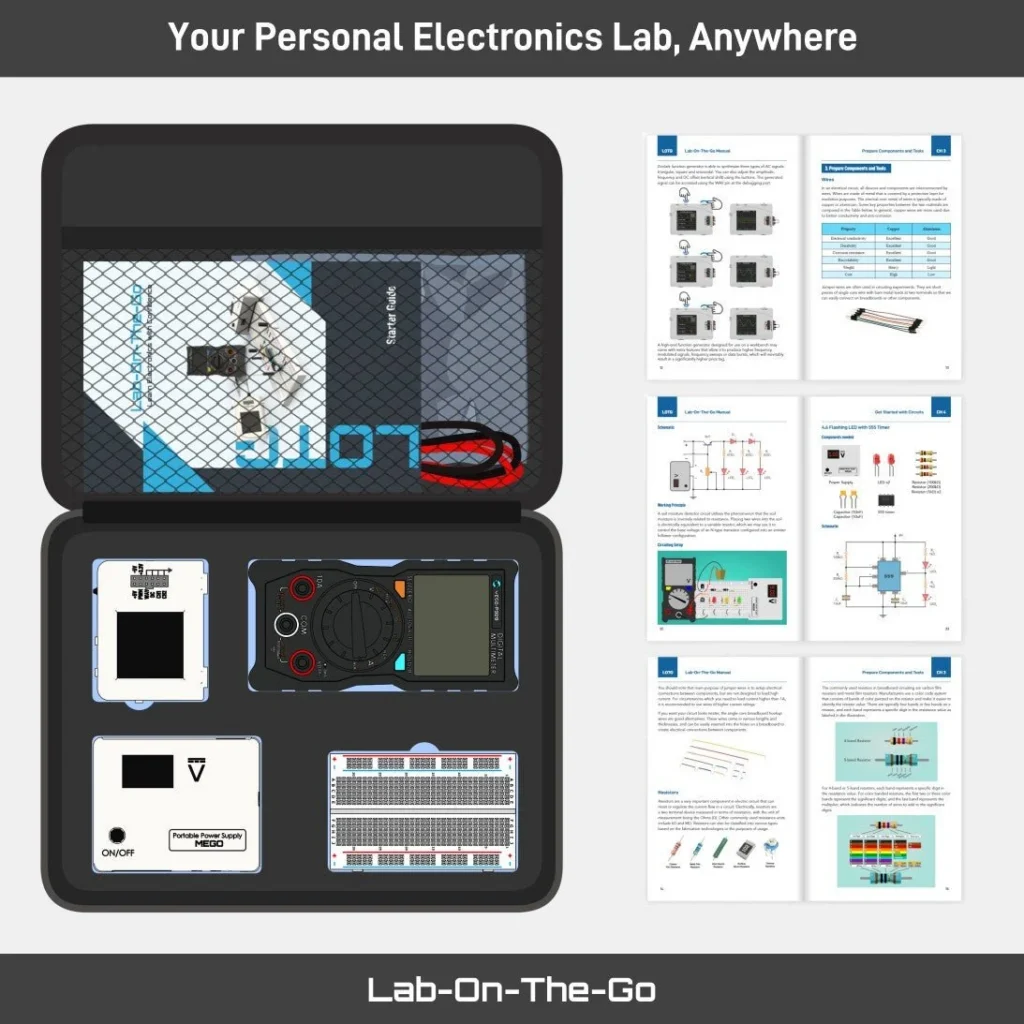
Lab-On-The-Go Electronics Tool Kit
The measuring step is where many learners get stuck, because it depends on instruments that are not always accessible outside a lab. A portable kit such as the Lab-On-The-Go puts a rechargeable power supply, a digital multimeter, and an oscilloscope with a function generator in one case, so a student can capture that unexpected waveform at their own desk and work through the loop at their own pace

EIM TECHNOLOGY
Founder & Engineering Education Innovator
Daniel Cao is the Founder of EIM Technology and holds a Master of Applied Science in Engineering. With experience in engineering research, product development, PCB design, and technical education, he is the author of several books on electronics engineering. His work focuses on developing practical learning systems that integrate engineering hardware, lab instruments, curriculum, and project-based learning. Through EIM Technology, Daniel aims to make electronics and computer engineering more accessible and engaging, helping students build real experience in designing, measuring, testing, and troubleshooting electronic systems.