A practical guide to learning electronics and computer engineering through real circuits, measurement instruments, and hands-on projects.
The best electronics engineering kit for a technically experienced adult combines real components, measurement instruments such as an oscilloscope and multimeter, structured learning materials, and a path into microcontrollers and embedded systems. For many programmers, engineers, and mathematics or physics graduates, a portable lab paired with a guided fundamentals kit can be a more proportionate first step than a full professional bench.
You might be an experienced programmer who has never used an oscilloscope. A mechanical engineer who wants to add sensors and intelligent control to a machine. A physics graduate who understands electromagnetic theory but has limited experience building electronic circuits. Or simply someone who has always wanted to explore electronics beyond beginner-level projects.
You already have technical knowledge. You are probably not looking for another children’s STEM toy, a box of disconnected components, or a tutorial that tells you which wire to connect without explaining why. You want to understand how real electronic systems work, build something meaningful, and develop skills you can continue using.
For adults, the best electronics kit is not necessarily the one with the most components or the most complicated final project. It is a learning system that connects engineering principles, physical hardware, measurement instruments, and increasingly sophisticated applications. Most importantly, it should respect the knowledge you already have and the limited time you can devote to learning something new.
1. Why Is Electronics a Valuable Next Step for Technically Minded Adults?
Many capable adults spend their professional lives working in one domain. They become excellent at what they do, but their expertise may not extend into the physical electronics that increasingly connect different engineering fields. Learning electronics can expand that expertise without requiring another university degree. The opportunity looks different depending on your background.
For Programmers, Software Engineers, and Mathematics or Physics Graduates
If you are a programmer, you already understand algorithms, logic, data structures, and software development. You may have worked with Python, C++, simulations, artificial intelligence, or complex software systems. But what happens when your code needs to interact with a physical device? Suddenly voltage levels, analog-to-digital conversion, electrical noise, signal timing, and communication protocols become important. A sensor does not always return perfect data. A digital signal is not always a perfect square wave. A microcontroller may execute the correct program while the hardware behaves unexpectedly.
Electronics helps you move beyond software running on a screen and into embedded systems, intelligent devices, robotics, and hardware-software integration. For mathematics and physics graduates, the transition can be equally rewarding. You may already understand differential equations, Fourier transforms, electromagnetic principles, or signal processing. Electronics gives you a way to observe those ideas experimentally. A frequency response curve becomes something you can measure. A filter is no longer just a transfer function. An amplifier is no longer simply an ideal gain block. You can build the circuit, apply a signal, observe its response, and investigate the difference between the mathematical model and physical reality.
For people with strong theoretical or software backgrounds, electronics can be the missing practical connection between what you already know and what you can physically build.
For Mechanical, Civil, and Other Engineering Professionals
Mechanical and civil engineers already work with physical systems, materials, forces, structures, and real-world constraints. Adding electronics creates another layer of capability. A mechanical prototype can incorporate sensors, data acquisition, motor control, and embedded software. A structural experiment can include strain measurement, vibration monitoring, and digital data logging. A small automation system can combine physical mechanisms with electronic feedback and control.
You do not need to become a semiconductor designer to benefit. Understanding how to select a sensor, condition its signal, interface it with a microcontroller, and troubleshoot the electronics can make you a more capable multidisciplinary engineer. Consider a vibration-monitoring project: the mechanical behavior may already be familiar, but turning it into useful digital information requires sensing, signal conditioning, sampling, processing, and communication. Learning that chain gives you a better understanding of the complete system and makes collaboration with electronics teams more effective.
For Serious Hobbyists and Independent Makers
Not everyone learns electronics for professional reasons. For many adults, building electronic systems is simply an intellectually rewarding hobby. You might enjoy restoring equipment, building audio circuits, experimenting with microcontrollers, developing home automation, or designing your own devices. The challenge is finding a learning experience that goes beyond copying online projects.
There is nothing wrong with Arduino tutorials, ready-made modules, or inexpensive starter kits. They are excellent for exploration. But eventually you may want to know why an output is noisy, why an amplifier distorts, or why a communication interface works at one speed but fails at another. Is the problem software, wiring, power, or signal integrity? That is where real laboratory instruments and systematic electronics knowledge become valuable. The transition from assembling modules to understanding and debugging circuits is one of the most rewarding steps for an independent maker.
2. What Makes an Electronics Engineering Kit Worth Buying?
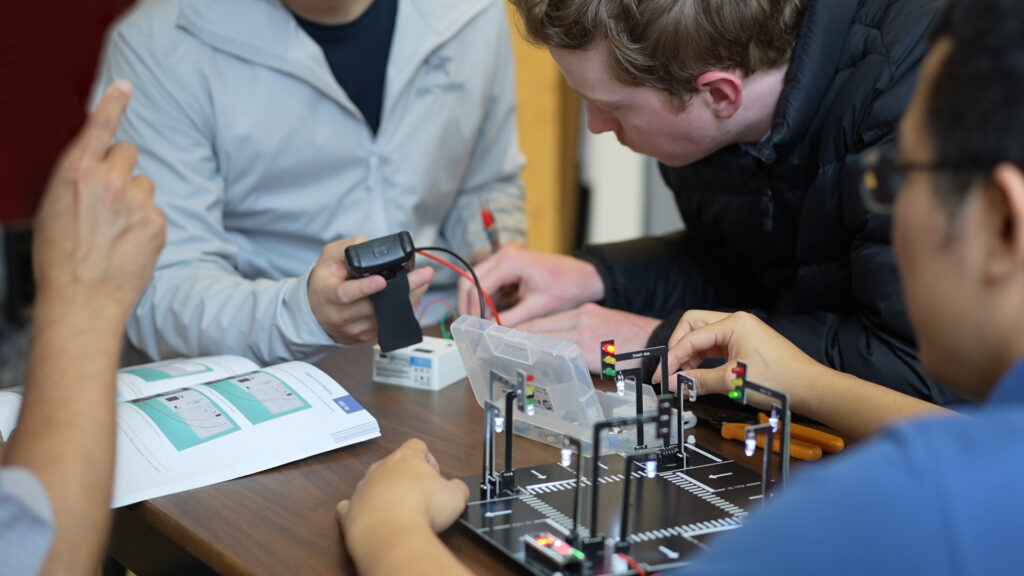
There are countless electronics kits online, but they serve very different purposes. Some introduce children to circuits; others focus on assembling a single robot or gadget. Some provide a development board and a collection of sensors, leaving learners to find their own instruction. For technically experienced adults, the most useful solution should offer more than a collection of parts: it should offer a coherent engineering learning experience.
| What to look for | Why it matters |
|---|---|
| Real components and circuits | Understand hardware beyond preassembled modules |
| Oscilloscope and multimeter | Measure signals and troubleshoot real problems |
| Signal generation and power control | Test circuits under known conditions |
| Structured learning materials | Connect experiments to engineering principles |
| Microcontroller development | Bring software and physical electronics together |
| Integrated projects | Apply multiple skills within a working system |
| Progression path | Continue into advanced topics without starting over |
An important distinction is the difference between building a circuit and understanding its behavior. Imagine constructing an operational amplifier circuit. A conventional tutorial may provide the connections and a gain formula. A deeper exercise asks you to measure the input and output, explore frequency limitations, observe distortion, and compare real results with the theoretical model. The same principle applies to digital electronics: programming a microcontroller to communicate with a peripheral is useful, but inspecting electrical signals and troubleshooting timing develops deeper understanding.
Why Not Start with a Full Professional Electronics Lab?
You might reasonably ask: if professional oscilloscopes, bench power supplies, and signal generators are available, why not buy the same equipment used in universities or industry? There is nothing wrong with that approach. Professional instruments are excellent tools, and you may eventually need them as your projects become more demanding. The question is whether building a full laboratory is the best first step for someone learning independently.
In a university laboratory, much of the infrastructure is already in place. Equipment has been selected, experiments are prepared, and instructors or teaching assistants can help when something goes wrong. At home, all of that becomes your responsibility. Before you can begin a simple experiment, you may spend substantial time comparing instruments, choosing compatible power supplies, configuring measurement connections, sourcing parts, understanding safety limitations, and troubleshooting the setup itself. Those are legitimate engineering skills, but they can consume the time you hoped to spend learning the underlying concepts.
At this stage, your priority is probably not to build the perfect electronics laboratory. It is to understand the principles, become comfortable with real measurements, and start completing meaningful projects. A portable, structured setup can help you get to that point faster. You still learn to connect, measure, and debug hardware, but you are not forced to design an entire lab infrastructure before the first experiment.
There is also the question of investment. For many adults, electronics is an opportunity to expand existing skills, explore a possible future direction, or enjoy a serious intellectual hobby. You may not be planning an immediate career change or another degree. Spending thousands of dollars on a complete professional bench before you know how far you want to go may be unnecessary. A well-chosen starter system in the several-hundred-dollar range can be a more proportionate investment, particularly for working adults who value both their time and flexibility.
And if life gets busy and your new electronics hobby eventually ends up collecting dust on a shelf, at least it will not be an especially expensive monument to your ambition. Start small, learn the fundamentals properly, and invest in specialized equipment when your projects genuinely require it. Portable tools are not a substitute for every professional instrument; they are a sensible way to begin.
3. What Is a Practical Path from Electronics Fundamentals to Embedded Systems?
At EIM Technology, we approach electronics learning as a connected engineering pathway rather than a series of unrelated project boxes. The objective is not to reproduce a university degree or promise professional expertise after a few experiments. It is to help motivated learners build practical knowledge, investigate real circuits, and progress toward more sophisticated applications.
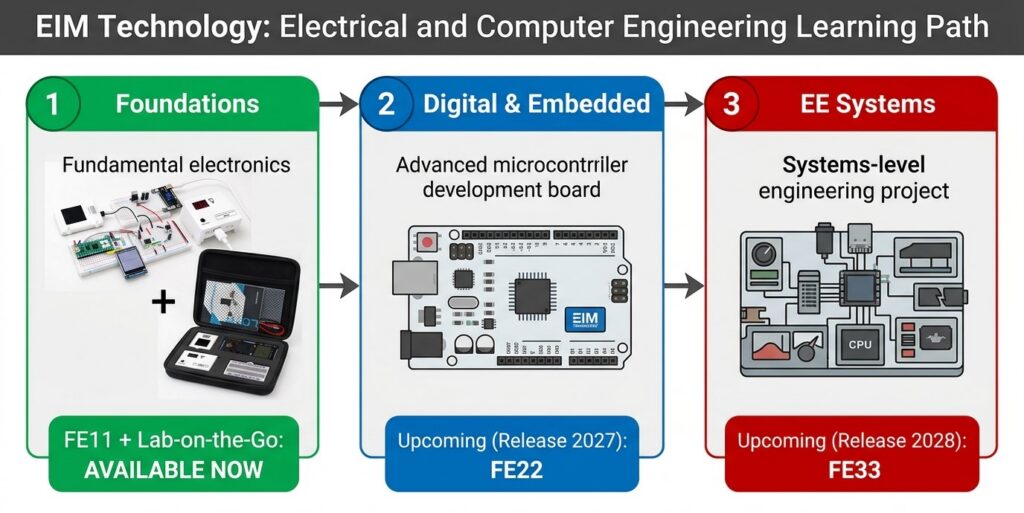
Start with Lab-on-the-Go and Fundamental EE Starter (FE11)
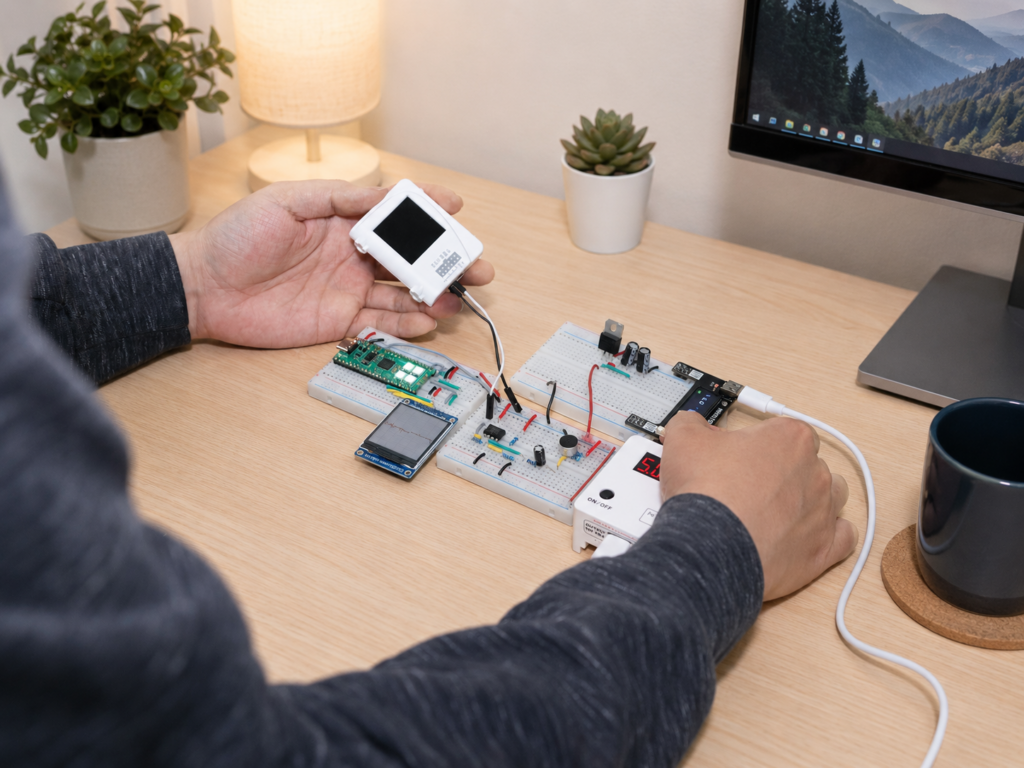
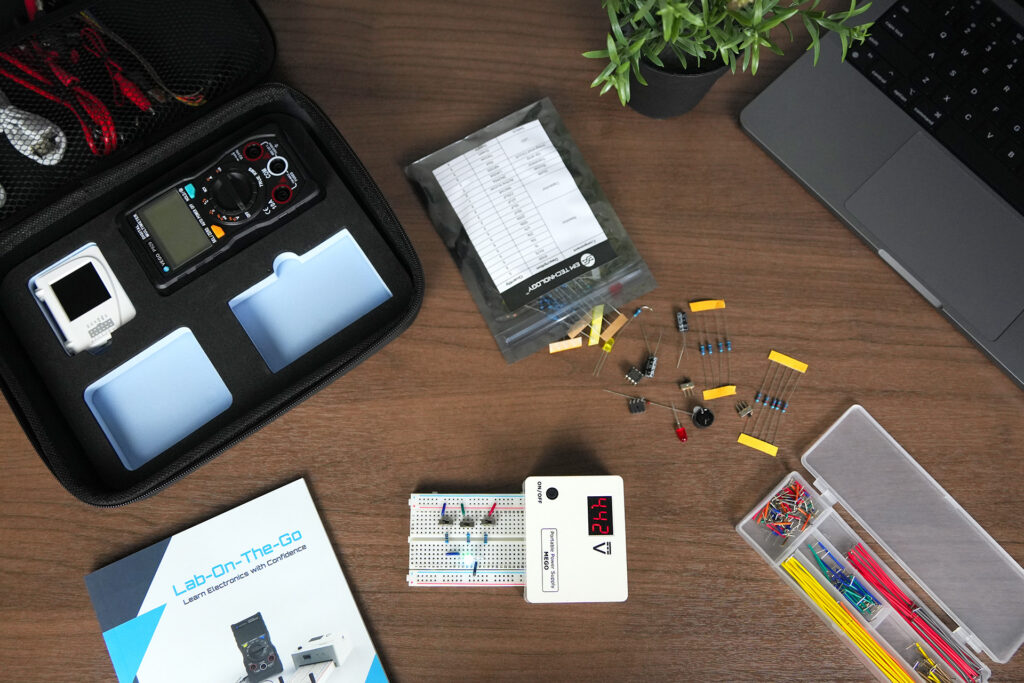
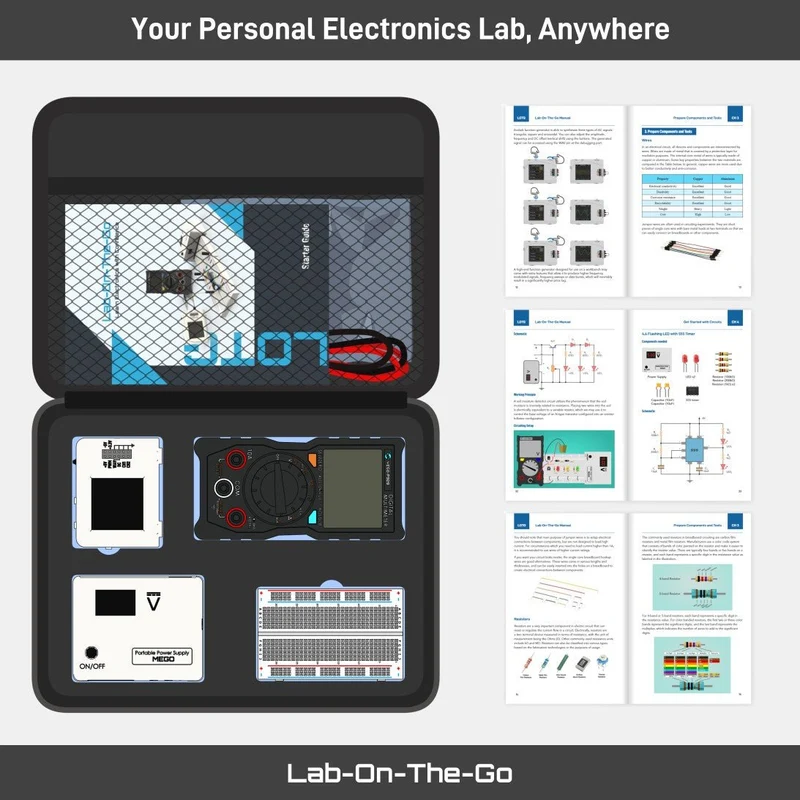
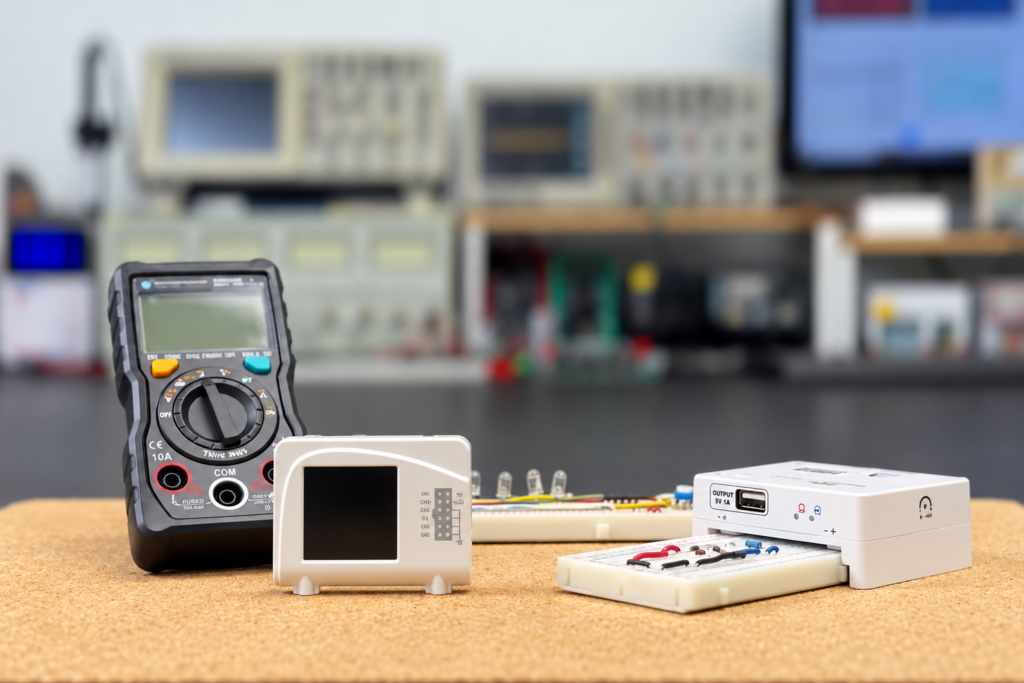
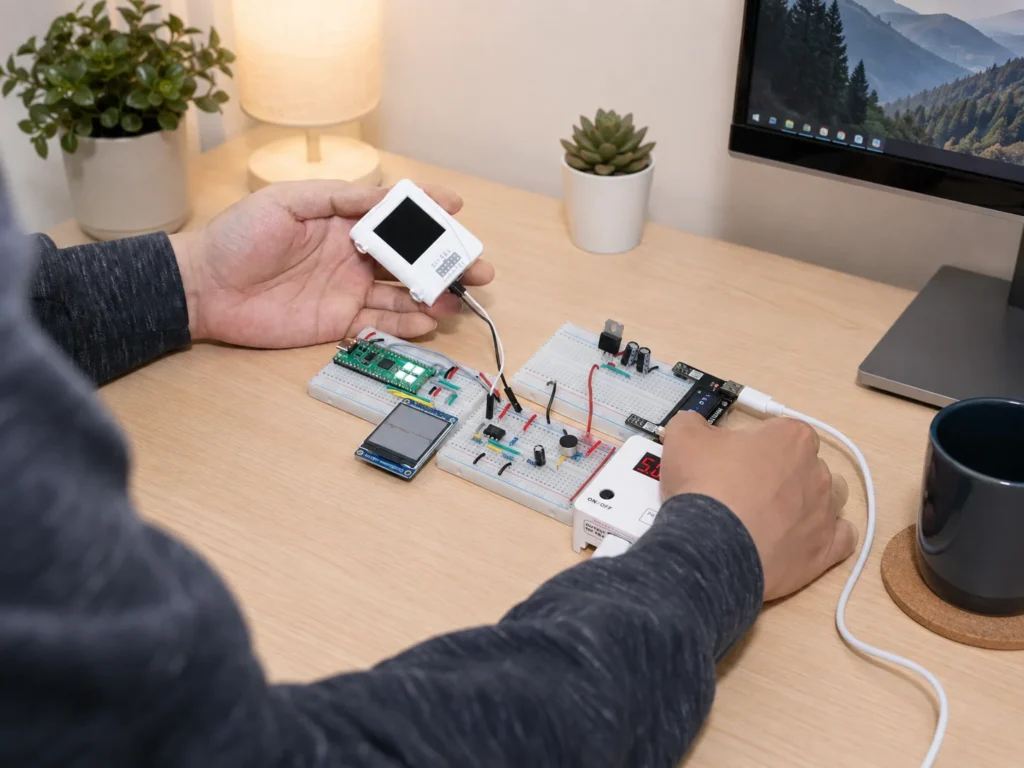
For adults coming from software, mathematics, physics, mechanical engineering, or independent making, we recommend beginning with two complementary products. Lab-on-the-Go provides a reusable portable electronics laboratory with an oscilloscope, signal generator, adjustable power supply, and digital multimeter. You can power circuits, apply known test signals, observe waveforms, and investigate unexpected behavior without relying entirely on simulation.
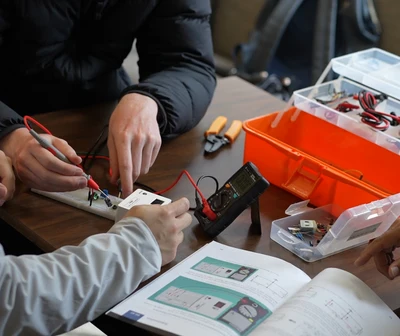
Fundamental EE Starter (FE11) provides the structured learning experience around the hardware. It combines real electronic components, PCBs, printed instructional materials, guided experiments, and projects covering circuits, signals, analog electronics, and microcontroller applications. Lab-on-the-Go gives you the tools to investigate hardware; FE11 gives you a purposeful sequence of things to build, understand, and test.
You can start with basic circuit behavior and move into grounding, supply ripple, frequency response, operational amplifiers, and practical interpretation of component datasheets. You can then explore microcontroller programming and the interface between software and physical electronics. These are not just isolated topics: the point is to see how a system behaves when you build it, measure it, and debug it yourself. Lab-on-the-Go can remain useful in later projects rather than being discarded after a single kit.
Explore the current products: Lab-on-the-Go and Fundamental EE Starter (FE11).
Fundamental EE Starter, FE11
For learners who want a structured way to build that habit, the Fundamental EE Starter kit (FE11) follows one connected path through circuits, analog design, microcontrollers, PCBs, and guided projects, with an online learning platform alongside the hardware. AI can explain each concept along the way, while the kit keeps the learning grounded in real circuits.
Continue into Digital, Embedded, and System-Level Engineering
Once you have a foundation in circuits, measurement, and microcontrollers, advanced topics become easier to approach. EIM’s upcoming Digital & Embedded stage (FE22) is planned to cover digital logic, FPGA development, Verilog, microcontroller interfaces, and conversion between analog and digital signals. It is especially relevant to programmers interested in embedded systems, hardware acceleration, and the relationship between software and digital hardware.
The subsequent EE Systems stage (FE33) is intended to connect analog electronics, signal processing, embedded control, and digital hardware in larger integrated projects. The advantage is continuity: your initial laboratory instruments can continue supporting experiments as your learning hardware and technical challenges become more complex. FE22 and FE33 are upcoming stages on the product roadmap and are not yet available for purchase.
4. Which Electronics Kit Should You Start With?
The right starting point depends on what you already know and what you hope to build. If you are a programmer interested in embedded hardware, FE11 introduces circuits and microcontroller applications while Lab-on-the-Go lets you inspect the electrical behavior behind your code. If you are a mechanical or civil engineer, the same combination can help you understand sensing, signal conditioning, measurement, and the electronic foundations of intelligent physical systems. If you studied mathematics or physics, it provides a practical way to compare theoretical models with actual signals. And if you are a serious hobbyist, it offers a route beyond disconnected tutorials toward systematic understanding.
If you already own suitable instruments, FE11 can be a reasonable standalone choice. If you want a more complete starting environment, FE11 with Lab-on-the-Go is our recommended combination. It is a manageable way to explore electronics without committing to a full professional bench, and it gives you a foundation you can build on if your interest grows.
Frequently Asked Questions
Are advanced electronics kits suitable for adults with no electronics background?
Yes, if the materials build the fundamentals before moving into complex applications. Prior programming, mathematics, physics, or engineering knowledge helps, but electronics experience is not required to begin foundational experiments.
What is a good electronics kit for a software engineer?
Look for a combination of real circuits, microcontroller programming, measurement instruments, and structured projects. FE11 and Lab-on-the-Go are designed to connect electronics fundamentals with practical hardware experimentation.
Do I need an oscilloscope to learn electronics?
Not for every beginner circuit. But it becomes valuable for changing signals, amplifier behavior, timing, frequency response, and troubleshooting that a basic multimeter cannot fully reveal.
Why not buy professional instruments immediately?
They are excellent when you need their capabilities. But an independent learner may spend more time and money than necessary selecting and configuring a full bench before understanding the fundamentals. A portable structured system can reduce that initial barrier.
Can I learn electronics and embedded systems without going back to university?
Yes, meaningful practical skills can be developed through self-directed study and hands-on experiments. Independent learning does not replace a formal engineering degree or professional licensure where those are required.
What comes after a foundational electronics kit?
Depending on your goals, you can progress into analog electronics, signal processing, microcontroller interfaces, digital logic, FPGA development, and integrated electronic systems.
Build on What You Already Know
You do not need to abandon your existing specialization to learn electronics. If you understand programming, mathematics, physics, or another branch of engineering, you already have knowledge that can make electronics learning more meaningful. What you may be missing is a practical environment in which those ideas become real circuits, measurable signals, and working systems.
Start with the fundamentals. Learn to use real instruments. Build circuits you understand. Investigate why they work, and why they sometimes do not. Then take those skills into embedded development, digital hardware, and more advanced engineering applications.
Ready to bring your technical knowledge into the physical world? Explore Lab-on-the-Go and Fundamental EE Starter (FE11) to build your personal electronics learning environment. Designed for serious learners, with real hardware, real measurement, and engineering projects.

EIM TECHNOLOGY
Founder & Engineering Education Innovator
Daniel Cao is the Founder of EIM Technology and holds a Master of Applied Science in Engineering. With experience in engineering research, product development, PCB design, and technical education, he is the author of several books on electronics engineering. His work focuses on developing practical learning systems that integrate engineering hardware, lab instruments, curriculum, and project-based learning. Through EIM Technology, Daniel aims to make electronics and computer engineering more accessible and engaging, helping students build real experience in designing, measuring, testing, and troubleshooting electronic systems.