Short answer: Choose the Analog Devices ADALM2000 if your priority is advanced, computer-based signal analysis for analog circuits and signals courses. Choose EIM’s Lab-on-the-Go if you want a portable first electronics lab with three independent instruments that work without a computer, plus a breadboard and components. Both are legitimate learning tools; the better choice depends on what you want to learn.
If you are studying electronics or computer engineering, or looking to build your first electronics lab at home, you have probably come across the Analog Devices ADALM2000 (M2K). It is a remarkably capable educational instrument, combining an oscilloscope, waveform generator, logic analyzer, network analyzer, and several other functions into a compact USB-powered device.
But is it necessarily the best starting point for everyone? That depends on what you want to learn. If your priority is advanced signal analysis, quantitative measurements, or characterizing analog circuits, the ADALM2000 has significant advantages. If you are looking for a portable, self-contained lab that helps you become comfortable with physical instruments while exploring electronics, programming, and embedded systems, EIM’s Lab-on-the-Go offers a different approach.
Both are legitimate educational solutions. The more useful question is not which one has the longest specification sheet, but which one better supports your learning goals.
How Do the ADALM2000 and Lab-on-the-Go Compare Technically?
Let us begin with the technical differences. The ADALM2000 is unquestionably the more capable high-speed measurement platform. Its specifications are particularly impressive for a compact educational instrument.
| Feature | ADALM2000 (M2K) | Lab-on-the-Go |
|---|---|---|
| Oscilloscope | 2 channels; 12-bit; 100 MSPS; 25 MHz bandwidth | Zoolark: 2-channel digital oscilloscope |
| Signal generation | 2-channel arbitrary waveform generator; 150 MSPS DAC | Zoolark: 0.1 Hz–1 MHz; sine, square, and triangle waveforms; adjustable PWM |
| Logic analysis | 16 channels; up to 100 MS/s | No dedicated logic analyzer |
| Network and spectrum analysis | Network and spectrum analyzer tools in Scopy | No dedicated network or spectrum analyzer listed |
| DC power | Two programmable supplies, 0 to +5 V and 0 to -5 V; 50 mA each | MEGO: rechargeable, adjustable 4–24 V; up to 5 W |
| Multimeter | Software voltmeter in Scopy (AC and DC) | VEGO: separate auto-ranging multimeter for voltage, current, resistance, continuity, capacitance, and temperature |
| Computer required | Yes, for the standard Scopy interface | No, for core instrument operation |
| Prototyping materials | ADALP2000 parts kit sold separately | 410-hole breadboard, components, probes, cables, and test leads included |
| Learning focus | Software-defined measurement and circuit analysis | Independent instruments and broader project-based learning |
Sampling rate is not the same thing as measurement accuracy, so compare the specifications that matter for your own experiments. Full ADALM2000 specifications are on the Analog Devices ADALM2000 product page.
The ADALM2000 is especially attractive for studying filters, amplifiers, frequency response, digital communication, and mixed-signal behavior. Its Scopy software provides sophisticated visualization and analysis capabilities that would otherwise require several conventional instruments.
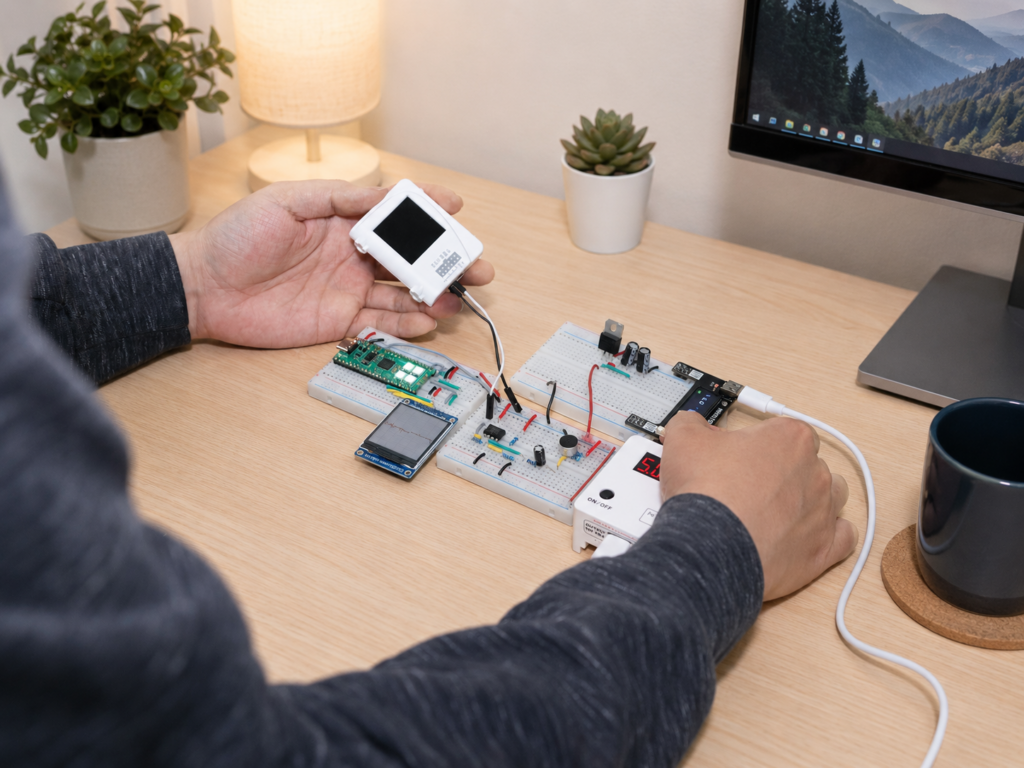
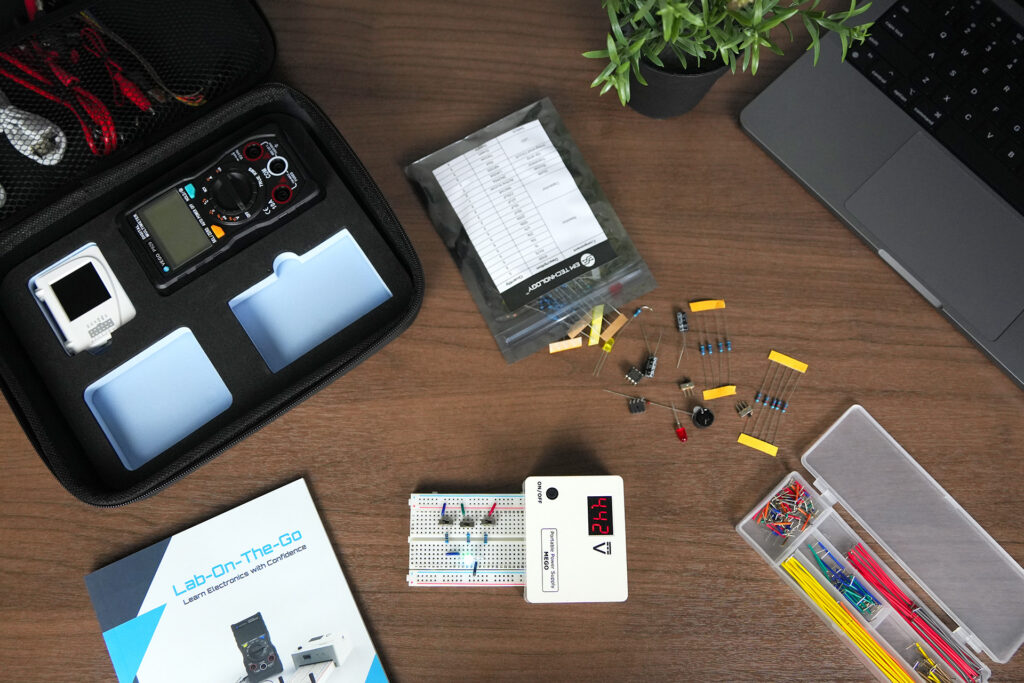
Lab-on-the-Go makes a different trade-off. Instead of maximizing measurement performance within a computer-connected platform, it provides three compact physical instruments: the MEGO power supply, the Zoolark oscilloscope and signal generator, and the VEGO digital multimeter.
For fundamental circuit experiments, understanding how to connect instruments, generate signals, measure electrical quantities, and troubleshoot hardware can be more immediately useful than having access to every advanced analysis feature. Neither approach is universally superior: they serve different priorities.
Software-Defined Instruments or Independent Lab Equipment: What Is the Difference?
One of the most meaningful differences between these products is how you interact with them. The ADALM2000 relies on a host computer running Scopy for its standard instrument interface. This is not inherently a disadvantage. Software-defined instrumentation enables sophisticated visualization, digital analysis, and a unified environment for multiple instrument functions. However, it also means the measurement environment depends on a connected computer and compatible software.
Lab-on-the-Go approaches the problem differently. Its core instruments can be operated independently, without launching a desktop application. The MEGO power supply includes a rechargeable battery, while Zoolark provides its own display and controls.
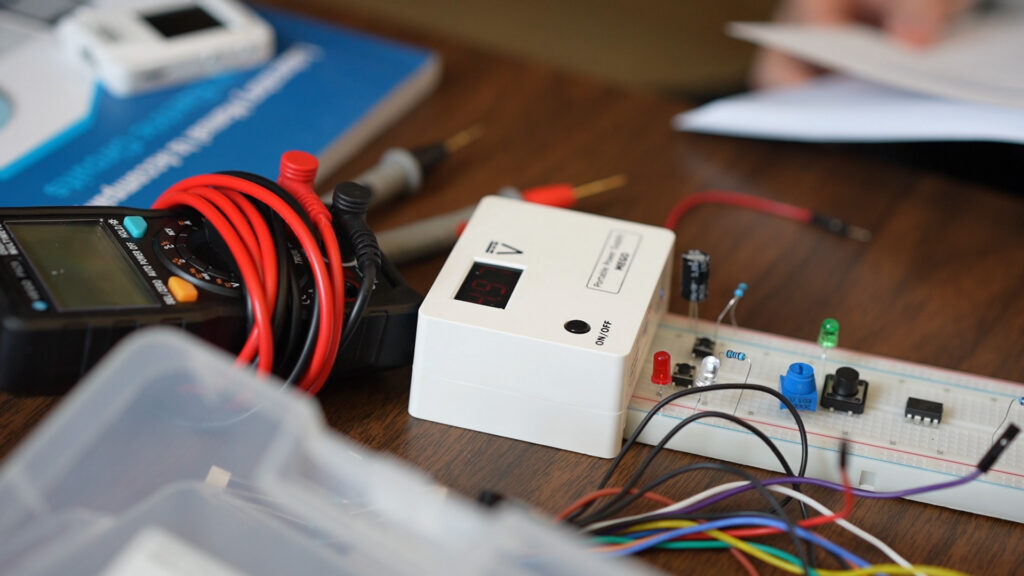
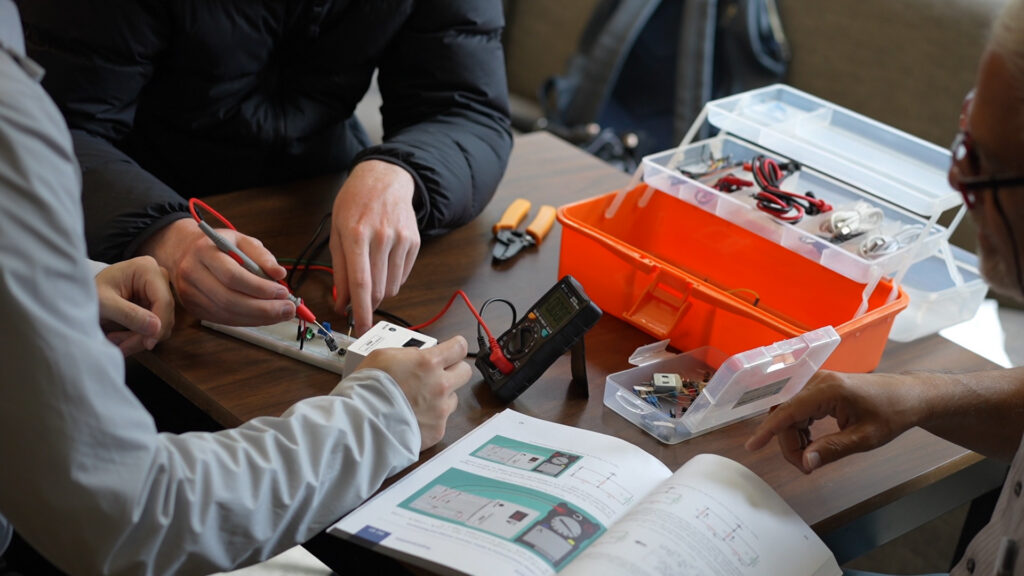
This distinction matters when learning laboratory equipment. A dedicated multimeter teaches you to select the appropriate measurement function, connect probes correctly, and distinguish voltage from current measurements. A standalone oscilloscope introduces practical experience with timebase, triggering, and waveform display settings. If you are unsure which of the two instruments you need first, our multimeter vs. oscilloscope guide covers both instruments. These skills remain relevant when students eventually use professional bench instruments.
There is also an accessibility advantage. Students can set up Lab-on-the-Go on a small desk, move between classrooms, or conduct suitable low-voltage experiments without carrying a laptop. Rechargeable power reduces dependence on an external supply. The ADALM2000 itself is extremely compact and convenient when a computer is already part of the workspace. Lab-on-the-Go is not necessarily smaller or lighter as a complete package; its advantage is operational independence, not minimum physical size.
For a student already comfortable with Scopy and primarily interested in analyzing signals, the ADALM2000 may be more efficient. For someone developing familiarity with individual instruments and circuit troubleshooting, the independent-instrument approach may be a better fit.
Which Learning Path Does Each Platform Support?
Hardware specifications are only part of the decision. Analog Devices has invested substantially in educational resources. The ADALM2000 works with circuit experiments, university laboratory materials, and the separately available ADALP2000 analog parts kit. It is a serious learning platform, particularly for analog electronics, circuit theory, and signals and systems. Its analysis capabilities also make it useful well beyond introductory work.
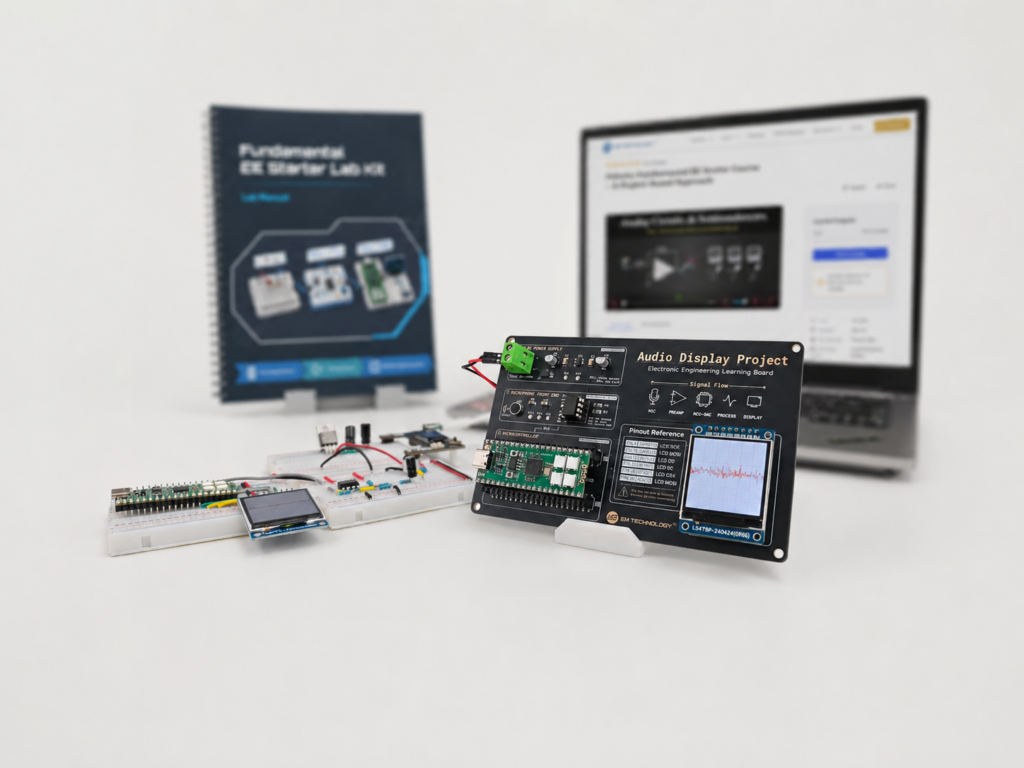
EIM Technology takes a somewhat different approach. Our objective is to help learners develop a structured understanding of electronics and computer engineering, progressing from fundamental circuits toward programming, digital logic, signal processing, and embedded hardware systems. Lab-on-the-Go serves as the measurement and experimentation foundation for this broader learning path.
| Learning stage | Focus |
|---|---|
| Lab-on-the-Go: Instruments | Power supplies, measurement, waveform observation, and circuit troubleshooting |
| Fundamental EE Starter (FE11): Level I | Foundational electronics, guided experiments, and practical circuit understanding |
| Digital & Embedded Systems: Level II | Microcontrollers, FPGA, digital systems, embedded programming, and signal processing |
The Level I stage is the Fundamental EE Starter (FE11), and the Level II topics are outlined on the Digital Circuits & Embedded Design learning path page.
For example, a learner might begin by measuring voltage and current in a simple circuit, then investigate the response of an RC filter. Later, the same measurement skills can be applied to microcontroller-generated signals, digital-to-analog conversion, audio processing, or systems combining software and programmable hardware.
If you are a physics student studying precise signal behavior, or an engineering student concentrating on analog circuit characterization, the ADALM2000 may be a particularly strong choice. If you are coming from mathematics, physics, chemistry, mechanical engineering, or software development and want a broader understanding of how electronic and computing systems work together, EIM’s learning pathway may be better aligned with your goals.
Neither platform replaces theory, programming practice, or independent problem-solving. A structured sequence of projects can, however, help learners connect knowledge that might otherwise remain isolated across subjects.
Which Is Better for University Students and Teaching Laboratories?
For universities and colleges, this is not always a choice between competing instruments. The ADALM2000 is well suited to courses requiring quantitative signal analysis, frequency-domain measurements, digital protocol inspection, and repeatable experiments in a software-based environment. It can be particularly valuable in analog electronics, signals and systems, and instrumentation courses.
Lab-on-the-Go may serve a different role: a supplementary personal laboratory for introductory engineering courses, first-year projects, outreach programs, and interdisciplinary hands-on learning. Its core instruments do not require desktop software installation, potentially reducing some setup and computer-management requirements. That does not eliminate the need for safety procedures, equipment maintenance, or software for later programming projects.
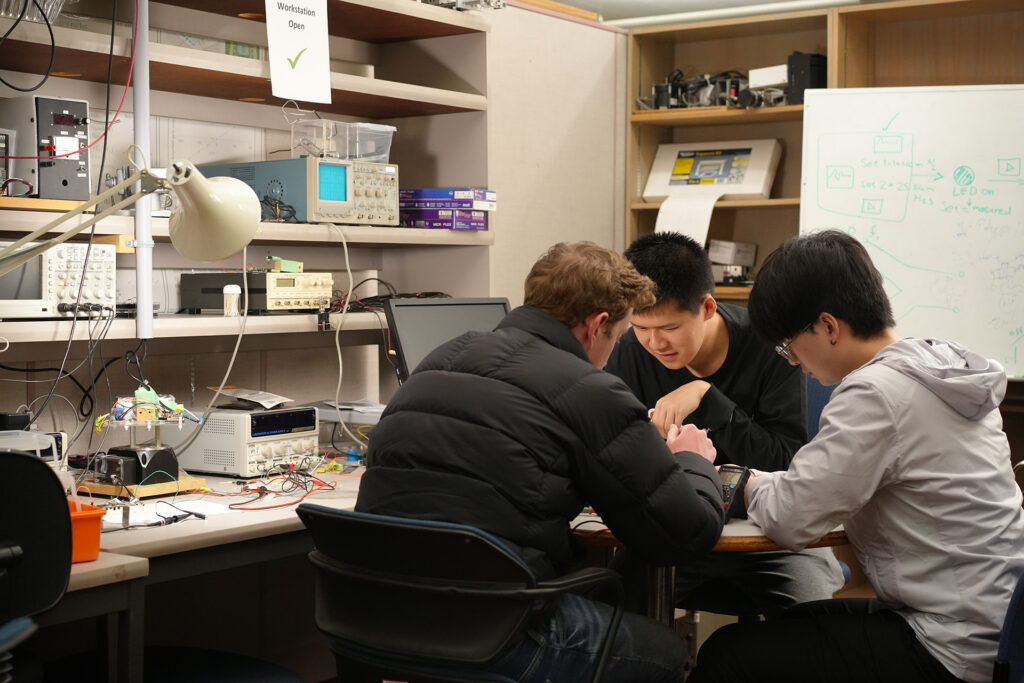
Students can take the instruments beyond the laboratory. A compact rechargeable setup can support suitable experiments at home, in classrooms, or during project sessions where access to a conventional electronics bench is limited. Separate instruments also allow instructors to teach measurement habits explicitly: students learn how different tools interact with the same circuit rather than accessing every function through one software interface. For more ideas on this, see how to get more from university electronics labs.
For departments already using ADALM2000, replacement is not necessarily the objective. A reasonable model is to retain ADALM2000 for measurement-intensive courses while introducing Lab-on-the-Go for foundational instrument training, independent experimentation, and project-based activities. Departments should evaluate curriculum fit, safety requirements, and purchasing arrangements before adoption.
Final Verdict: Which Should You Choose?
The ADALM2000 is an excellent educational instrument, and for some applications it is clearly the stronger technical choice. Its sampling performance, digital analysis capabilities, and software tools make it valuable for students investigating signals in detail.
Lab-on-the-Go is designed for a different starting point. It offers independent instruments, rechargeable power, essential circuit-building materials, and a practical foundation that can extend into a broader electronics and computer engineering learning pathway. It is especially relevant for learners who want to develop familiarity with the tools, measurements, and systems used in engineering work.
Price can also be a consideration. Lab-on-the-Go has a published MSRP of CA$309 (about US$229, billed in CAD), with free shipping in the United States and Canada. ADALM2000 pricing varies by distributor, institution, and educational discount. Price alone should not determine the decision.
If your primary goal is sophisticated quantitative analysis, choose the ADALM2000. If your goal is to establish a flexible, accessible first electronics lab and gradually explore how circuits, programming, and embedded systems fit together, Lab-on-the-Go deserves serious consideration.
The right first lab is not necessarily the one with the most advanced specifications. It is the one that helps you build the skills you intend to use.
Lab-On-The-Go Electronics Tool Kit
The measuring step is where many learners get stuck, because it depends on instruments that are not always accessible outside a lab. A portable kit such as the Lab-On-The-Go puts a rechargeable power supply, a digital multimeter, and an oscilloscope with a function generator in one case, so a student can capture that unexpected waveform at their own desk and work through the loop at their own pace
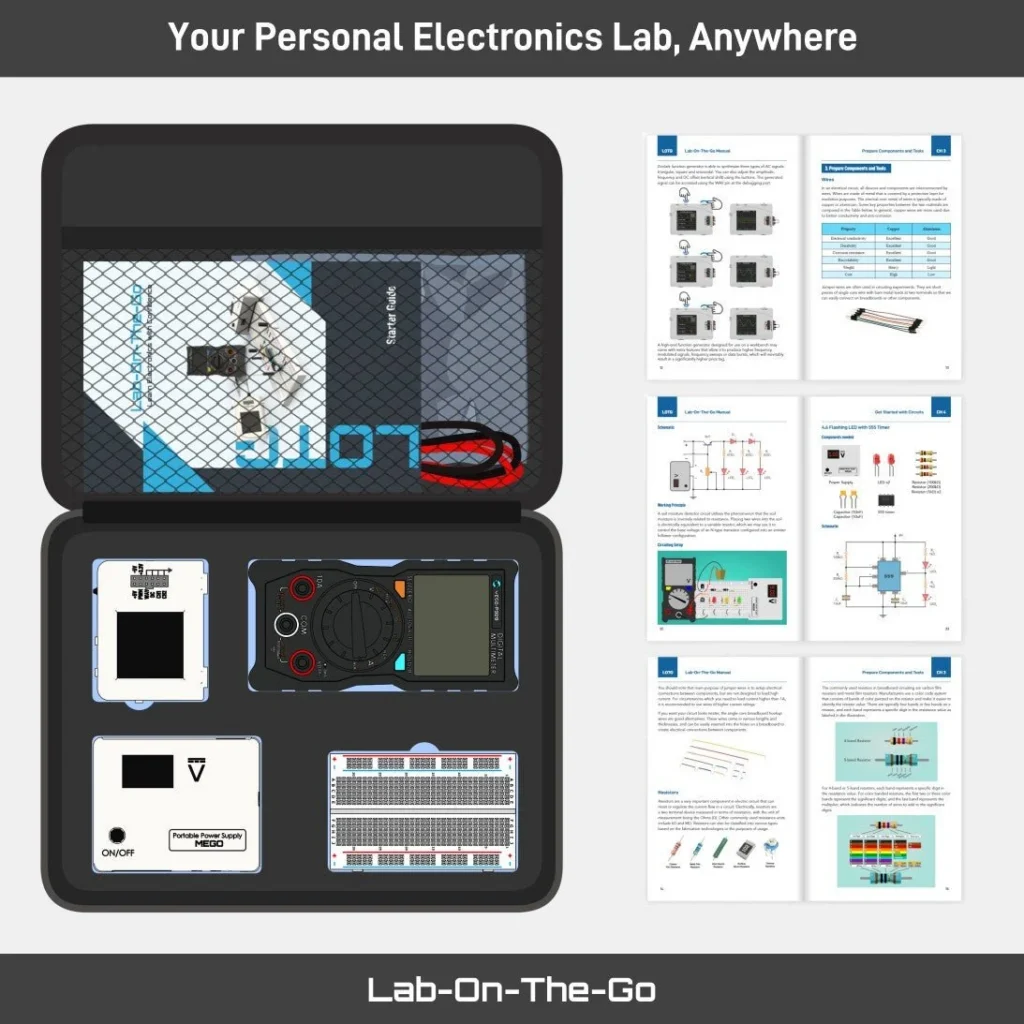
Lab-on-the-Go
- Three compact instruments: MEGO rechargeable power supply (4–24 V), Zoolark oscilloscope and signal generator, and VEGO auto-ranging multimeter
- Breadboard, components, probes, cables, test leads, quick-start guide, and carrying case included
- Core instruments work without a computer
- CA$309 MSRP (about US$229, billed in CAD), with free shipping in the United States and Canada
Frequently Asked Questions
Is the ADALM2000 suitable for beginners?
Yes. It was designed for education and has substantial learning resources. It is particularly suitable for students learning circuit analysis and measurement through a computer-based interface. Beginners should also consider whether they want independent physical instruments and a ready-to-use prototyping setup.
Can Lab-on-the-Go replace the ADALM2000 in university courses?
Not universally. Lab-on-the-Go can support many fundamental electronics experiments, but it does not replace the ADALM2000’s high-speed acquisition, 16-channel logic analysis, or advanced software-based measurements. The choice depends on course requirements.
Do I need a computer to use Lab-on-the-Go?
No computer is required for the core measurement and power-supply functions. Programming microcontrollers or developing FPGA projects in EIM’s advanced learning systems still requires suitable development tools.
Can Lab-on-the-Go be used for university laboratory teaching?
Yes, particularly for introductory measurement training, foundational electronics, portable experiments, and project-based activities. Institutions should review experiment requirements, measurement specifications, safety constraints, and curriculum compatibility.
If you want to build and troubleshoot circuits on a desk without a computer, Lab-on-the-Go may be the more practical starting point, because it includes a power supply, an oscilloscope and signal generator, a multimeter, a breadboard, and components in one kit. If your main goal is sophisticated quantitative analysis on a computer, the ADALM2000 is the stronger choice.
If you want to build and troubleshoot circuits on a desk without a computer, Lab-on-the-Go may be the more practical starting point, because it includes a power supply, an oscilloscope and signal generator, a multimeter, a breadboard, and components in one kit. If your main goal is sophisticated quantitative analysis on a computer, the ADALM2000 is the stronger choice.

EIM TECHNOLOGY
Founder & Engineering Education Innovator
Daniel Cao is the Founder of EIM Technology and holds a Master of Applied Science in Engineering. With experience in engineering research, product development, PCB design, and technical education, he is the author of several books on electronics engineering. His work focuses on developing practical learning systems that integrate engineering hardware, lab instruments, curriculum, and project-based learning. Through EIM Technology, Daniel aims to make electronics and computer engineering more accessible and engaging, helping students build real experience in designing, measuring, testing, and troubleshooting electronic systems.