AP and IB are strong preparation for the academic foundations of Electrical and Computer Engineering, especially calculus, physics, and programming. On their own, however, they leave much of engineering itself unexplored: building circuits, using instruments, reading datasheets, and debugging hardware. For most students, the strongest preparation combines AP or IB with structured hands-on engineering, so the two complement each other.
For high school students planning to study Electrical Engineering, Electronics Engineering, Computer Engineering, or a related ECE program in the United States or Canada, AP and IB courses are often seen as some of the best ways to prepare for university. That is broadly true. A student who has already studied calculus, physics, and perhaps computer science at an advanced level will usually enter engineering with a stronger academic foundation than someone encountering these subjects for the first time.
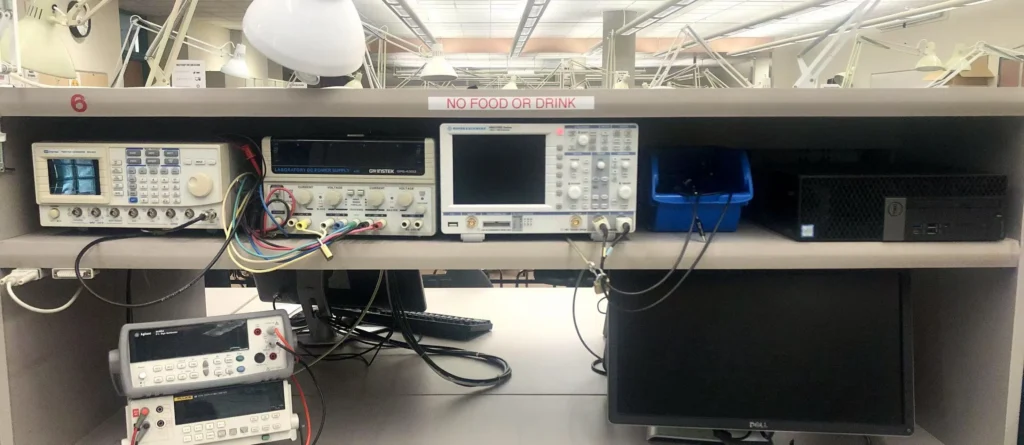
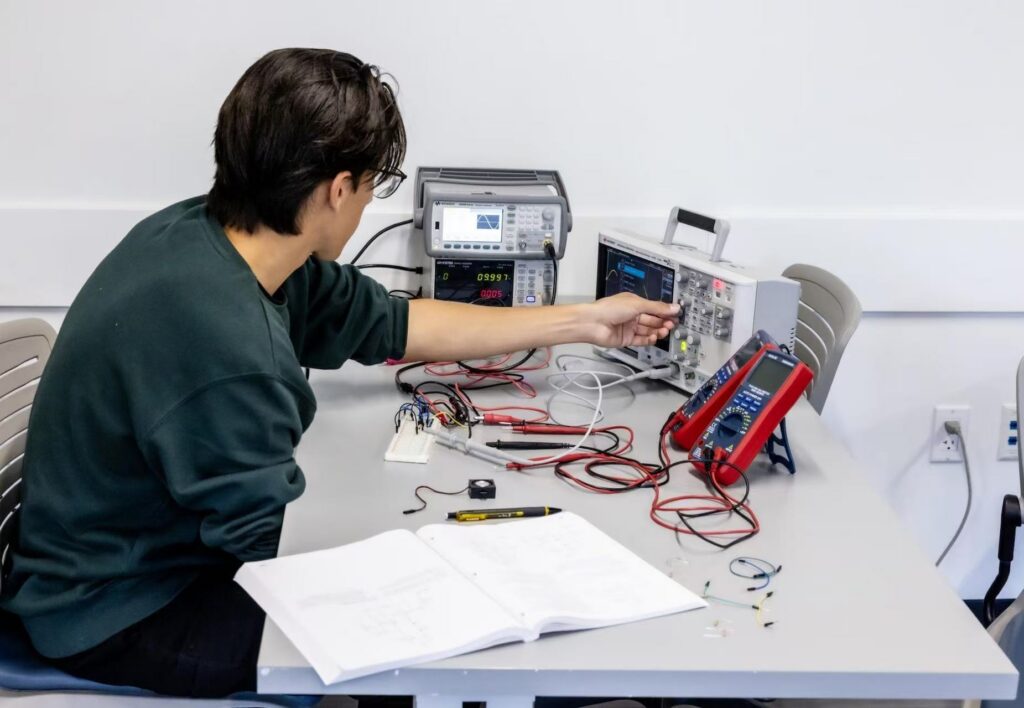
But there is an important distinction that families sometimes miss. AP and IB can prepare students very well for the academic foundations of engineering, while still leaving much of engineering itself unexplored. A student may earn excellent grades in AP Calculus or IB Physics and still have very little idea what it feels like to build a circuit, use an oscilloscope, read a datasheet, debug a hardware problem, or make software communicate with a physical device.
That does not make AP or IB less valuable. It simply means we should be more precise about what they are valuable for. For students considering Electronics or Computer Engineering, the strongest preparation is therefore not to choose between advanced academic courses and practical engineering experience. The better approach is to understand how the two complement each other: AP and IB can build the foundation, while hands-on engineering begins to build the map that connects those foundations to an actual engineering education.
1. What Do AP and IB Actually Give Future Engineering Students?
The most obvious benefit of AP and IB is academic preparation. Engineering programs are mathematically demanding, particularly during the first one or two years. Calculus, physics, linear algebra, differential equations, programming, and other foundational subjects can arrive quickly and often overlap with several demanding technical courses at the same time.
A student who has already studied advanced mathematics and physics therefore has a meaningful advantage. This does not necessarily mean that university becomes easy, nor does it mean that the student can simply skip material they have encountered before. The advantage is familiarity. When a concept appears in university, the student already has some mental structure in which to place it.
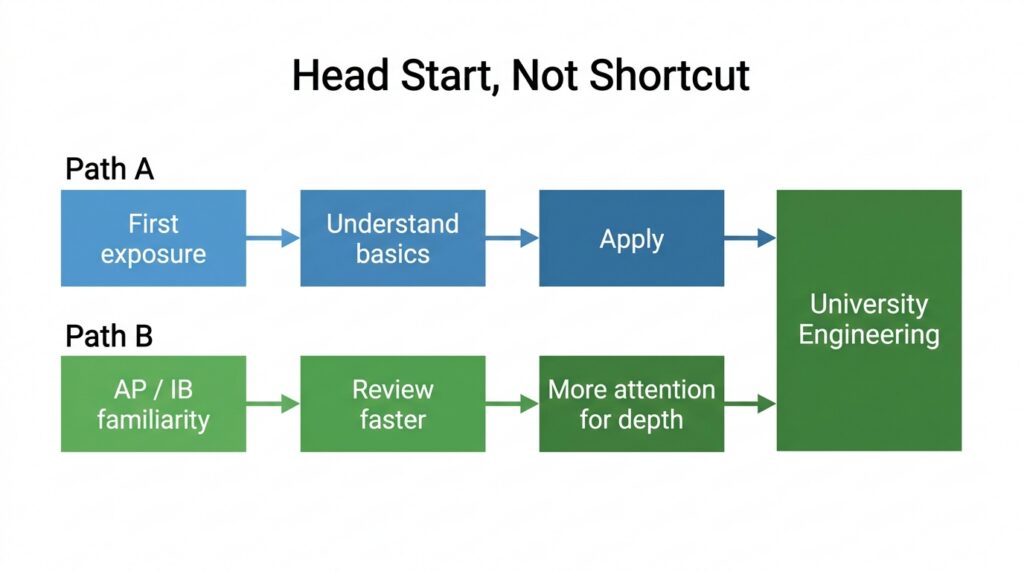
Imagine two students entering a first-year engineering course. One is seeing most of the mathematical concepts for the first time and must simultaneously understand the notation, the underlying idea, the problem-solving method, and the way the professor applies it. The other has encountered many of those concepts through AP or IB. That second student still has to learn the university version, which may be faster and considerably deeper, but less of their mental effort is consumed simply trying to understand what the subject is about.
That additional capacity can be valuable. Engineering students rarely struggle because of only one difficult course. The challenge is usually the combination of several technical courses, laboratories, assignments, programming work, projects, and examinations competing for attention at the same time. Having already built a solid foundation in mathematics and physics can therefore make the transition into university much smoother.
There is, however, a trap here. Students with strong AP or IB backgrounds can enter university, recognize a familiar course title or topic, and assume they already know the material. They begin paying less attention, sometimes even treating lectures as optional, only to discover later that a university engineering course can move far beyond the high-school version in depth, speed, and complexity.
AP and IB give you a head start, not a shortcut.
That is probably the most useful way to understand their role. Their value is not that they allow students to avoid learning something later. Their value is that students can encounter familiar ideas with more confidence and use some of the attention they save to understand those ideas at a deeper level. Whether an AP or IB course also provides university credit is a separate question; credit and placement policies vary by institution and program, so students should check the current requirements of the universities they are actually considering.
2. Where Does Academic Preparation End and Engineering Begin?
The limitation of AP and IB becomes clearer once students move beyond the first layer of an engineering curriculum. Mathematics and physics remain extremely important, but Electronics and Computer Engineering quickly expand into subjects such as circuit analysis, analog and digital electronics, signals, programming, digital logic, microcontrollers, computer architecture, embedded systems, communication interfaces, and hardware/software integration.
These subjects certainly depend on mathematics and physics, but learning them is not simply a matter of continuing to solve more difficult equations. Engineering gradually introduces another dimension: students must use theoretical knowledge to understand, design, build, measure, and troubleshoot systems that exist in the physical world. This is why it is useful to distinguish between academic readiness and engineering readiness. The first means having the mathematical and scientific foundation needed to learn engineering; the second means beginning to understand how engineering is actually practiced.
| Academic Readiness | Engineering Readiness |
|---|---|
| Calculus and algebra | Building and testing circuits |
| Physics | Using measurement instruments |
| Programming fundamentals | Reading schematics and datasheets |
| Mathematical problem solving | Hardware/software integration |
| Structured academic problems | Diagnosing and debugging unexpected behavior |
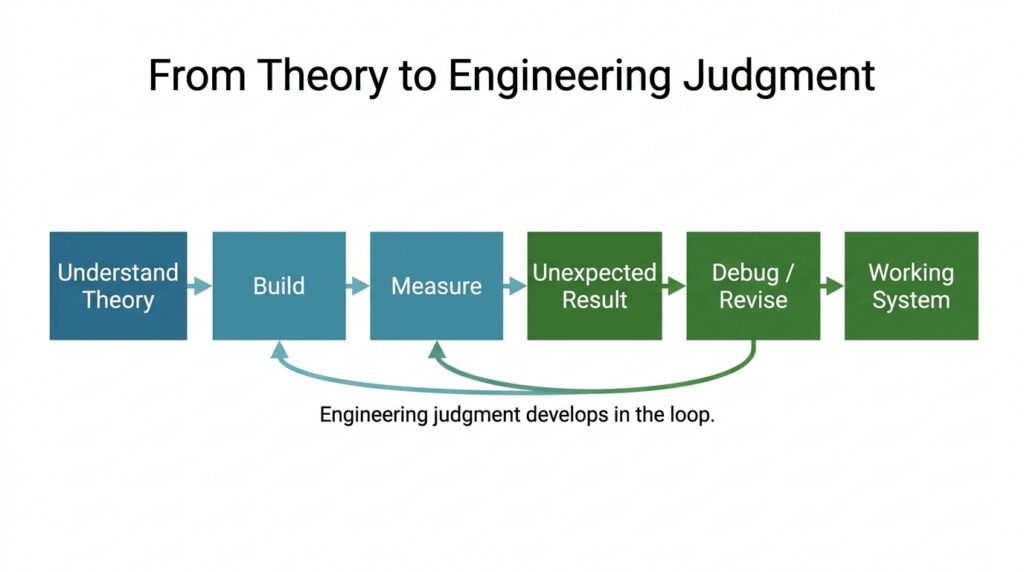
AP and IB can contribute enormously to the left-hand side. Most high-school students, however, have far fewer opportunities to develop the right-hand side in a systematic way. Consider something as simple as a voltage measurement. In a textbook problem, the circuit is clearly defined, the component values are known, and the problem has been constructed so that the information provided is sufficient to reach an answer. A real circuit is different. A connection may be wrong, the signal source may have limitations, the instrument itself may affect the measurement, a component may depart from its ideal model, or the original assumption may simply have been incorrect.
At that point, solving another equation may not be the next step. The student has to decide what to measure, what evidence would distinguish one possible cause from another, and what should be changed next. The same pattern appears in computer engineering. A program may be logically correct but fail because of timing, communication, memory, voltage levels, peripheral configuration, or the interaction between several pieces of hardware and software.
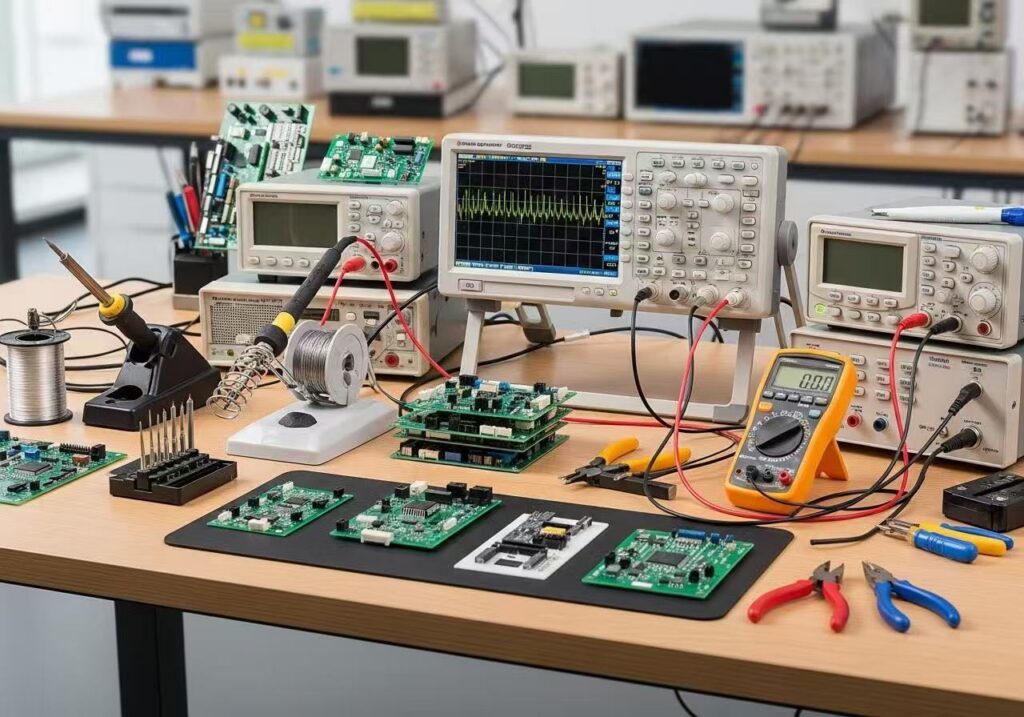
This difference between knowing how something should work and figuring out why it does not work is one of the defining transitions from studying science and mathematics to practicing engineering. Building circuits, using instruments, programming microcontrollers, implementing digital logic, reading documentation, and debugging complete systems are therefore not merely entertaining applications added after the “real” academic learning. They develop a different category of judgment that is difficult to acquire without repeatedly encountering real systems.
There is also a more personal reason to gain this experience before university. Strong grades in mathematics and physics can indicate that a student has the academic ability to study engineering, but they do not prove that the student will enjoy engineering work. Some students love the process of taking a system from “it should work” to “it actually works”; others discover that they prefer mathematics, science, software, or another field. Finding that out before committing several years to a degree is itself valuable.
3. Before University, Build a Map Rather Than Trying to Finish the Degree Early
Once parents recognize this gap, there is a temptation to go too far in the opposite direction. If practical engineering experience is useful, perhaps a high-school student should begin learning university circuit theory, signal processing, FPGA design, embedded systems, and as many other subjects as possible before graduation. I do not think that is the right objective either.
There is little value in turning high school into an accelerated version of an undergraduate engineering degree. Students already have demanding academic schedules, and rushing through advanced topics often produces superficial familiarity rather than durable understanding. A teenager does not need to “finish” university material before entering university. A much better objective is to establish an engineering map: enough exposure to understand what the major pieces are, what each one does, and how they connect.
A student does not need to become an expert in circuit theory, but it helps enormously to have built circuits and measured real voltages and signals. They do not need to complete a university signals course, but it helps to understand that real signals can be observed, measured, filtered, sampled, and processed. They do not need to become an embedded-systems engineer, but it helps to have programmed a microcontroller and watched software interact with physical hardware. They do not need to master FPGA design, but seeing the difference between software execution and digital hardware can make later courses in logic and computer architecture far less abstract.
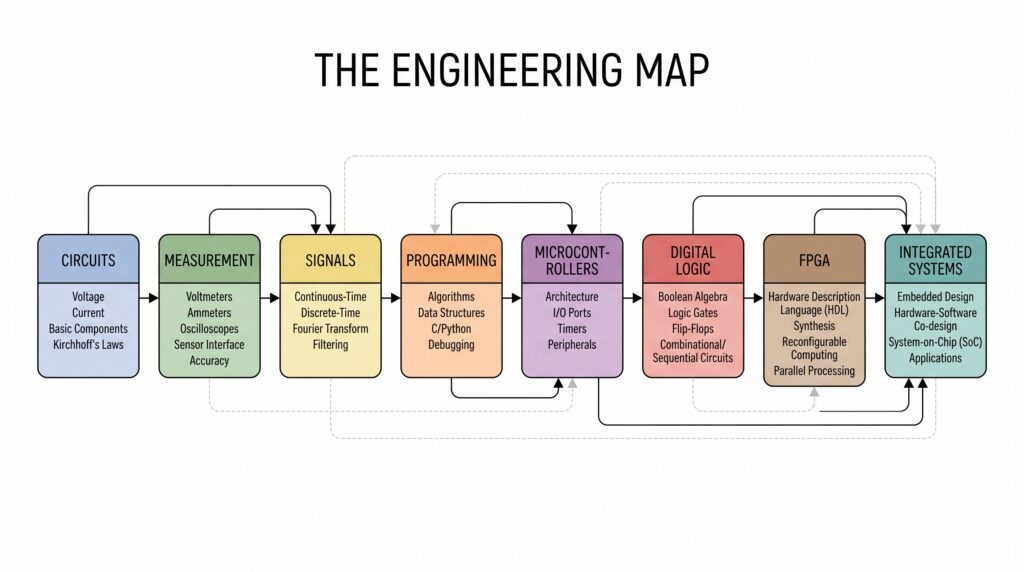
Once this map exists, later university courses have somewhere to attach. Circuit analysis is no longer an isolated collection of equations because the student has a physical reference point. Signals are not merely mathematical functions because the student has seen real waveforms. Digital logic is easier to place because it has already been connected to hardware behavior, and embedded systems are less mysterious because the student has already seen software control physical devices.
This becomes even more important in the AI era. Explanations, sample code, circuit suggestions, and technical summaries are increasingly easy to obtain. That is useful, but it also shifts the scarce part of engineering education away from simply accessing information. The harder skill is judging whether an answer is correct, understanding where it fits in a larger system, testing it against reality, and recognizing when the result does not make sense. Those abilities depend on context and engineering judgment, not merely access to more content.
A student who enters university with that context can also use university differently. The most difficult-to-replace value of a university is not simply the lecture material; it includes experienced professors, specialized laboratories, expensive equipment, research groups, design teams, peers, industry connections, and opportunities to participate in projects that are difficult to reproduce independently. If a student spends most of the first years simply trying to understand what circuits, signals, digital systems, and embedded computing are, much of that richer environment can remain out of reach.
The goal is not to replace university learning. It is to arrive with enough of a map to extract more value from it.
4. A More Complete Preparation Path: AP/IB Plus Structured Hands-On Engineering
This leads to a more useful way of thinking about preparation for Electronics and Computer Engineering. It should not be AP or IB versus hands-on engineering, because the two solve different problems. AP and IB strengthen the academic foundation; practical engineering gives that foundation context and begins connecting separate subjects into a working picture of the field.
For a motivated high-school student, a sensible progression might begin with strong mathematics and physics, add AP or IB where appropriate, and then gradually introduce circuits, measurement, programming, microcontrollers, digital systems, FPGA, and integrated projects. The important word is progression. Independent engineering resources are abundant, but they are also fragmented. It is easy to buy a microcontroller board, watch a tutorial, build an isolated circuit, or complete a weekend project. It is much harder to know what should come next, what concepts are being developed, and how one project should prepare the student for the next.
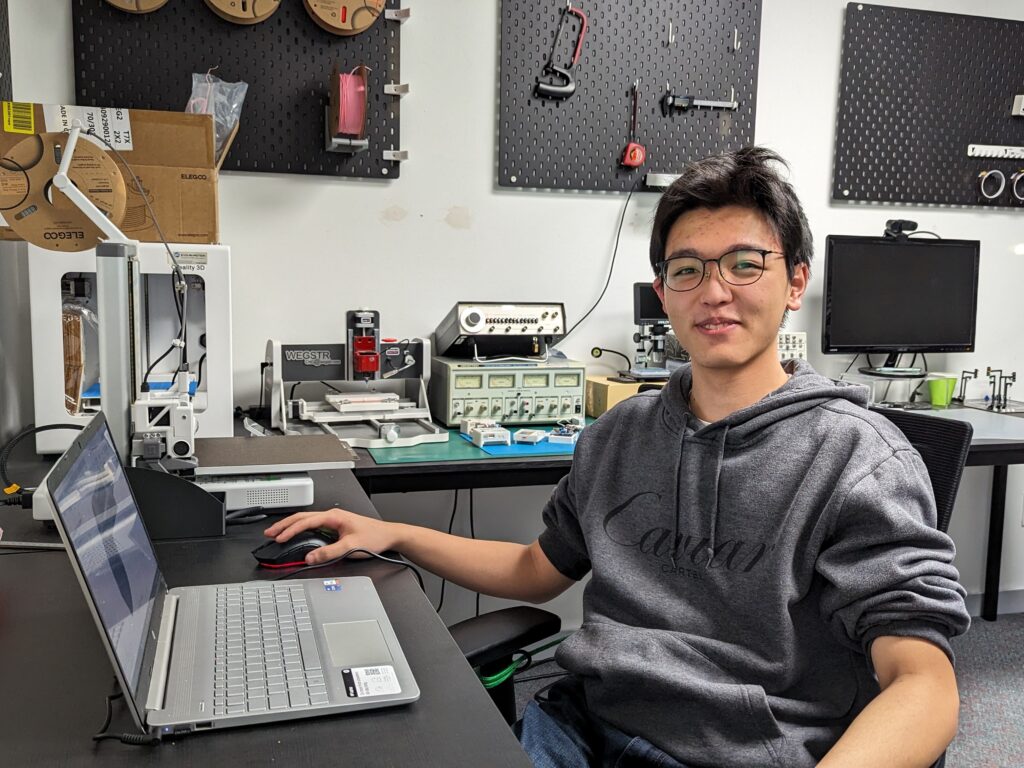
That is the problem we have tried to solve with the EIM Fundamental EE learning system. Rather than treating the breadboard, instruments, components, microcontroller, FPGA hardware, textbooks, experiments, and projects as separate products, we organize them as parts of one learning path. Students can begin with circuit building, measurement, components, and troubleshooting, then progress into electronics, signals, programming, microcontrollers, digital logic, FPGA development, and eventually projects in which several of those areas have to work together.
For students who already have strong AP or IB preparation, this is particularly useful because they often do not need another stack of worksheets. They need somewhere to apply what they already know and connect it to what comes next. A voltage equation becomes more meaningful when the student can measure the voltage. A signal becomes more meaningful when it can be observed on an oscilloscope. Digital logic becomes more meaningful when it is implemented in hardware, and programming becomes more meaningful when code has to control and communicate with a physical system.
Our entry-level Fundamental EE Starter (FE11) therefore begins with the foundations: real circuits, real measurements, engineering instruments, components, and systematic troubleshooting. Students who want to continue can move into the broader Fundamental EE pathway, where the work expands toward semiconductor and analog electronics, signals, microcontrollers, digital systems, FPGA development, and integrated hardware/software projects.
Fundamental EE Starter, FE11
For learners who want a structured way to build that habit, the Fundamental EE Starter kit (FE11) follows one connected path through circuits, analog design, microcontrollers, PCBs, and guided projects, with an online learning platform alongside the hardware. AI can explain each concept along the way, while the kit keeps the learning grounded in real circuits.
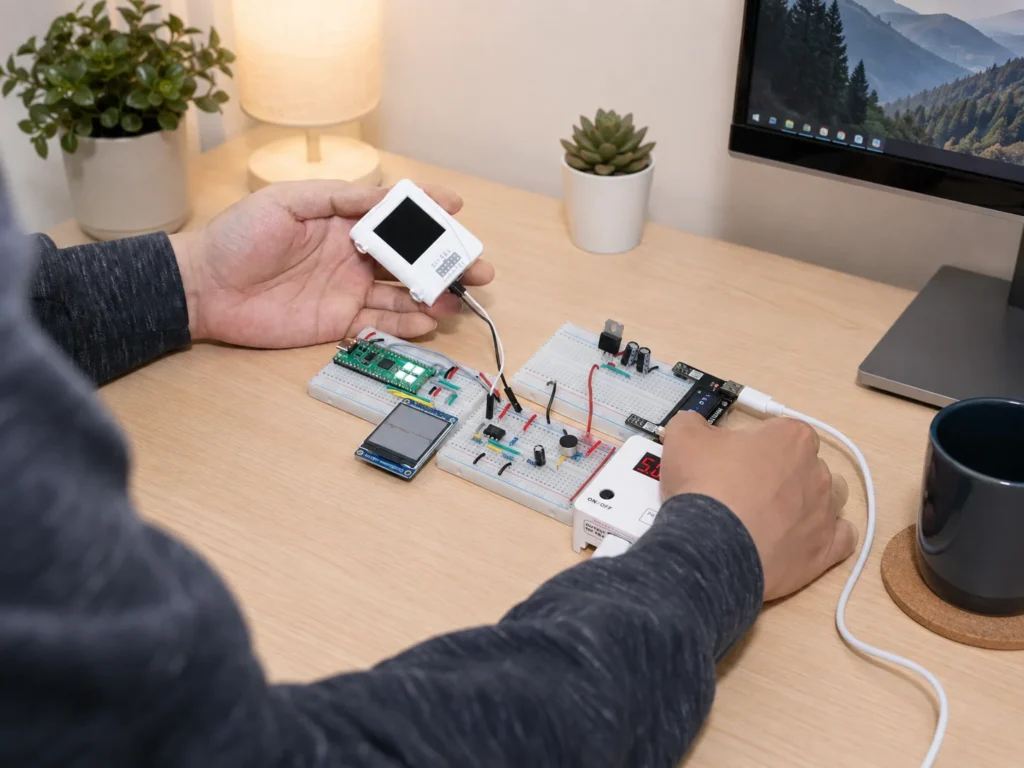
The objective is not to make a high-school student “finish engineering early.” It is to help the student enter university with enough context that the courses, laboratories, professors, and projects have somewhere to connect. Instead of using all of their attention to ask, “What is this?”, the student has more room to ask, “Why does it work this way? What happens if I change it? What else can I build with it?”
That is where strong AP or IB preparation becomes much more powerful. AP and IB provide some of the landmarks. Structured hands-on engineering connects those landmarks into a map. And once that map exists, university can become a place to explore much further rather than simply a place to keep up.
Frequently Asked Questions
Are AP Calculus and AP Physics useful for Electrical or Computer Engineering?
Yes. Calculus and physics are important foundations for most ECE programs, so advanced high-school study can make early university material more familiar. The university courses may still be faster, deeper, and more demanding, so AP preparation should be viewed as a head start rather than a replacement for later learning.
Is IB good preparation for engineering?
Yes. Strong IB Mathematics and Physics preparation can provide a similar academic advantage. Students should check the exact admission and credit requirements of each target university because policies vary by institution and engineering program.
Does taking AP or IB mean I can skip first-year engineering courses?
Not necessarily. Credit and placement policies differ, and even when credit is available, whether it is wise to skip a foundational course depends on the university and the student’s intended program. The more durable benefit of AP and IB is familiarity with important concepts.
What should a high-school student learn before Electronics or Computer Engineering?
There is no need to complete university engineering courses in advance. A more useful goal is basic exposure to circuits, measurement, programming, microcontrollers, digital logic, and integrated projects so that the student enters university with a mental map of the field.
Is Arduino or microcontroller experience enough?
It is a useful starting point, but it represents only one part of ECE. A stronger pathway connects programming with circuits, measurement, signals, digital systems, hardware interfaces, and progressively more complete projects.
What is the best preparation for ECE in high school?
For most students, the strongest combination is solid mathematics and physics, appropriate AP or IB courses, and structured hands-on engineering experience. The academic side provides the foundation; the practical side helps students understand what that foundation is for.

EIM TECHNOLOGY
Founder & Engineering Education Innovator
Daniel Cao is the Founder of EIM Technology and holds a Master of Applied Science in Engineering. With experience in engineering research, product development, PCB design, and technical education, he is the author of several books on electronics engineering. His work focuses on developing practical learning systems that integrate engineering hardware, lab instruments, curriculum, and project-based learning. Through EIM Technology, Daniel aims to make electronics and computer engineering more accessible and engaging, helping students build real experience in designing, measuring, testing, and troubleshooting electronic systems.