Computer Science (CS) tends to concentrate on computation, algorithms, and software; Computer Engineering (CE) crosses the boundary between software and hardware; and Electrical Engineering (EE) reaches further into circuits, signals, devices, and the physical world. The three overlap substantially, so a high school student is better served by real exposure to each layer before choosing a major.
This is a practical guide for high school students choosing between CS, CE, and EE in the United States and Canada, including curriculum differences, the AI-era perspective, and why real engineering experience matters before choosing a major.
For high school students considering engineering or technology programs in the United States or Canada, three majors often create the most confusion: Computer Science (CS), Computer Engineering (CE), and Electrical Engineering (EE). They overlap substantially, and depending on the university, students in these programs may even take several of the same courses during their first one or two years. The way universities organize these departments also varies: some have separate CS, CE, and EE programs, while others place Electrical and Computer Engineering together within an ECE department or use broader structures such as EECS. Yet despite the overlap, these majors approach technology from noticeably different directions, and those differences can strongly influence what students study, what kinds of projects they work on, and where they eventually specialize.
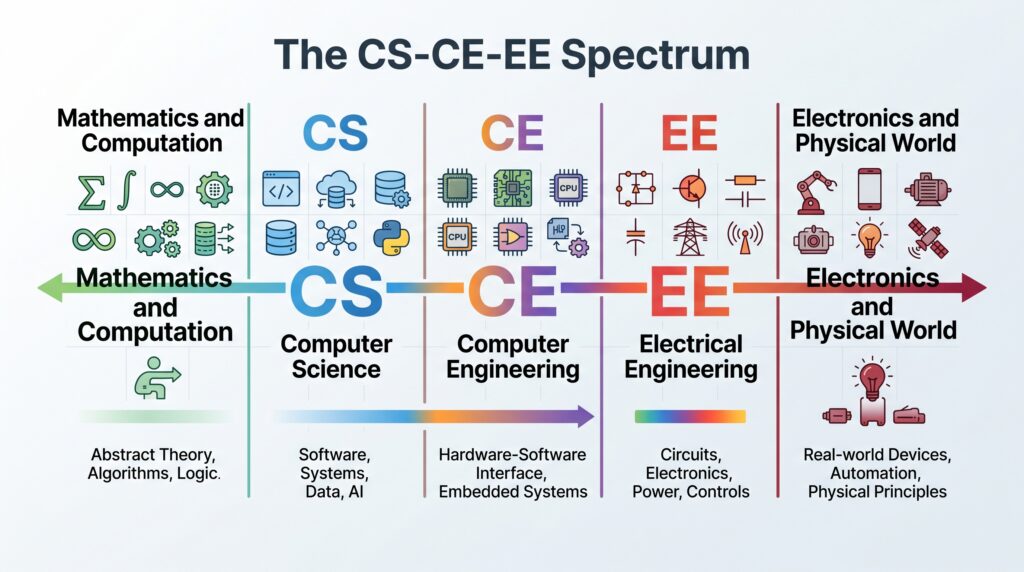
For a high school student, the easiest way to understand the relationship is not to start with university department names. Instead, imagine a spectrum running from mathematics and computation on one side to electronics and the physical world on the other. A simplified version might look like this: Mathematics and Computation, then Computer Science, then Computer Engineering, then Electrical Engineering, then Electronics and Physical Systems. This is not a strict academic classification, but as a mental model for students and parents comparing the three fields for the first time, it is extremely useful.
The biggest difference is therefore not whether students “use computers,” because all three fields do. The more useful question is which layer of a computing or electronic system the student wants to understand and build. CS tends to concentrate higher in the abstraction stack, CE crosses the software-hardware boundary, and EE reaches further into signals, circuits, devices, energy, and the physical environment. That distinction becomes clearer when we look at the curriculum.
What Is Computer Science? Understanding Computation
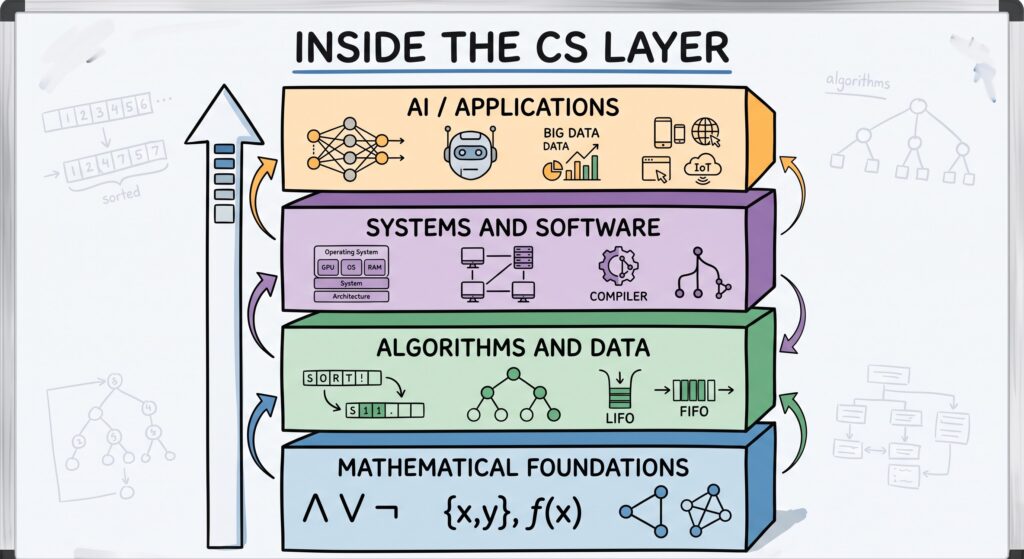
Despite the word “computer” in its name, Computer Science is fundamentally concerned with computation rather than the physical computer itself. As students move toward the theoretical side of CS, they encounter subjects such as discrete mathematics, logic, probability, algorithms, complexity, and computation theory. These subjects provide the mathematical and conceptual foundations for understanding how information can be represented and how computational problems can be solved efficiently. In that sense, Computer Science sits relatively close to mathematics on our spectrum.
That does not mean a CS degree is purely theoretical. Undergraduate students typically write a great deal of code and may study data structures, algorithms, databases, operating systems, computer networks, software engineering, artificial intelligence, machine learning, compilers, cybersecurity, and many other areas. Different universities emphasize these subjects differently, and students can often specialize significantly through electives. Nevertheless, much of the field ultimately returns to several fundamental questions: how should a problem be represented, how should data be organized, what algorithm should be used, and how can computation be performed more efficiently?
What Is Computer Engineering? Where Software Meets Hardware
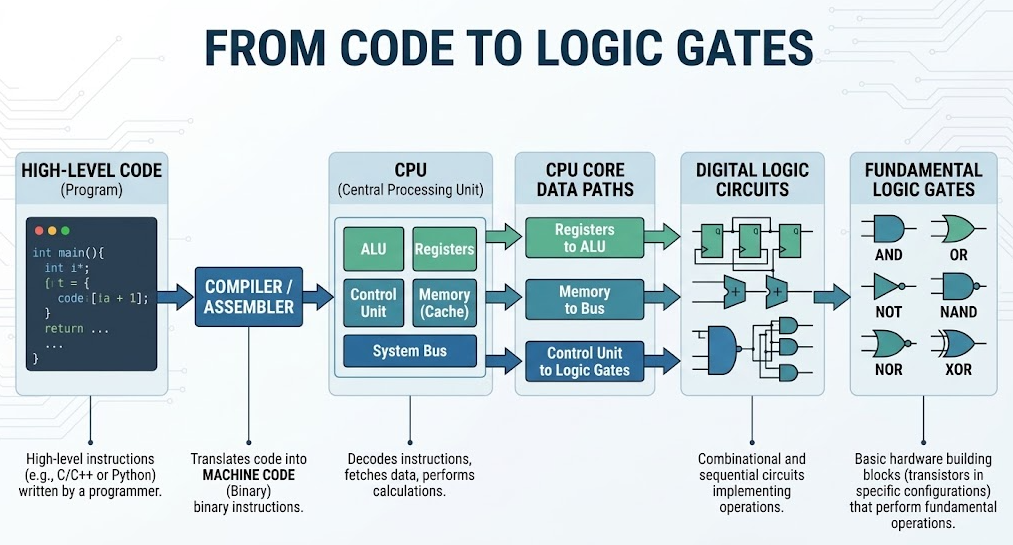
Move toward the middle of the spectrum and we reach Computer Engineering. CE is particularly interesting because it occupies much of the territory between Computer Science and Electrical Engineering. Computer Engineering students usually program extensively, and depending on the university they may study software, data structures, operating systems, and other subjects that overlap with CS. At the same time, however, they begin moving downward through the computing stack and studying what actually makes a computer system work.
Typical subjects may include digital logic, computer architecture, microprocessors, embedded systems, FPGA design, hardware interfaces, electronics, and computer networks. A student might therefore write software in one course and design digital hardware in another. Later, those two worlds can come together in embedded devices, robotics, computer architecture, semiconductor systems, edge computing, or hardware acceleration. This ability to move between software and hardware is one of the defining characteristics of Computer Engineering.
One useful way to distinguish CS from CE is to look at how far down the computing stack the student wants to go. A CS student might ask, “How can I design software or an algorithm to solve this problem efficiently?” A CE student may ask the same question, but then continue downward: what processor is executing this code, how does memory interact with it, how are peripherals connected, and how does digital logic implement the operations underneath the software? That additional layer changes the nature of the education substantially.
What Is Electrical Engineering? Moving Into the Physical World
Continue toward electronics and the physical world and we reach Electrical Engineering. EE is an extremely broad discipline, and computers represent only one portion of it. Depending on the university and specialization, students may study circuits, analog electronics, signals and systems, digital signal processing, communications, electromagnetics, control systems, semiconductor devices, power electronics, energy systems, instrumentation, or other areas. Mathematics remains extremely important, but it is increasingly being used to understand signals, devices, circuits, fields, energy, and physical systems.
This is where the difference from Computer Science becomes much easier to see. A CS student might spend most of a project thinking about software architecture, algorithms, or data, while an EE student may need to understand why an analog signal contains noise, how a circuit responds at different frequencies, why a sensor behaves differently from its theoretical model, or how an electronic system interacts with the physical environment. Computer Engineering often occupies the territory between these worlds, especially when digital hardware and embedded computing are involved. The boundaries, however, are deliberately porous.
CS vs CE vs EE: How Do They Compare?
The following comparison is deliberately simplified, but it provides a useful starting point for students researching university majors. It should not be treated as a universal curriculum map because universities can differ significantly. A systems-focused CS student may study computer architecture extensively, while a software-oriented CE student may take considerably more programming than the table implies. The purpose is to reveal the center of gravity of each discipline rather than create rigid boundaries
| Area | CS | CE | EE |
|---|---|---|---|
| Main focus | Computation, algorithms, software | Hardware + software systems | Electronics, signals, physical systems |
| Programming | Very high | High | Moderate to high |
| Digital logic | Sometimes | Core area | Common |
| Computer architecture | Common in systems | Core area | Possible |
| Circuits & electronics | Usually limited | Moderate | Core area |
| Embedded systems | Possible elective | Core area | Common |
| FPGA / digital hardware | Less common | Common | Common |
| Signals & DSP | Specialized | Possible | Common |
| Semiconductors | Limited | Possible | Common in relevant tracks |
How Does a High School Student Know Which One Fits?
For students preparing to apply to university, memorizing the definitions of CS, CE, and EE is actually the easy part. The much harder question is deciding which part of this spectrum they genuinely enjoy. This is where I see a major information gap among high school students. They are often being asked to make an important academic decision before they have had meaningful exposure to several of the options.
Computer Science is somewhat easier to experience before university because programming is highly accessible. A student can take a school CS course, learn Python independently, build a website, experiment with AI tools, or complete online programming projects with little specialized equipment. By Grade 11 or 12, some students therefore have enough experience to say that they genuinely enjoy programming or computational problem solving. Even then, their understanding of university-level CS may still be incomplete, but at least they have something concrete on which to base the decision.
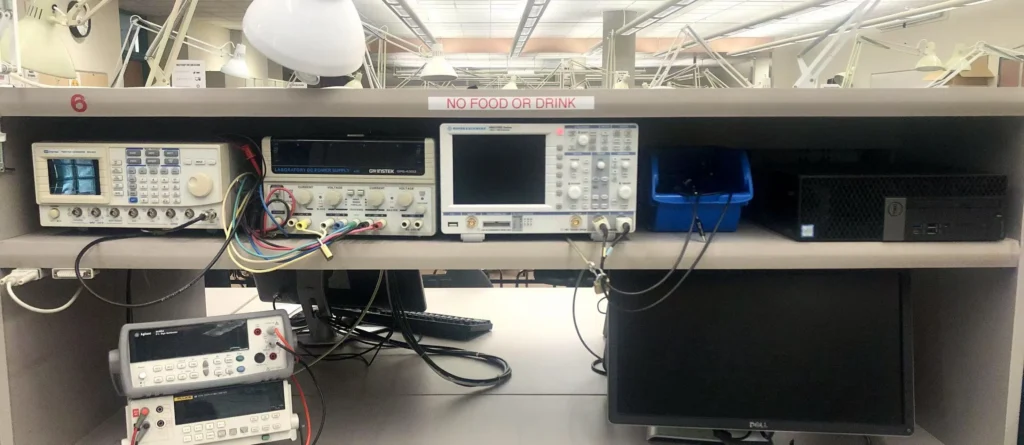
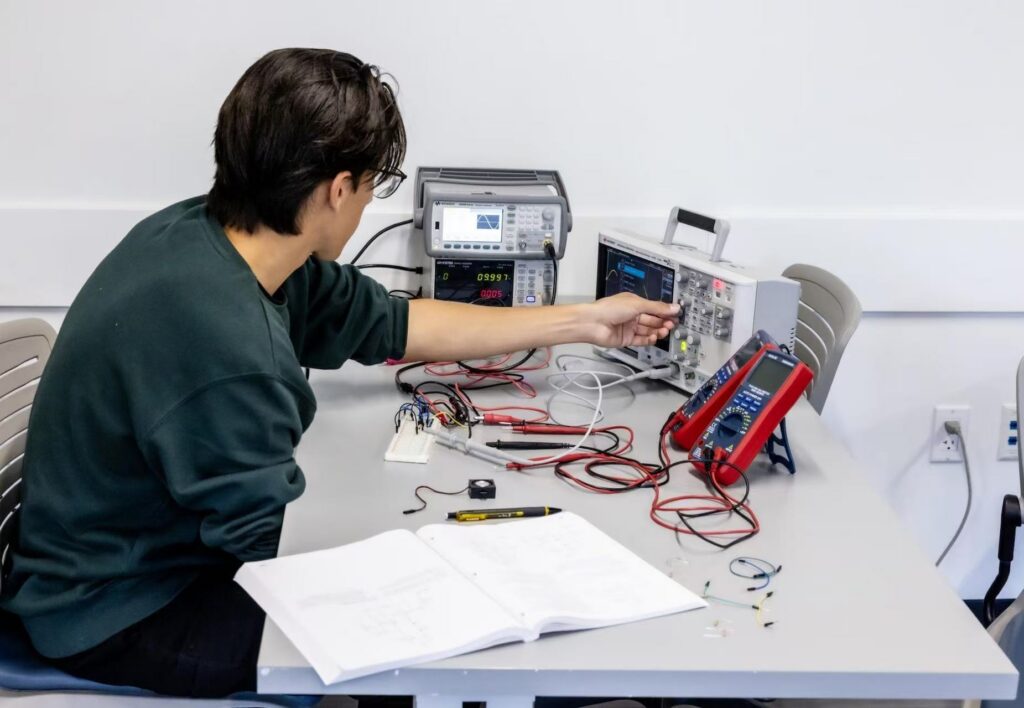
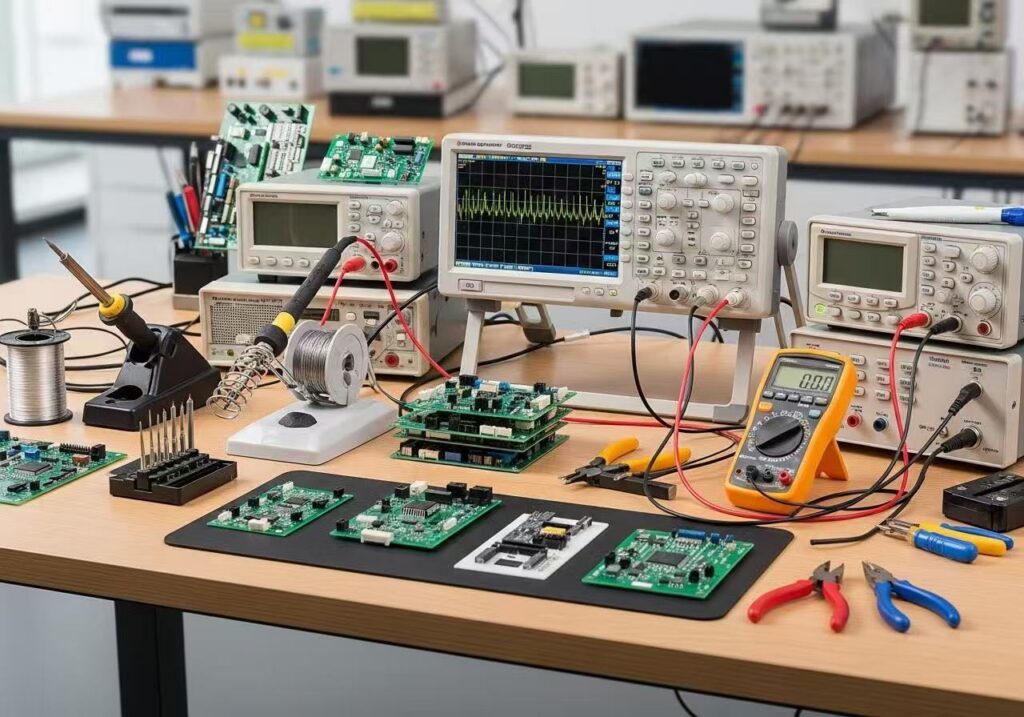
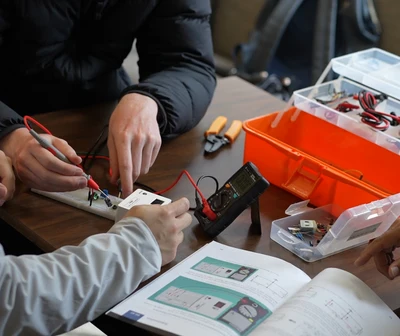
Computer Engineering and Electrical Engineering can be much harder to evaluate from high school experience alone. Many students have never built a reasonably complete circuit, used an oscilloscope or other test equipment, programmed a microcontroller as part of a larger hardware system, worked with an FPGA, or debugged communication between hardware and software. They may know that EE is “hard” or that CE involves “both hardware and software,” but those are labels rather than experiences. Asking a sixteen- or seventeen-year-old student to choose among these majors under those conditions creates a significant information imbalance.
This leads to an important distinction: not having an interest in something is different from never having had a meaningful opportunity to experience it. A student who has spent three years programming but has never touched an electronic instrument naturally has much more information about CS than about EE or CE. That does not necessarily mean CS is the better fit. It may simply mean that one side of the comparison has been explored while the other side remains almost completely unknown.
Why Does Hands-On Engineering Experience Change the Decision?
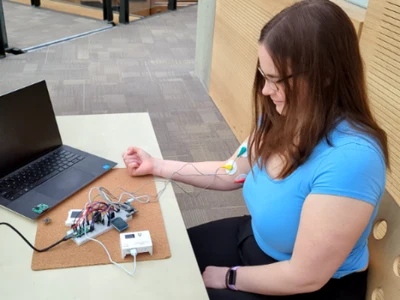
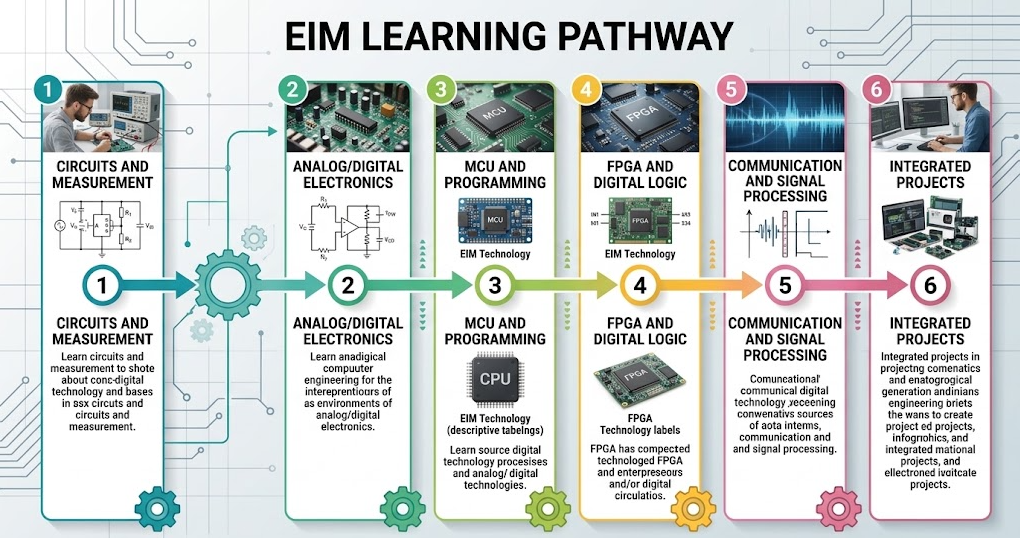
This is one reason we developed our electronics and computer engineering learning pathway around actual engineering work rather than simply explaining engineering careers to students. The goal is not to create another programming course, nor is it to have students complete a collection of disconnected electronic projects. Instead, the pathway gradually moves through circuits, electronic components, measurement, test equipment, analog and digital electronics, programming, microcontrollers, FPGA and digital logic, communication between hardware and software, signal processing, and eventually more integrated engineering systems. Students encounter several layers of the CS-CE-EE spectrum rather than being shown only one narrow slice of it.
More importantly, those layers eventually have to work together. Understanding what an MCU is intellectually is very different from programming one, connecting it to external hardware, observing signals, discovering that something does not behave as expected, and then debugging the system until it works. The same applies to digital logic, electronic circuits, communication interfaces, and signal processing. Engineering becomes much easier to understand once the student experiences the cycle of building, measuring, debugging, modifying, and testing.
After enough exposure, students often begin to notice their own preferences without needing someone else to assign them a major. One student may be perfectly capable of working with circuits but discover that algorithms and abstract computational problems are what keep them engaged for hours; CS may therefore be a natural direction. Another may enjoy programming but become much more interested when that code controls a physical device, communicates with an FPGA, processes sensor data, or interacts with real hardware; Computer Engineering deserves serious consideration in that case. A third student may continually move toward circuits, signals, measurements, electronic devices, and lower-level physical behavior, making Electrical or Electronics Engineering increasingly attractive.
How Does AI Change the CS, CE, and EE Decision?
AI makes this question even more interesting because the value of simply producing code is changing rapidly. Many routine programming tasks that once required a junior developer to write everything manually can now be accelerated substantially by AI tools. That does not mean software engineering or Computer Science is disappearing, and strong CS students who understand algorithms, systems, AI, optimization, security, and advanced computing remain extremely valuable. It does mean that students should be careful about choosing CS simply because they learned some coding in high school and were told that programming automatically leads to a safe career.
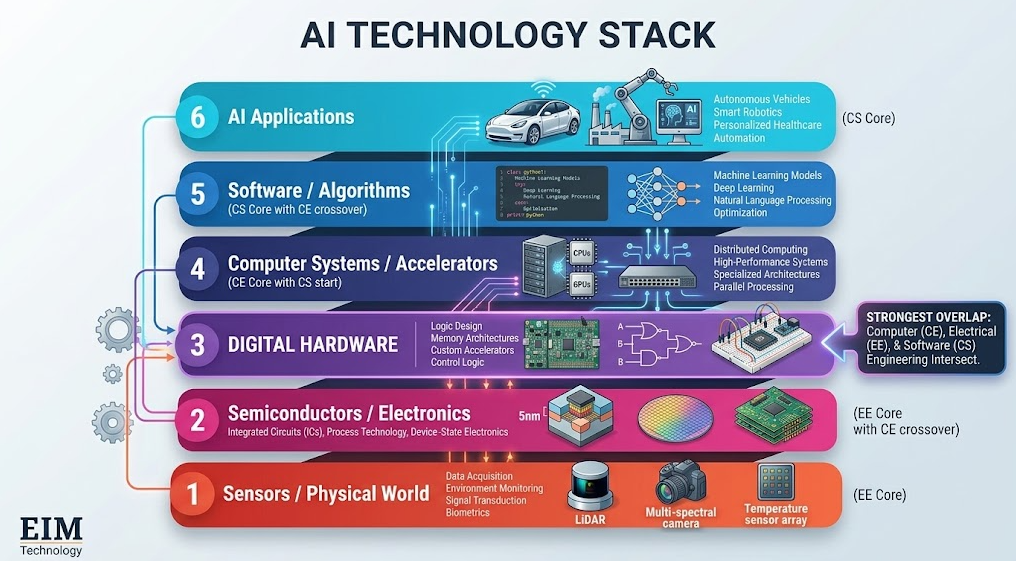
Computer Engineering occupies a different position because computing increasingly extends beyond conventional software. AI models ultimately run on processors, accelerators, memory systems, data centers, embedded devices, vehicles, robots, instruments, and other physical computing platforms. Designing, interfacing, optimizing, and understanding those systems requires knowledge that crosses software and hardware boundaries. For students who enjoy both programming and physical computing systems, this combination can provide considerable flexibility.
Electrical and Electronics Engineering extend the chain even further into the physical infrastructure behind modern technology. AI systems still depend on semiconductor devices, power delivery, sensors, communication systems, signal acquisition, analog interfaces, control systems, and enormous amounts of physical hardware. AI can certainly assist engineers working in these areas, just as it assists programmers, but generating a plausible circuit or piece of code is not the same as understanding whether a physical system will actually work. Measurement, verification, debugging, trade-offs, and physical constraints remain central parts of engineering.
For that reason, I would not frame the decision as “Which major is safest from AI?” That is too simplistic, and no serious university major should be selected on that basis alone. A better question is: At which layer of modern technology does the student want to develop deep expertise? CS, CE, and EE all remain important, but they create value at different layers of the technology stack.
Why Should You Explore Before You Decide?
For a high school student, the purpose of early engineering education should not be to force a professional specialization several years too early. It should provide enough authentic exposure that the student can make a better-informed decision. University websites and course descriptions are useful, but they cannot reproduce the experience of actually writing code, wiring a circuit, using test equipment, debugging digital logic, communicating between processors, measuring signals, and watching several pieces finally work together as a system. That experience creates information that cannot easily be obtained from reading alone.
This philosophy is central to the engineering programs we develop at EIM Technology. Students can begin with fundamental circuits, components, measurements, and instruments, then progressively move toward electronics, programming, microcontrollers, FPGA and digital systems, signal processing, and integrated projects. The intention is not simply to teach more material earlier. It is to create a coherent pathway through which students can experience enough of electronics and computer engineering to understand both the subject and themselves better.
Fundamental EE Starter, FE11
For learners who want a structured way to build that habit, the Fundamental EE Starter kit (FE11) follows one connected path through circuits, analog design, microcontrollers, PCBs, and guided projects, with an online learning platform alongside the hardware. AI can explain each concept along the way, while the kit keeps the learning grounded in real circuits.
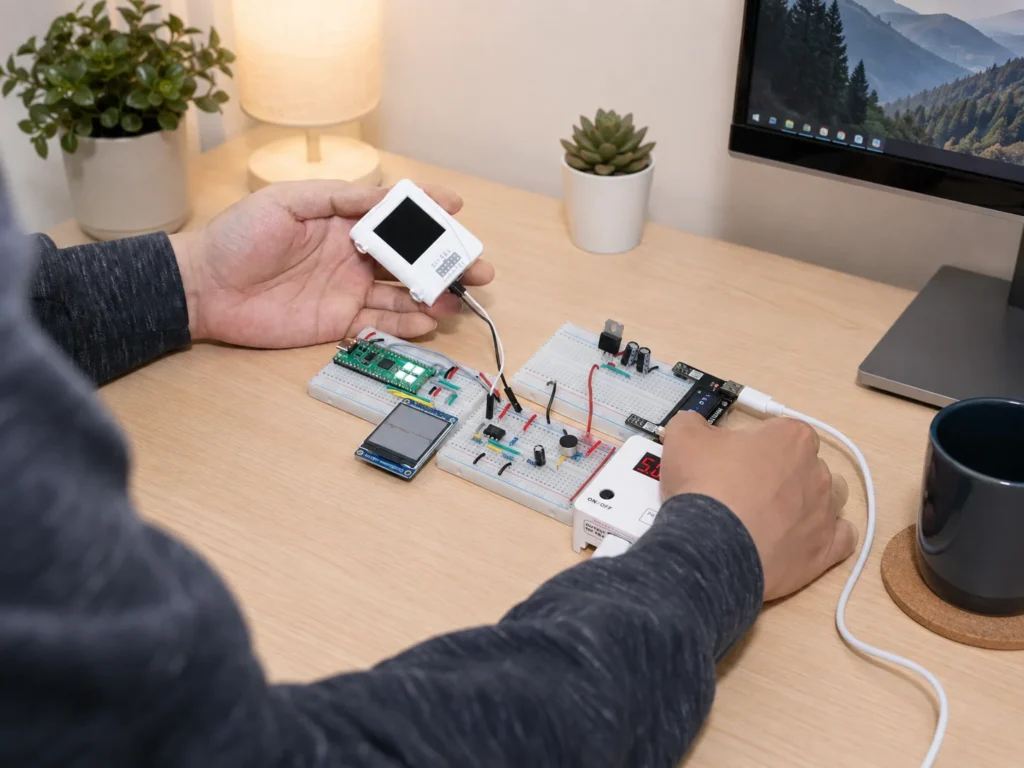
For students in the Vancouver area, we also offer in-person engineering training where students can work through this process with guidance and access to a complete engineering environment. Students outside Vancouver, or those who are comfortable learning more independently, can begin with our entry-level engineering learning systems at home. The hardware, instruments, electronic components, learning materials, and projects are organized so that students can gradually build something much closer to a personal electronics laboratory rather than purchasing disconnected components without a clear learning path. From there, students can continue into increasingly sophisticated electronics and computer engineering projects.
Ultimately, choosing between Computer Science, Computer Engineering, and Electrical Engineering should not be about finding the degree with the best label. It should be about discovering which layer of technology makes a student curious enough to keep going when the problems become difficult. CS tends to move toward computation, algorithms, and software; CE sits strongly across the software-hardware boundary; EE extends deeper into electronics, signals, devices, and the physical world. The boundaries overlap, but the experience of working in each area feels very different.
A high school student does not need to have the final answer immediately. But if university applications are approaching, it is worth replacing assumptions with experience as early as possible. Try building real systems before deciding which part of the system you want to spend the next several years studying. That is often a much better starting point than choosing a major based only on reputation, salary statistics, or what someone else says is “the future

EIM TECHNOLOGY
Founder & Engineering Education Innovator
Daniel Cao is the Founder of EIM Technology and holds a Master of Applied Science in Engineering. With experience in engineering research, product development, PCB design, and technical education, he is the author of several books on electronics engineering. His work focuses on developing practical learning systems that integrate engineering hardware, lab instruments, curriculum, and project-based learning. Through EIM Technology, Daniel aims to make electronics and computer engineering more accessible and engaging, helping students build real experience in designing, measuring, testing, and troubleshooting electronic systems.