A practical way to learn electronics and computer engineering (ECE) is to build a map of the field before you specialize. Start with three foundations (circuit fundamentals, analog electronics, and digital systems), connect them to real hardware and measurement, and then choose where to go deep once you can see how the specializations fit together.
This roadmap is for high-school students preparing for ECE, university students changing direction, and independent learners who want to understand the field before choosing a specialization.
Why Is Electronics and Computer Engineering Bigger Than It Looks?
At many North American universities, Electrical and Computer Engineering, commonly grouped under ECE, covers an enormous range of subjects: circuits, electronics, digital logic, embedded systems, computer architecture, signal processing, communications, control, power electronics, semiconductor devices, RF systems, integrated circuits, and more.
The boundary between “electrical” and “computer” is also much less obvious than it may first appear. Modern engineering systems are rarely purely hardware or purely software. A robot, medical device, vehicle, communication system, or consumer product may combine sensors, analog electronics, processors, digital logic, firmware, communication interfaces, power electronics, and software in the same system.
This breadth is one of the strengths of ECE. It is also one of the reasons the field can feel overwhelming to new students.
Is the Problem a Lack of Knowledge, or Too Much Knowledge?
Imagine entering university after studying mathematics, physics, and general science in high school. Suddenly, you encounter circuit analysis, semiconductor devices, programming, digital logic, microcontrollers, signals, laboratories, design projects, and engineering mathematics.
A few semesters later, the list becomes even longer. An undergraduate degree has limited time: students must learn foundations developed over many decades, complete labs and projects, meet degree requirements, and eventually begin specializing. It is unrealistic to become deeply proficient in every branch of ECE during an undergraduate program.
That does not make university courses less important. They provide the theoretical foundation for advanced engineering. But there is a difference between learning many individual subjects and understanding how those subjects fit together.
How Can You Learn ECE the Way You Would Learn a City?
Think about moving to a large city for the first time. You would not learn it by memorizing every residential street one by one. You would first learn the major roads, downtown, transit routes, universities, commercial centres, and several recognizable landmarks.
Once that mental map exists, learning a new location becomes much easier. You already know approximately where you are and how the new information connects to something familiar.
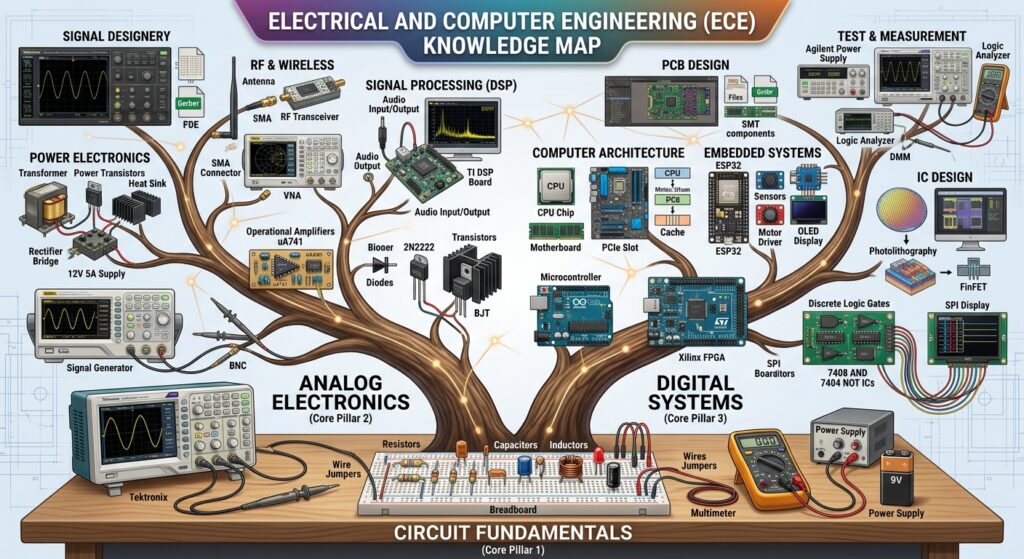
ECE can be approached in much the same way. You do not need to master every technical detail before you understand the field. Instead, identify a relatively small number of foundational areas that act as landmarks. From our perspective, three of the most important are circuit fundamentals, analog electronics, and digital systems.
What Three Foundations Organize Much of ECE?
Circuit fundamentals provide the common language. Voltage, current, resistance, capacitance, measurement, loading, transient behaviour, and basic network analysis appear almost everywhere in electronics. Whether you later work with sensors, processors, power supplies, or communication hardware, you are still interacting with physical circuits.
Analog electronics builds from that foundation into signals and real electronic devices. Semiconductor components, amplifiers, filters, sensor interfaces, signal conditioning, and many power-electronic concepts grow from this side of the field. It is also where students begin to see an important engineering reality: real signals are continuous, noisy, imperfect, and affected by the physical world.
Digital systems introduce another way of processing information. Logic gates lead to combinational and sequential logic, registers, counters, state machines, arithmetic units, memory, processors, and eventually computer architecture. This is the foundation behind much of modern computing hardware.
Where hands-on learning helps
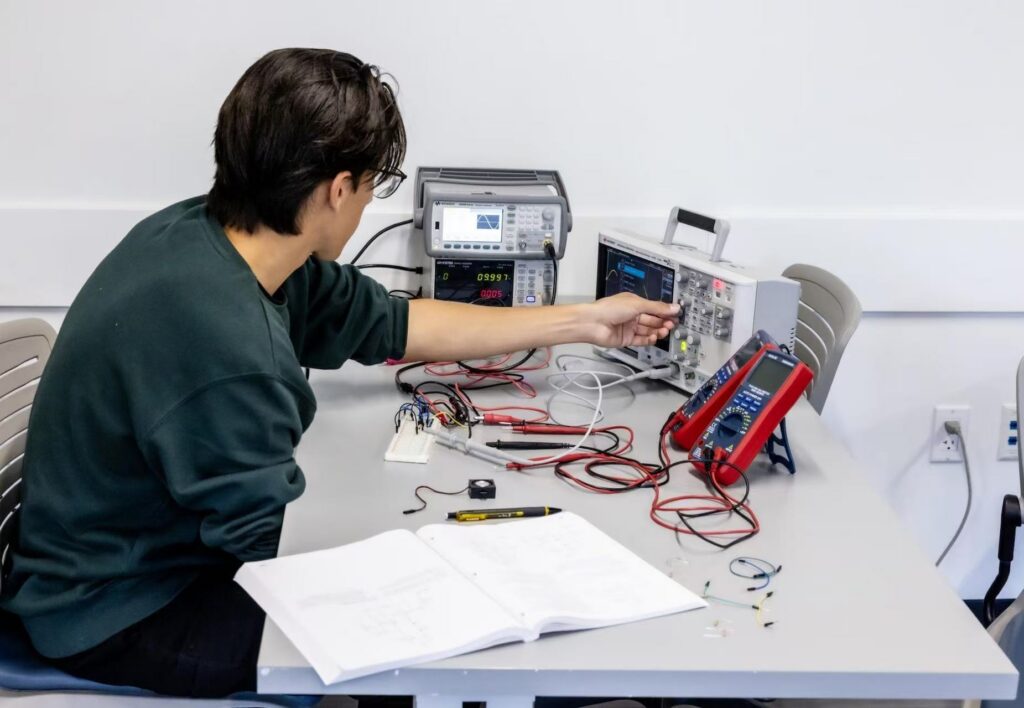
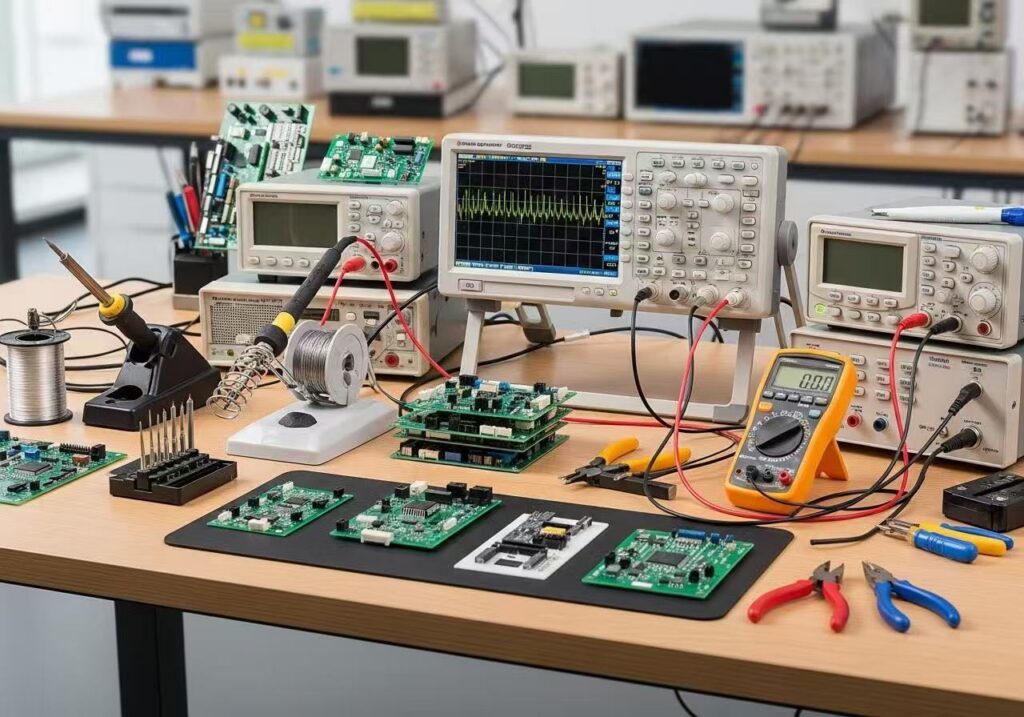
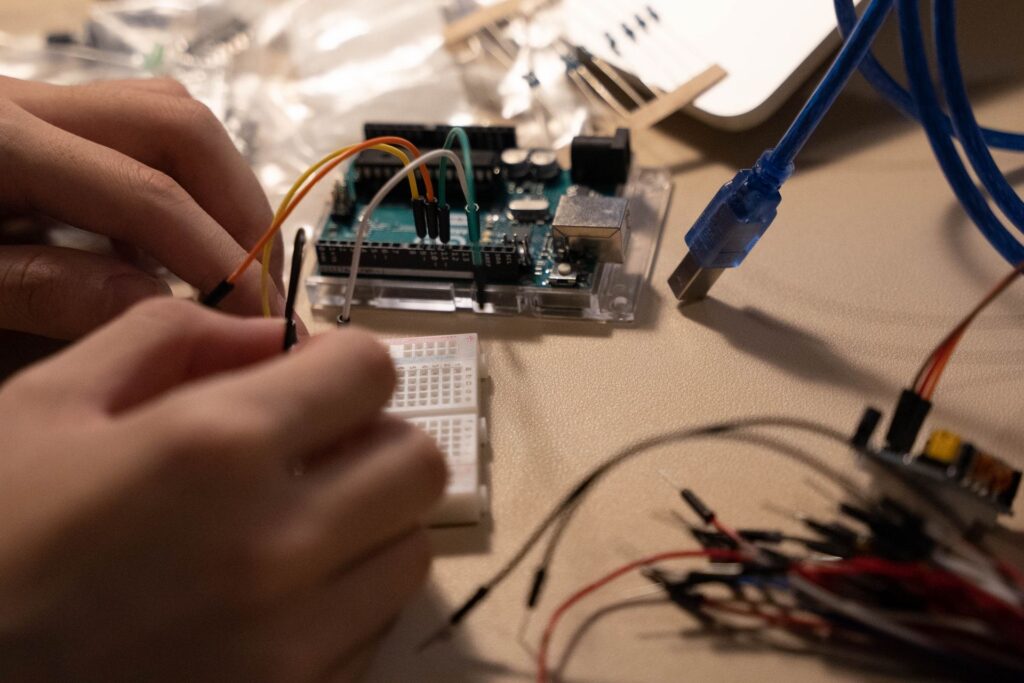
A roadmap becomes much more useful when the learner can connect it to real hardware. This is the idea behind EIM Technology’s Fundamental EE learning path: use structured experiments to connect circuits, signals, digital logic, microcontrollers, and programmable hardware before these topics appear as disconnected university courses. The goal is not early specialization. It is to make the map tangible.
Fundamental EE Starter, FE11
For learners who want a structured way to build that habit, the Fundamental EE Starter kit (FE11) follows one connected path through circuits, analog design, microcontrollers, PCBs, and guided projects, with an online learning platform alongside the hardware. AI can explain each concept along the way, while the kit keeps the learning grounded in real circuits.
How Do ECE Specializations Build on the Core?
Consider embedded systems. A microcontroller-based product combines physical circuits, digital hardware, programming, interfaces, sensors, and often some analog electronics. More advanced systems may add real-time operating systems, communication protocols, or programmable logic.
Digital signal processing adds another layer. The mathematics matters, but practical DSP also requires understanding how signals are sampled, represented, processed, stored, and eventually converted back into something physical. Implementations may run on processors, dedicated DSP hardware, or FPGAs.
Power electronics builds heavily on circuit fundamentals, semiconductor devices, switching behaviour, control, and measurement. RF and communication hardware extend familiar ideas about signals, filtering, amplification, and impedance into higher-frequency environments. Integrated-circuit design branches again: digital IC design grows from digital logic and computer architecture, while analog and mixed-signal IC design draws heavily from semiconductor and analog-circuit fundamentals.
The important point is not that everything is the same. It is that many advanced fields are built by extending, combining, and specializing a smaller set of fundamental ideas.
Why Does This Change the Way You Learn at University?
Suppose two students enter the same electronics course. One encounters amplifiers, filters, ADCs, microcontrollers, and digital interfaces for the first time as separate topics. The other has already built a few basic circuits, measured real signals, programmed a microcontroller, and experimented with digital logic.
The second student does not necessarily know more theory. But the new theory has somewhere to go. A filter is no longer just another equation. An ADC is not simply another block in a lecture slide. A register is not an isolated digital-logic concept. Each new idea connects to an existing mental model and, ideally, to something the student has already built or measured.
That is the difference between trying to memorize a city street by street and already having the map.
What Does a Practical Roadmap Before Specialization Look Like?
This idea is also behind the learning system we have been developing at EIM Technology. Rather than attempting to turn a beginner into a specialist immediately, the goal is to establish a structured foundation across the core areas of electronics and computer engineering, supported by real experiments.
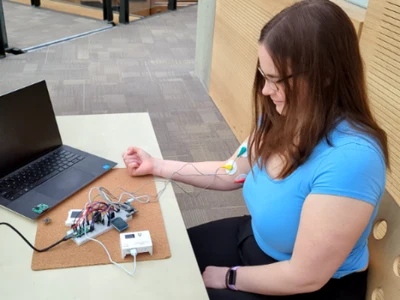
The learning path begins with Fundamental EE Starter (FE11) and progresses toward more advanced electronics, MCU, FPGA, and integrated-system work. It is paired with Lab on the Go, a compact electronics laboratory that allows students to build circuits and actually measure what is happening instead of learning entirely from simulations or diagrams.
The objective is not to claim that completing a bundle makes someone a professional engineer. It does not. The objective is much more practical: build the map before university courses begin demanding that you navigate the city.
Build Breadth First, Then Choose Where to Go Deep
Eventually, every serious engineering student needs specialization. Some will move toward semiconductors or IC design. Others may prefer embedded systems, FPGA development, robotics, communications, power electronics, computer architecture, or signal processing. Some will pursue research and graduate studies, while others will focus on product development and industry.
Trying to choose that specialization before understanding the broader field can be difficult. A better strategy is to establish enough breadth to recognize the landscape, then deliberately go deeper where your ability and interest intersect. A well-executed electronics project can also become more than a learning exercise: it can demonstrate design decisions, implementation, measurement, debugging, and engineering thinking when students later apply for internships, co-op positions, research opportunities, or entry-level roles.
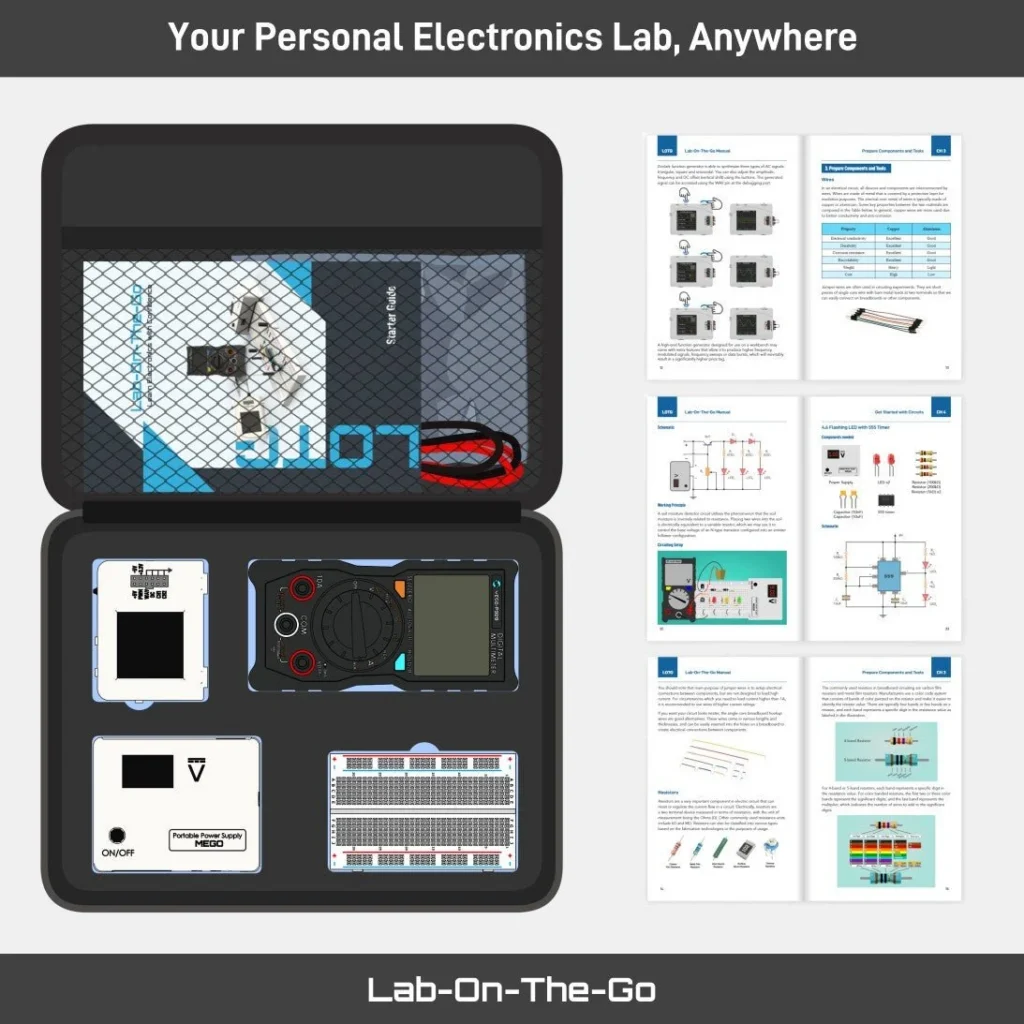
Lab-On-The-Go Electronics Tool Kit
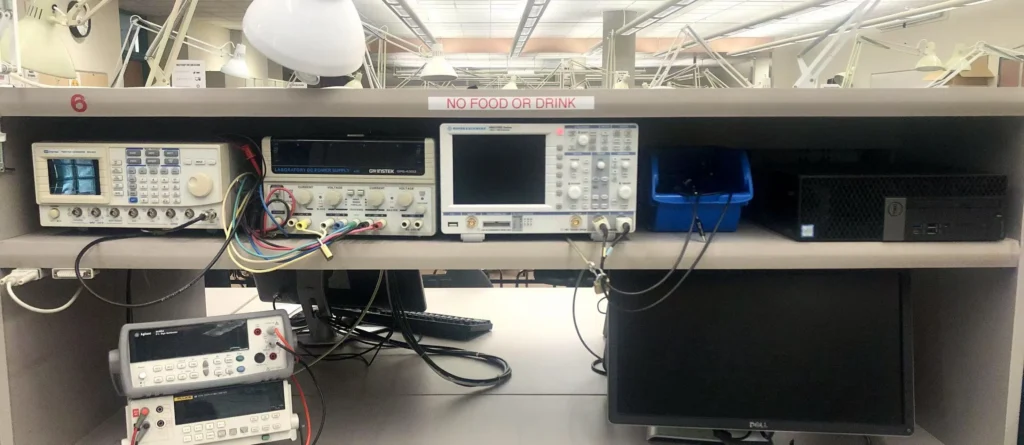
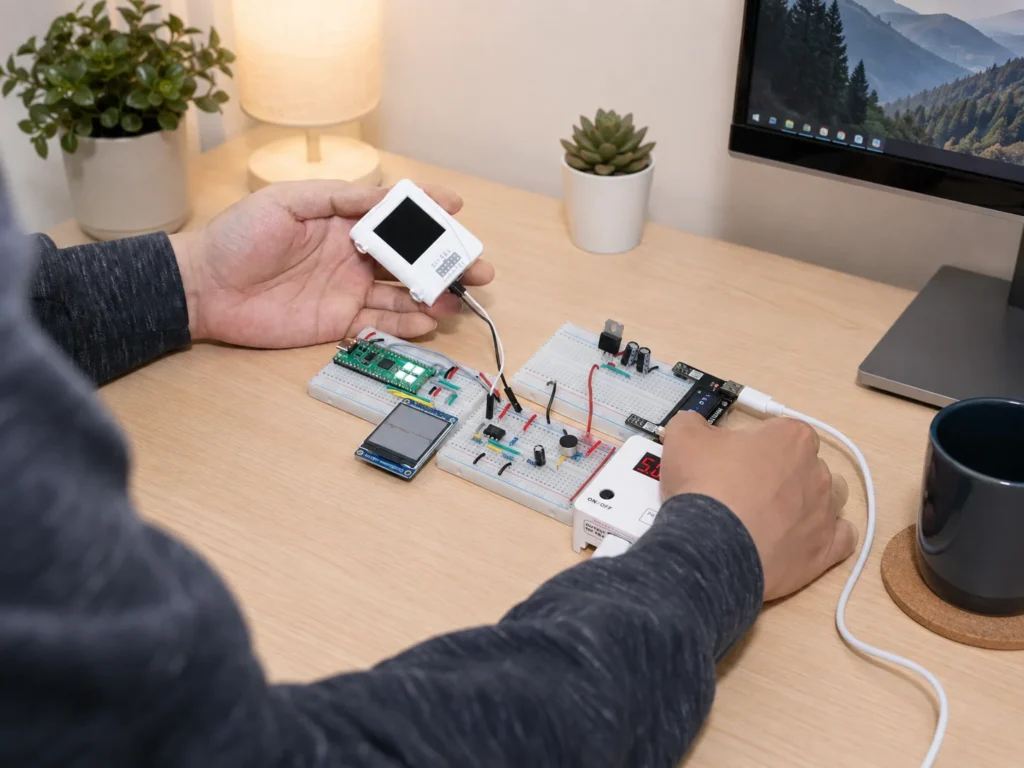
The measuring step is where many learners get stuck, because it depends on instruments that are not always accessible outside a lab. A portable kit such as the Lab-On-The-Go puts a rechargeable power supply, a digital multimeter, and an oscilloscope with a function generator in one case, so a student can capture that unexpected waveform at their own desk and work through the loop at their own pace
Final takeaway: ECE is too large for anyone to learn everything at once. Learn the landmarks, build the map, develop enough hands-on experience to connect theory with reality, and then choose a direction in which to go deep.

EIM TECHNOLOGY
Founder & Engineering Education Innovator
Daniel Cao is the Founder of EIM Technology and holds a Master of Applied Science in Engineering. With experience in engineering research, product development, PCB design, and technical education, he is the author of several books on electronics engineering. His work focuses on developing practical learning systems that integrate engineering hardware, lab instruments, curriculum, and project-based learning. Through EIM Technology, Daniel aims to make electronics and computer engineering more accessible and engaging, helping students build real experience in designing, measuring, testing, and troubleshooting electronic systems.