Not long ago, an educator asked me a question about hands-on engineering education that I think deserves a much more serious answer. With AI becoming increasingly capable and simulation software already widely available, what is truly irreplaceable about a physical engineering lab? If a student can ask an AI model to explain a principle in seconds, simulate a circuit without purchasing components, and test multiple designs without damaging anything, why should schools and students continue investing significant money and time in physical laboratory work?
The question has become even more relevant as AI moves beyond text. A difficult engineering concept can increasingly be explained through generated diagrams, visual demonstrations, interactive widgets, animations, and dynamically created examples. Combined with modern simulation software, these tools can make an abstract circuit or system remarkably intuitive without the student ever touching a physical component. We are moving closer to learning environments in which much of the engineering world can be explored virtually, instantly, and at very low marginal cost.
That makes the economic argument difficult to ignore. Engineering laboratories are expensive: they require instruments, components, space, maintenance, preparation, supervision, and replacement of damaged hardware. Hands-on learning is also slow; a principle that can be explained or visualized digitally in minutes may take a student an entire afternoon to build, measure, troubleshoot, and understand experimentally. So the question should not be dismissed with the familiar statement that “hands-on learning is important.” If physical engineering education requires considerably more time and money, we should be able to explain exactly what that additional investment buys.
I believe at least three parts of engineering learning remain extremely difficult to reproduce digitally: physical perception of the real world, durable learning created through active interaction, and engineering judgment shaped by real consequences. Together, they provide a strong explanation for why physical engineering experience remains worth paying for.
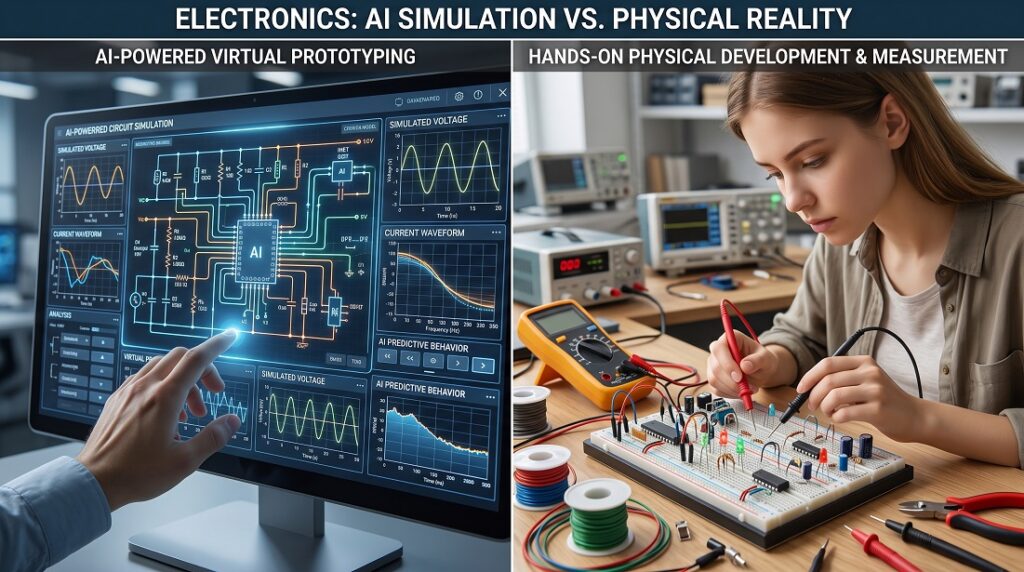
1. A Digital Representation Is Still a Representation
AI has become extraordinarily good at representing reality. It can explain an electronic circuit in words, generate a schematic, produce an illustration of current flow, create an interactive visualization, analyze measurement data, and guide a student through a problem step by step. Simulation adds another layer by creating mathematical models of how a physical system should behave. These representations will continue to improve, and the educational value is enormous; a well-designed interactive explanation can sometimes communicate a concept more clearly than a poorly designed physical laboratory.
But there is still an important distinction between representing a physical system and encountering one. The physical world is continuous. Before information appears on a screen, someone or something has already decided how reality will be represented: a graph contains the variables we chose to plot, a simulation contains the behavior included in its model, and a photograph contains the light captured from a particular perspective. Even an immersive virtual environment ultimately presents a selected and encoded version of reality.
Physical interaction works differently because information arrives through many channels simultaneously. Vision, sound, touch, temperature, resistance, vibration, smell, spatial relationships, and movement can all become part of the experience, and the student does not necessarily know in advance which signal matters. A circuit that appears perfectly reasonable on a schematic may feel unexpectedly hot; a motor may sound slightly different before a problem becomes obvious; a loose connection may produce intermittent behavior; and an overheating component may announce a problem through smell before the faulty node has been identified with an instrument.
The point is not that human senses are more accurate than engineering instruments. Usually they are not. The point is that direct physical interaction places the student inside a much broader and less curated information environment. Real engineering rarely begins with a perfectly formatted dataset telling us which variable is wrong; a system gives us incomplete, noisy, simultaneous evidence, and we have to decide what deserves attention. A physical laboratory therefore teaches something beyond the intended principle of an experiment: over time, it teaches students how to perceive a physical system.
2. The Inefficiency of Hands-On Learning Can Also Be Its Advantage
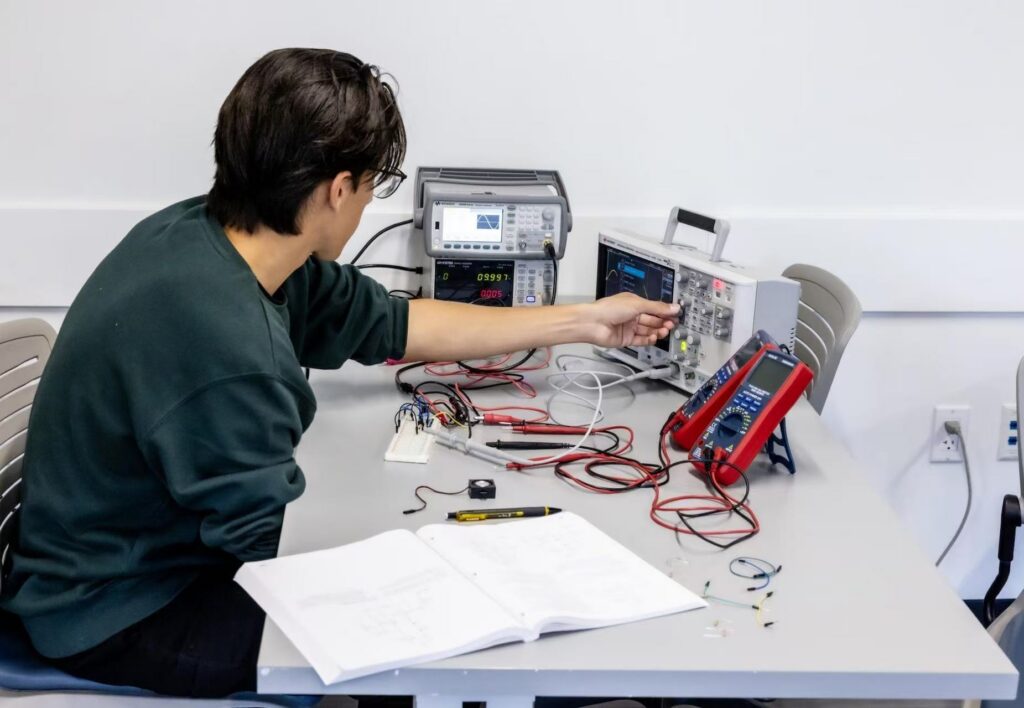
The second difference is less obvious because it initially looks like a weakness. Hands-on engineering takes time. A student may spend an hour wiring something that can be drawn in software in minutes; a wire may need to be cut and replaced, a connection may be wrong, a component may need to be measured before installation, or a PCB may need modification. The circuit may fail, forcing the student to inspect the system and repeat part of the process, which can look remarkably inefficient compared with asking AI and receiving an immediate explanation.
But educational efficiency cannot be measured only by how quickly information reaches the learner. We also have to ask how much of that information becomes usable knowledge later. When students physically construct and troubleshoot a system, they form expectations, make decisions, coordinate physical actions, observe results, discover discrepancies, retrieve previous knowledge, and decide what to change next. The learning process becomes a closed feedback loop rather than a one-directional transfer of information.
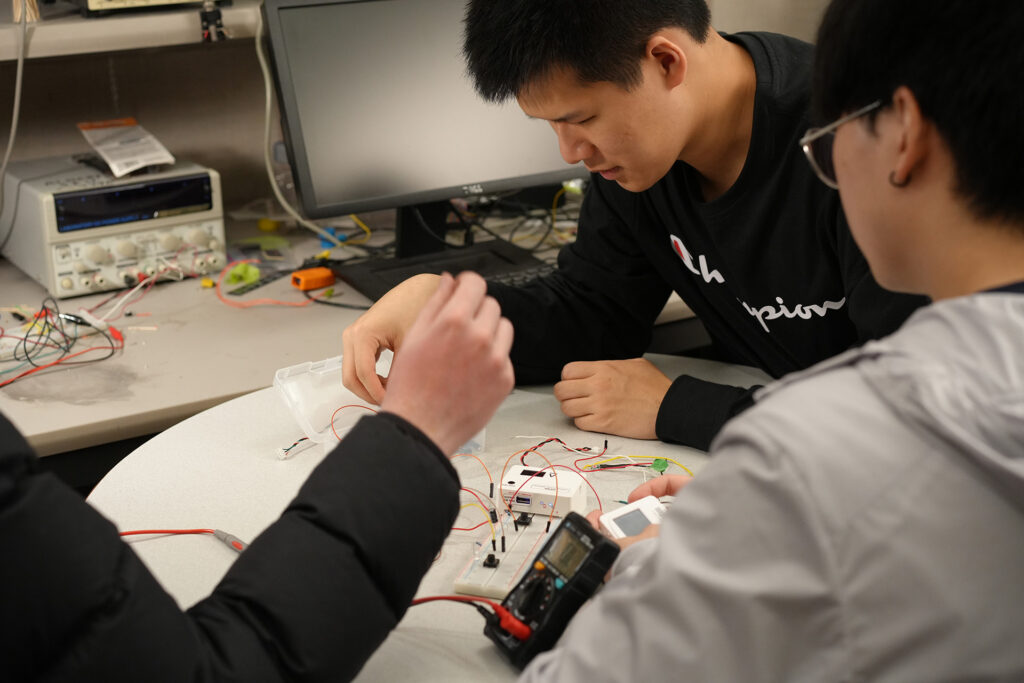
Consider a student who installs a component incorrectly and spends twenty minutes discovering the mistake. That student has certainly taken longer than someone who was immediately shown the correct answer, but those twenty minutes are not necessarily wasted. The mistake has created a prediction, a consequence, an investigation, and eventually a correction; the principle now has an experience attached to it. This is why the “friction” in hands-on learning needs to be separated into useless friction and productive friction.
Confusing instructions, unnecessarily complicated equipment, poor laboratory logistics, or hours spent searching for information that could have been explained in minutes are genuinely inefficient, and AI should help remove them. Building, measuring, comparing, troubleshooting, modifying, and rebuilding are different because they repeatedly force students to retrieve what they know and apply it where the answer is not immediately visible. The better question is therefore not simply how much material a student can cover in one hour, but how much of that learning can be recognized and used six months later when the problem looks different. AI can dramatically improve the first measure; well-designed hands-on engineering can strengthen the second.
The Real Problem May Be the Cost of Access, Not the Value of the Lab
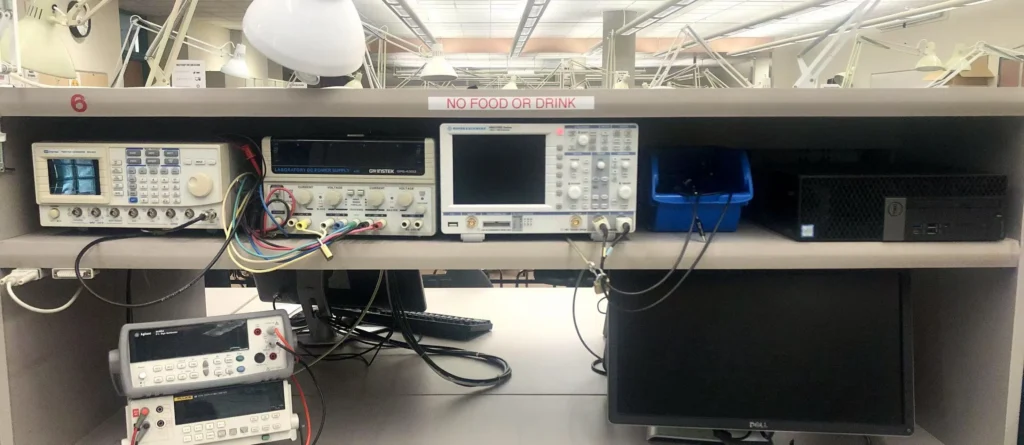
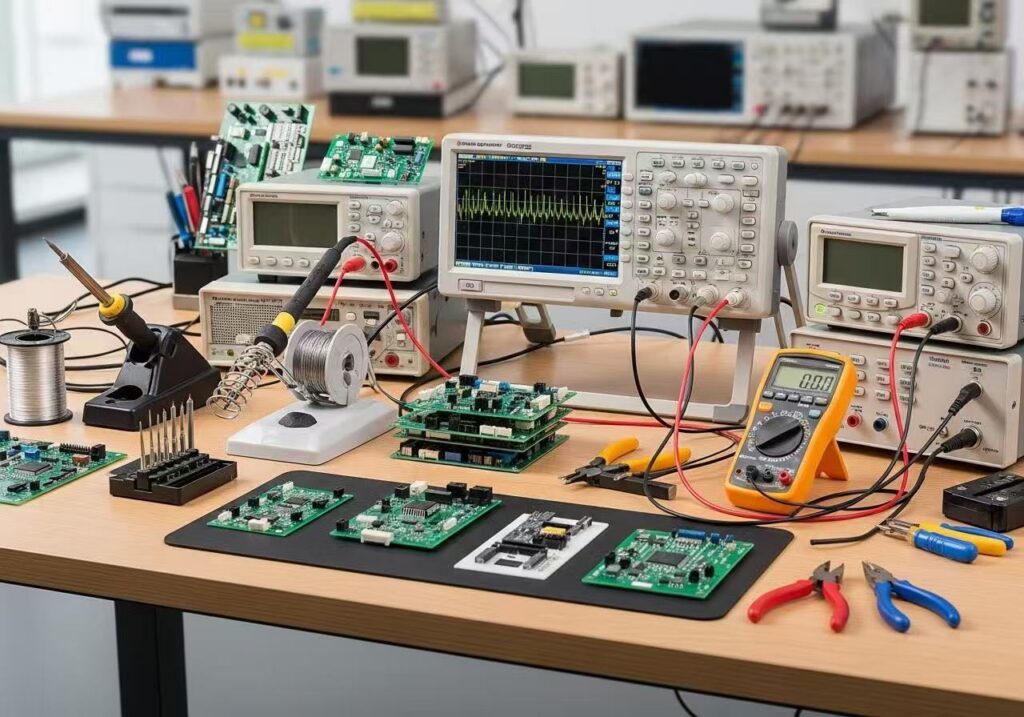
At this point, however, there is an uncomfortable issue that advocates of hands-on learning sometimes avoid: traditional engineering laboratories really are expensive. A student who wants to experiment independently may need a power supply, oscilloscope, multimeter, signal generator, breadboard, components, probes, cables, and enough physical space to use them. For a school, multiplying that equipment across dozens of laboratory stations quickly turns hands-on education into a significant infrastructure investment. This creates an important distinction: the educational value of physical experimentation may be high while the traditional method of delivering that experience may still be unnecessarily expensive.
That is one of the problems we have been trying to address at EIM Technology. Instead of treating the laboratory as a room that students must travel to, our Lab-on-the-Go add-on is designed around a different idea: bring the essential measurement and experimentation environment closer to the student. A compact set of instruments can support breadboard work, circuit measurement, waveform observation, basic signal generation, and repeated experimentation without requiring access to a conventional laboratory bench every time a student wants to test an idea.
The objective is not to claim that a portable laboratory replaces a fully equipped university electronics lab. It does not, and it should not try to. The objective is to reduce the threshold at which meaningful physical experimentation becomes possible. Frequency of access can be as important as sophistication of equipment: a powerful oscilloscope sitting in a laboratory that a student can access for two scheduled hours each week serves a different educational purpose from a simpler instrument that the student can use whenever a question occurs.
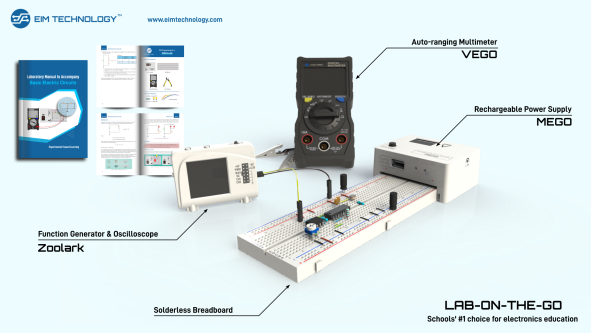
The best laboratory is not always the one with the highest specifications. Sometimes it is the one that actually gets used. This is an important part of the cost discussion because reducing the friction of access changes how often students can complete the prediction-measurement-debugging loop. A portable lab becomes valuable not by imitating every capability of a professional bench, but by making meaningful experimentation available often enough to become a habit.
From Individual Experiments to an Engineering Learning System
Access to instruments alone, however, does not automatically create good engineering education. Students also need something meaningful to build. This is where we have increasingly focused our own approach around a progression rather than a collection of disconnected experiments. The Fundamental EE Starter introduces the basic physical language of electronics through circuits, components, measurement, and structured hands-on work, with the goal of making the first step into electronics manageable without reducing it to a purely virtual experience.
From there, students can move toward increasingly integrated electronics and computing work: analog and digital circuits, microcontrollers, FPGA-based digital systems, signals, measurement, and eventually projects in which multiple subsystems must work together. The important part is not the name of any individual kit; it is the learning architecture behind them. A student first encounters a principle, AI can help explain it, simulation can help visualize it, and the student then builds something physical, measures the result, finds the difference between expectation and reality, and eventually integrates that knowledge into a larger system.
In other words, the objective is not to build an alternative to AI-assisted learning. It is to provide the physical layer that AI-assisted learning is missing. This is also why a portable laboratory becomes more valuable when it is reusable across multiple stages of learning. Instead of buying a completely different experimental environment for every topic, the same measurement platform can continue supporting progressively more sophisticated learning kits and projects, so the cost of the laboratory becomes infrastructure for an entire learning path rather than an expense attached to one experiment.
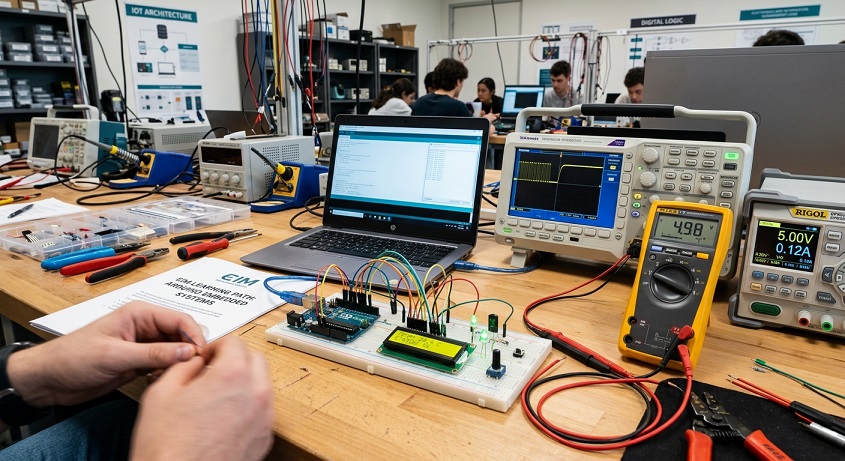
3. Real Consequences Build Engineering Judgment and Responsibility
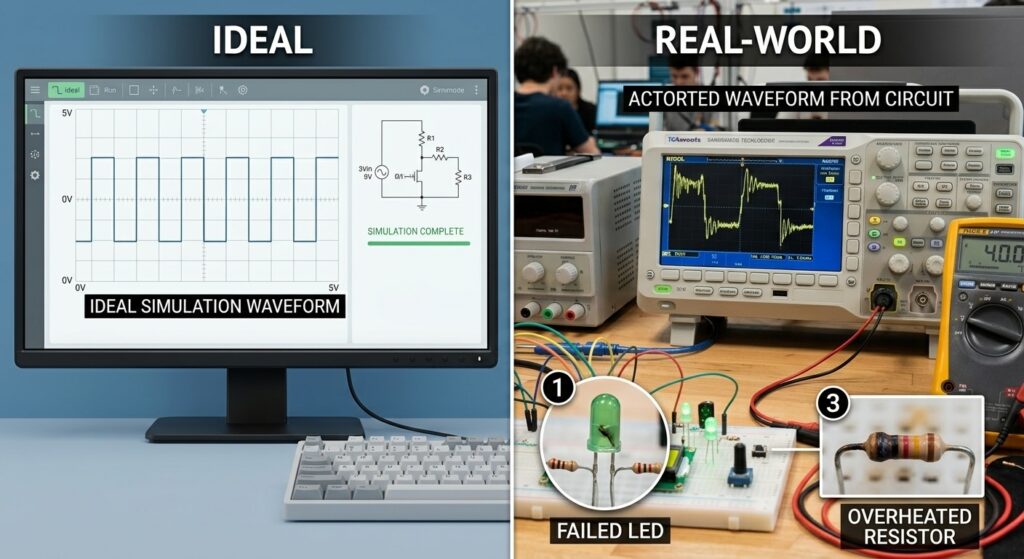
There is a third reason physical experience matters, and I consider this the most important: engineering decisions eventually have consequences. In simulation, failure is fundamentally abstract. A voltage exceeds a limit and the software displays a warning, a component operates outside its expected range, a circuit fails to converge, or a digital design violates a timing constraint. The student can change a parameter, reset the simulation, and continue, and that abstraction is one of simulation’s greatest advantages because it allows failure to be explored safely and cheaply.
But it is also one of simulation’s limitations as a complete substitute for physical engineering experience. In the real world, an overloaded resistor becomes hot, a reversed component may fail, a short circuit can damage hardware, and an incorrectly selected component can produce smoke or an unmistakable burnt smell. These experiences create a different relationship with engineering decisions: a warning message tells a student that a design violates a condition, while a physical failure teaches that the condition exists for a reason.
This distinction becomes increasingly important as students progress toward real engineering work. Engineering systems do not exist simply to produce correct answers on a screen; they may control machines, monitor patients, operate vehicles, regulate power, communicate information, or become part of products used by thousands of people. A small engineering decision can therefore propagate into a much larger system. Good engineering education should not expose students to unnecessary danger, but it can create controlled environments where meaningful physical consequences are experienced safely.
A low-voltage component becoming noticeably warm can teach something. An LED damaged because of incorrect current limiting can teach something. Seeing an unexpected waveform on an oscilloscope and tracing it back to a design mistake can teach something. Over time, these experiences establish a habit that is fundamental to engineering: What will happen if my assumption is wrong? That habit gradually becomes engineering judgment: checking before powering a circuit, questioning an unrealistic measurement, considering tolerances, anticipating failure modes, and taking specifications seriously.
The Cost Question Is Real: We Should Measure the Right Return
None of this makes the economics of engineering laboratories irrelevant. Physical laboratories require investment: equipment must be purchased and maintained, components are consumed, space has to be allocated, instructors need preparation time, and students themselves must spend hours completing work that might take minutes to demonstrate digitally. Those costs should absolutely be questioned, but questioning cost is different from assuming that the cheapest method produces the best educational return.
If the objective is simply to explain Kirchhoff’s laws, an AI explanation may be more efficient than a laboratory. If the objective is simply to show the expected response of a filter, simulation may be faster than building one. If the objective is simply to teach the syntax of an embedded program, there may be no reason to involve physical hardware at all. The justification for the laboratory appears when the learning objective changes from delivering information to developing the ability to connect theory with reality.
If the goal is for students to interpret imperfect measurements, debug systems, notice physical evidence, work through uncertainty, integrate subsystems, and respect the consequences of engineering decisions, then physical experience is no longer an expensive way of delivering the same information. It is delivering a different kind of education. A three-hour laboratory that merely demonstrates a result a student could understand from a five-minute simulation deserves to be questioned; physical laboratory time should increasingly concentrate on measurement, uncertainty, physical interaction, debugging, integration, failure, and iteration.
This is also why lowering the cost and friction of access matters. If compact laboratory tools and reusable learning platforms allow students to perform more of this work outside a traditional lab, then the discussion changes from “physical versus digital” to a more useful question: how do we get the highest educational return from each?
The Future Is Not AI or the Laboratory
AI should therefore change engineering laboratories, not eliminate them. Students can use AI to understand unfamiliar concepts before touching hardware, interpret documentation, generate starting code, review calculations, explore possible causes of failure, and compare alternative designs. Interactive explanations and simulations can make the underlying theory dramatically easier to understand before physical experimentation begins. Simulation can then let students test an idea quickly, visualize expected behavior, explore parameters, and identify obvious mistakes before risking hardware.
Then the physical laboratory can concentrate on what it does best. A modern engineering learning workflow can move from understanding and visualization into simulation, and then into building, measurement, debugging, and improvement. The early stages can increasingly be accelerated by AI and software, while the later stages reconnect the model to reality. Each tool is being used for what it does best rather than being forced to replace the others.
Understand → Visualize → Simulate → Build → Measure → Debug → Improve
This is the philosophy behind combining systems such as Lab-on-the-Go with structured learning platforms such as Fundamental EE Starter and the more advanced electronics and computing learning stages that follow it. The equipment is not intended to compete with AI, and the learning materials should not force students to rediscover information that AI can explain more efficiently. Instead, the system should make it easier to move from explanation to experiment and from experiment to engineering. The better AI becomes, the more important that transition may become.
What Are We Really Paying for?
When someone asks whether physical engineering laboratories are still worth their cost in the age of AI, I do not think the strongest answer is simply that students need more hands-on experience. We should be much more precise. We are paying for students to encounter information that has not already been filtered into a clean digital representation, for learning experiences in which thinking, observation, physical action, failure, and correction reinforce one another, and for students to develop the habit of measuring reality rather than simply trusting what a model predicts.
Perhaps most importantly, we are paying for future engineers to experience, within a safe educational environment, that engineering decisions have physical consequences. The challenge for modern engineering education is therefore not to preserve every traditional laboratory exactly as it was. It is to make these uniquely valuable experiences more accessible, more frequent, and more closely integrated with the extraordinary digital tools students now have available.
That means using AI where AI is strongest, using simulation where simulation is strongest, and redesigning physical engineering education so that expensive laboratory time is not wasted reproducing information that a screen can communicate better. This is also the larger idea behind what we are building at EIM Technology: not another collection of electronics kits, but a more accessible path from understanding a concept to building it, measuring it, debugging it, and eventually integrating it into a real engineering system.
AI can make the first step dramatically faster, and a well-designed hands-on learning system can make the next steps dramatically more accessible. But at some point, every engineer still has to meet reality. That is the part of engineering education worth being very careful not to optimize away.

EIM TECHNOLOGY
Founder & Engineering Education Innovator
Daniel Cao is the Founder of EIM Technology and holds a Master of Applied Science in Engineering. With experience in engineering research, product development, PCB design, and technical education, he is the author of several books on electronics engineering. His work focuses on developing practical learning systems that integrate engineering hardware, lab instruments, curriculum, and project-based learning. Through EIM Technology, Daniel aims to make electronics and computer engineering more accessible and engaging, helping students build real experience in designing, measuring, testing, and troubleshooting electronic systems.