Electronics engineering in 2026 should be learned through a connected system map, not as a list of isolated circuits, because integrated circuits and now AI have compressed the field’s knowledge without reducing what engineers need to understand. Students still need diodes, transistors, op-amps, and digital logic, but they also need to see where each element sits inside a complete signal, computing, and control system.
The signal chain that has not changed: Physical input → Analog conditioning → ADC → Digital processing → System output.
Open an electronics textbook from thirty years ago and compare it with one used in a university today. You will still find diodes, transistors, MOSFETs, operational amplifiers, logic gates, filters, feedback, and circuit analysis.
At first glance, this can make the discipline look strangely unchanged. Yet the products built from these principles have moved from boards filled with discrete components to highly integrated systems combining analog interfaces, processors, memory, programmable logic, embedded software, communications, and AI.
The apparent contradiction disappears once enduring principles are separated from the changing structure of engineering work. Electronics has not become smaller or less relevant. Its knowledge has become denser. Functions that once required many visible components now exist inside chips, while system complexity has expanded across hardware and software.
In 2026, the strongest learner is therefore not the person who has memorized the largest catalog of individual circuits. It is the person who understands how semiconductors, analog circuits, signal conditioning, digital logic, microcontrollers, FPGAs, software, instruments, and complete systems connect, and who can move quickly from that map into the exact detail a problem requires.
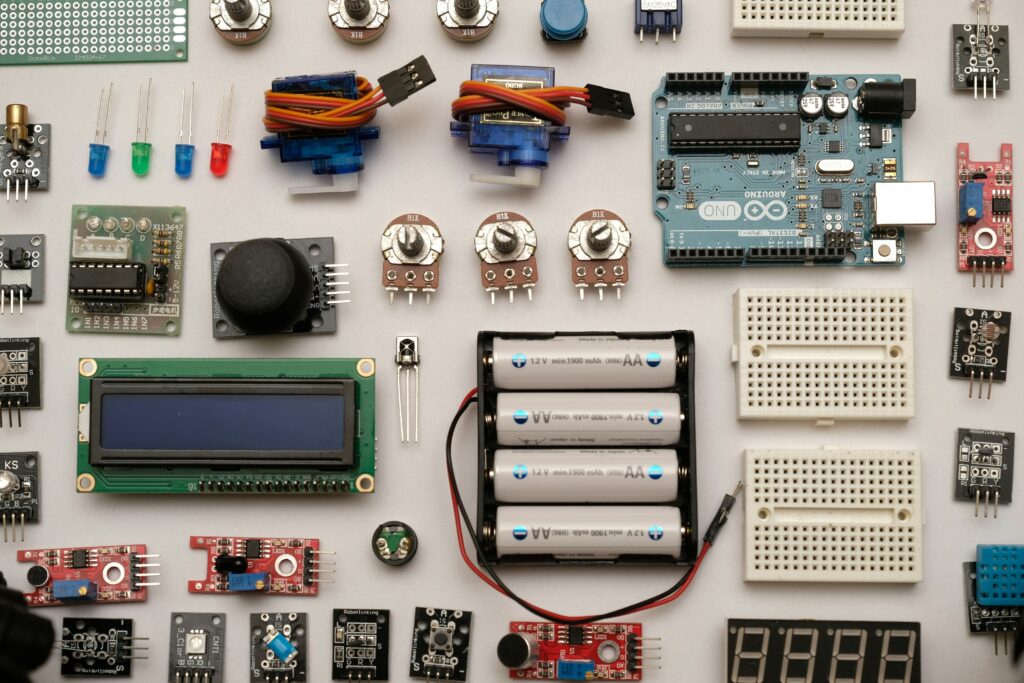
What Was the First Great Compression of Electronics Knowledge?
Long before AI began changing engineering work, electronics had already experienced a much larger structural transformation: the integrated circuit.
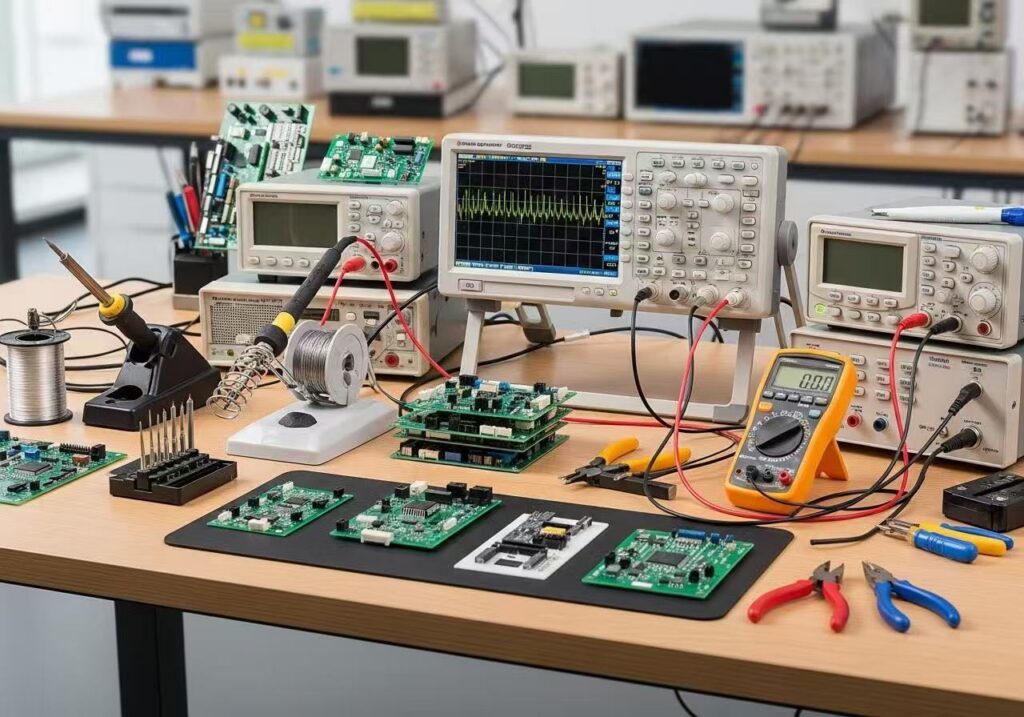
Before integrated circuits became widely available, engineers often had to create functions from individual transistors, resistors, capacitors, diodes, and other discrete components. A circuit that now fits inside a small chip might once have required a large board, many separate parts, and extensive design and testing.
A function that previously demanded weeks of detailed topology development could eventually be implemented with a commercially available IC and a small number of supporting components. In some applications, a chip could replace most of the circuitry an earlier generation would have designed from discrete devices.
But the engineering work did not vanish. It moved to another level. Engineers now had to select the device, interpret specifications, configure it, power it, connect it to sensors and processors, protect its inputs, manage noise, verify stability, and confirm that the complete product worked under real conditions. As chips became more capable, firmware and embedded software also became inseparable from the system.
The amount of technology did not decrease. It became more compressed.
How Does Compression Change the Allocation of Learning Time?
The rise of integrated circuits does not make diodes, transistors, MOSFETs, or operational amplifiers irrelevant. These devices remain essential in power supplies, protection circuits, sensor interfaces, signal-conditioning stages, motor drivers, audio systems, communication circuits, and analog front ends. They also reveal the physical behavior that remains hidden inside more complex devices.
A learner who understands a MOSFET can reason more effectively about switching loss, gate drive, motor control, and power conversion. A learner who understands op-amps can analyze feedback, filters, instrumentation, and sensor interfaces. A learner who understands diode behavior can make sense of rectification, clamping, protection, and nonlinear signals.
What has changed is the proportion of total learning time that can be devoted to each isolated topic before the learner sees the complete system. Modern engineers must also understand data conversion, embedded programming, digital systems, programmable logic, communications, memory, power management, testing, and hardware-software integration.
The field has expanded faster than the available learning time. The educational problem is no longer how to include every detail. It is how to organize the details around a coherent engineering structure.
Can a Smaller Circuit Still Contain the Hardest Problem?
A modern embedded product may be dominated by a microcontroller, FPGA, or system-on-chip. The analog circuitry might represent only a small fraction of the schematic. Yet that fraction can consume most of the debugging time.
A sensor signal may be weak, noisy, distorted, or improperly biased. An ADC may produce unstable readings because of source impedance, grounding, reference noise, or sampling behavior. A power rail may collapse during a transient load. A communication interface may fail because of timing or signal integrity. A board may work on a desk but fail when connected to a motor, battery, long cable, or external supply.
Integration reduces the number of visible components, but it often concentrates difficult engineering judgment into a smaller portion of the system. The analog front end can be a small fraction of the design while still causing a disproportionate share of the uncertainty.
This is why component count is a poor measure of technical importance. High-value engineering is not defined by drawing the greatest number of transistors manually. It is defined by identifying where the physical system is departing from the model and knowing how to prove the cause.
Do Electronics and Computer Engineering Now Form One Stack?
It is increasingly difficult to separate electronics engineering, computer engineering, and embedded software into independent worlds. A medical device, robot, electric-vehicle subsystem, smart instrument, or AI-enabled product may contain sensors, analog conditioning, an ADC, a microcontroller, programmable logic, firmware, digital signal processing, communications, power conversion, memory, and a user interface.
Different specialists may own different parts of the design, but the product itself does not respect academic department boundaries. An analog engineer benefits from understanding how the digital system will use the signal. An embedded developer needs to understand the schematic, power system, timing, and physical interfaces. An FPGA engineer must consider clocks, data movement, memory, and signal integrity.
AI illustrates this stack particularly well. The user sees a model and an interface. Beneath that visible layer are processors, GPUs, accelerators, memory, high-speed networks, power delivery, thermal management, servers, and semiconductor manufacturing. Software does not float independently in the cloud. It runs on physical computing systems.
The Modern Electronics Stack, Layer by Layer
| System layer | Core question | Typical knowledge |
|---|---|---|
| Physical input | What is being sensed or controlled? | Devices, sensors, protection, power |
| Analog path | Is the signal usable and trustworthy? | Biasing, gain, filters, noise, ADC interfaces |
| Digital hardware | How is data moved and transformed? | Logic, timing, FPGA, memory, buses |
| Embedded control | How does the product behave over time? | MCUs, firmware, protocols, real-time constraints |
| System verification | Does it work outside the ideal model? | Measurement, debugging, test, documentation |
The system is connected, so the learning path must be connected as well.
How Is AI the Second Great Compression?
AI is beginning to affect engineering in much the same way that integrated circuits affected circuit implementation: it can compress work. It can explain a circuit, generate starter firmware, suggest component values, compare devices, interpret a datasheet, review code, and propose several approaches to a design problem. Research that once required hours can sometimes be reduced to minutes.
That is a genuine shift. It does not justify removing fundamentals. It increases the value of understanding enough of the system to ask precise questions, expose assumptions, reject weak answers, and verify results.
An AI-generated circuit may look plausible while using the wrong voltage range, ignoring source impedance, exceeding a rating, or creating instability. Generated code may run under ideal conditions but fail because of timing, memory, interrupts, or hardware configuration. AI can assist with local detail; it cannot make physical verification optional.
This creates a powerful new learning model. Students can build the system map earlier, use AI as an almost continuously available technical tutor, and then deepen their understanding at the exact point where a real project exposes a gap. The better the map, the more useful the AI assistance becomes. Without the map, AI produces fragments. With it, AI accelerates engineering judgment.

Why Do Disconnected Courses Slow Students Down?
Many students encounter electronics as a sequence of isolated subjects: circuit analysis, analog electronics, digital logic, programming, signals, and microcontrollers. Each course may be correct, yet the student is often left to discover the relationships alone.
A student may solve an op-amp equation without understanding where the amplifier belongs in a signal chain. Another may write microcontroller code without understanding how the input reaches the ADC. A third may build an FPGA module without understanding how its data connects to a sensor, memory device, or analog output.
Electronics then feels more difficult than it needs to be because the pieces arrive before the architecture. The solution is not to remove the pieces. It is to organize them.
What Is a More Effective Learning Sequence for 2026?
A modern learning path should reveal the complete information chain early. A physical signal is detected. It is protected, amplified, filtered, or conditioned. An ADC converts it into data. A microcontroller or FPGA processes that data. Firmware and digital logic make decisions. The system produces an output, communicates, or controls the physical world. Power, timing, memory, interfaces, noise, and measurement affect every stage.
Once this chain is visible, individual subjects stop feeling arbitrary. Op-amps, filters, ADCs, state machines, communication protocols, and embedded code become tools inside a system the student can already visualize.
The strongest approach is neither learning every detail first nor skipping theory to assemble modules. It is a repeated cycle of system understanding, focused theory, construction, measurement, failure, diagnosis, and improvement.
When a filter behaves incorrectly, the learner has a reason to study impedance, bandwidth, loading, and tolerance. When an ADC reading is unstable, source resistance, reference noise, sampling, and grounding become meaningful. When an FPGA interface fails, timing and state-machine design become concrete. The project creates the question; theory and AI help answer it; measurement closes the loop.
What Is the Learning Architecture Behind EIM?
This philosophy is the foundation of EIM Technology’s electronics engineering learning path. The objective is not to train students around one development board, one manufacturer, or one temporary software ecosystem. Those associations can lose value when a product changes.
Instead, the pathway is built around relationships that remain useful across product generations: voltage and current, semiconductor behavior, analog signal conditioning, digital logic, data conversion, embedded control, programmable hardware, measurement, debugging, and system integration.
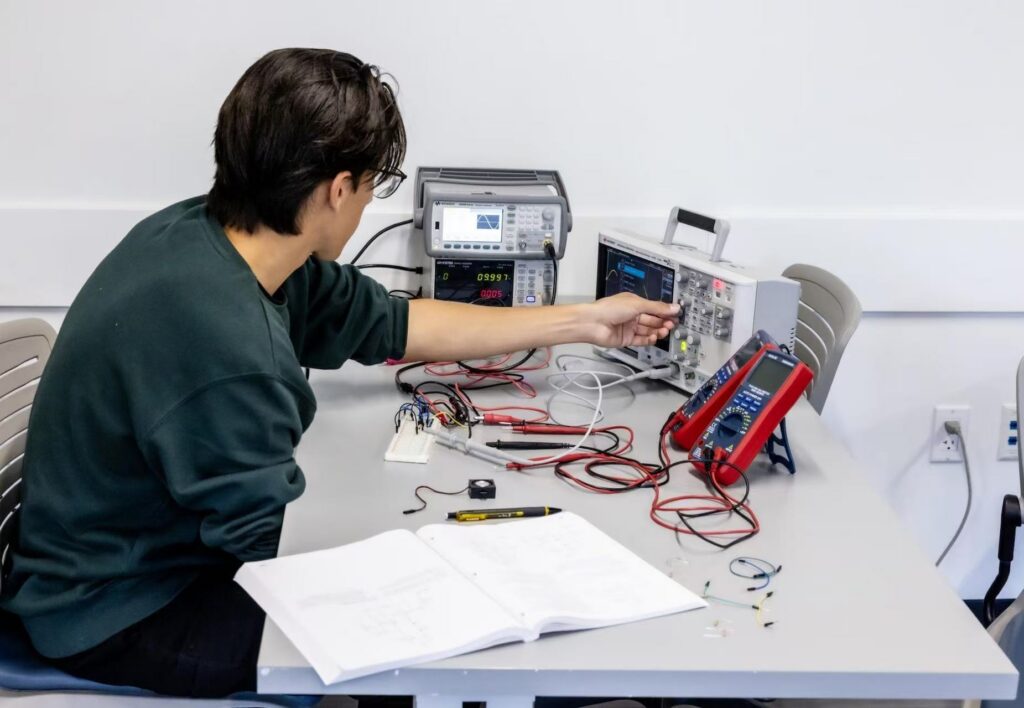
Fundamental EE Starter FE11 establishes essential circuit intuition through structured experiments and project-based learning. Students build and measure real circuits instead of accepting that a diagram should work.
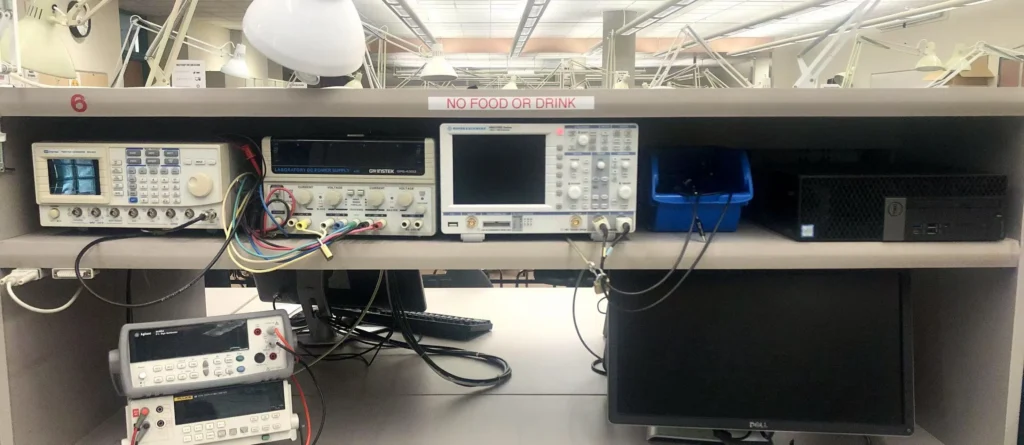
Lab-on-the-Go provides the compact measurement environment required to generate signals, observe waveforms, test behavior, and debug projects without depending entirely on a traditional laboratory.
The broader FE22 pathway connects semiconductors and analog electronics with signal conditioning, microcontrollers, digital logic, FPGAs, embedded software, and integrated projects. The products are not a collection of unrelated kits. They form a staged learning system in which each layer supports the next.
This structure compresses the time required to build an overall understanding without pretending that difficult subjects are simple. Students see the engineering landscape earlier, then return to individual areas with clearer purpose, stronger questions, and the ability to use AI more intelligently.
Depth is not being removed. When and why depth is introduced is what changes.
What Should a Modern Learner Become?
A student entering electronics or computer engineering in 2026 does not need to become an expert in every branch of the field. The better goal is complete system-level orientation, practical confidence across the major layers, and genuine depth in one or two areas.
The learner may eventually specialize in analog design, embedded systems, FPGA development, semiconductors, computer architecture, power electronics, RF, robotics, or signal processing. That specialization becomes more powerful when it rests on an understanding of the larger system.
This produces a capability many technically trained graduates lack: the ability to move between abstraction levels. They can define what the system must accomplish, locate the responsible subsystem, examine the circuit or code, use instruments to test it, use AI to accelerate the investigation, and decide whether the answer actually works.

What Mistakes Do Students Make When Learning Modern Electronics?
- Treating diodes, transistors, and op-amps as outdated. More functions now live inside integrated chips, but the physical behavior these devices reveal still governs how those chips are used.
- Assuming AI-generated circuits or code are correct without verification. A plausible-looking design can still use the wrong voltage range, ignore source impedance, or create instability, and only physical testing catches that.
- Learning analog, digital, embedded, and FPGA topics in isolation. Without a system-level map, each subject feels arbitrary instead of connected.
- Judging a design’s difficulty by component count. The analog front end can be a small fraction of a schematic and still cause most of the debugging time.
- Using AI as a shortcut past fundamentals. AI assistance becomes more useful once a system-level map already exists, not as a substitute for building one.
What Questions Do Students Ask About Learning Electronics in 2026?
Has AI made electronics fundamentals less important?
No. AI can generate a plausible circuit or piece of firmware, but it cannot make physical verification optional. Understanding fundamentals is what lets a student catch an AI-generated design that uses the wrong voltage range, ignores source impedance, or creates instability.
Why do modern electronics products need fewer visible components but more engineering knowledge?
Because integration moved circuit complexity inside chips rather than removing it. Engineers still need to select devices, interpret specifications, manage power and noise, and confirm the system works under real conditions
Which is harder, the digital system or the analog front end?
It depends on the design, but the analog front end often causes a disproportionate share of the debugging time even when it is a small fraction of the schematic, because analog behavior is more sensitive to real-world conditions.
Do electronics engineers and computer engineers still work in separate fields?
Less than before. A modern product, from a medical device to an AI-enabled system, typically needs sensors, analog conditioning, digital hardware, embedded software, and system verification working together.
How should a student use AI while learning electronics?
As a tool for explanation, starter code, and comparing approaches, used alongside real measurement and testing rather than in place of it. AI assistance becomes more useful once a student already has a system-level map to apply it to.
Do students need to master every layer of the system?
No. The goal is system-level orientation and practical confidence across the major layers, with genuine depth in one or two specialized areas.
So, How Should Electronics Engineering Be Learned in 2026?
Electronics engineering should not be learned as though the field stopped at discrete transistors, isolated analog circuits, or one generation of development boards. Integrated circuits compressed enormous amounts of circuit knowledge into chips. Embedded software expanded what electronic systems could do. Microcontrollers and FPGAs connected hardware with programmable behavior. AI is now compressing access to information and implementation assistance even further.
At every stage, the field has become denser, not smaller.
Students still need diodes, transistors, MOSFETs, op-amps, digital logic, and circuit fundamentals. But they also need to know where those elements belong within a larger signal, computing, and control system. The most effective path is to build the map first, connect the engineering layers, practice with real instruments and projects, and then go deeper wherever the system demands it.
That is the learning model behind FE11, Lab-on-the-Go, and the broader EIM electronics engineering pathway. It is designed for learners who do not want disconnected knowledge. They want the ability to understand, build, measure, and debug complete electronic systems.
Build the system-level foundation that modern electronics and computer engineering require.

EIM TECHNOLOGY
Founder & Engineering Education Innovator
Daniel Cao is the Founder of EIM Technology and holds a Master of Applied Science in Engineering. With experience in engineering research, product development, PCB design, and technical education, he is the author of several books on electronics engineering. His work focuses on developing practical learning systems that integrate engineering hardware, lab instruments, curriculum, and project-based learning. Through EIM Technology, Daniel aims to make electronics and computer engineering more accessible and engaging, helping students build real experience in designing, measuring, testing, and troubleshooting electronic systems.