In this blog, we going to look into a brief comparison between FPGA Board and Arduino. At first glance, the major difference is FPGA is a Programmable logic gate and not a microcontroller like Arduino. Now lets us look other differentiation between the two.
Field Programmable Gate Array (FPGA) Board Facts
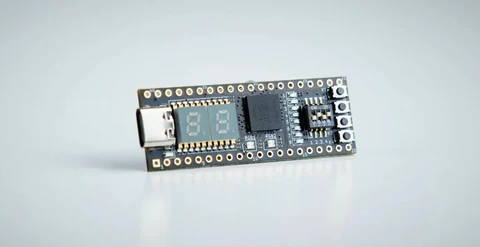
- Hardware Reconfigurable – Unlike traditional microcontrollers, FPGAs can be reprogrammed at the hardware level, allowing custom logic circuit designs.
- Parallel Processing – FPGAs can execute multiple tasks simultaneously, making them ideal for high-speed computing and real-time processing.
- Used in AI & Cryptography – FPGAs are widely used in machine learning, cryptography, and high-performance computing due to their ability to handle massive parallel workloads.
- No Predefined Architecture – Unlike microcontrollers, an FPGA starts as a blank slate, and the user defines its logic using HDL (Hardware Description Language) like Verilog or VHDL.
- Higher Power Consumption – Compared to microcontrollers, FPGAs consume more power but offer greater flexibility and speed.
Arduino Facts
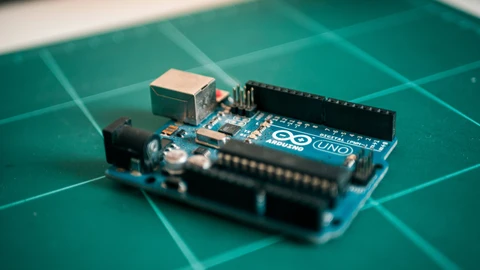
- Beginner-Friendly – Arduino is an easy-to-use microcontroller platform with a simple programming environment, making it ideal for hobbyists and beginners.
- Open-Source – Both Arduino hardware and software are open-source, allowing developers to create custom boards and modify the firmware.
- Huge Community Support – Arduino has a massive global community, providing libraries, tutorials, and resources for all levels of users.
- Used in IoT & Robotics – Arduino is commonly used in Internet of Things (IoT) projects, robotics, and home automation due to its simplicity and connectivity options.
- Limited Processing Power – Unlike FPGAs, Arduino boards run code sequentially and have limited processing speed, making them unsuitable for high-speed applications.
When to Use FPGA board vs. Arduino
| Feature | FPGA (Field Programmable Gate Array) | Arduino (Microcontroller Platform) |
|---|---|---|
| Best for | High-speed processing, parallel computing, real-time signal processing, AI, cryptography | Hobby projects, IoT, automation, robotics, simple embedded systems |
| Programming | Uses Hardware Description Language (HDL) like Verilog or VHDL | Uses C/C++-based Arduino IDE |
| Execution | Executes multiple operations in parallel | Executes instructions sequentially |
| Performance | High-performance, can implement custom hardware logic | Lower performance, follows a fixed instruction set |
| Flexibility | Can be reconfigured for custom digital logic designs | Uses pre-defined microcontroller architecture |
| Power Consumption | Typically higher due to hardware flexibility | Lower, optimized for embedded applications |
| Ease of Use | Complex, requires knowledge of digital design & HDL | Beginner-friendly, easy to program |
| Applications | AI acceleration, cryptography, image/video processing, high-speed data processing, real-time control | IoT, home automation, robotics, sensor interfacing, basic electronics projects |
When to Use an FPGA board
- When high-speed parallel processing is needed (e.g., AI, cryptography, video processing).
- When hardware customization is required for efficiency and performance.
- In applications where latency must be minimal, such as real-time signal processing.
- When working with custom communication protocols or specialized hardware interfaces.
Start learning FPGA Programming with EIM Technology’s Beginner Friendly FPGA Board
When to Use an Arduino
- For quick prototyping and hobbyist projects.
- When ease of programming and community support is a priority.
- For IoT, robotics, and automation, where low power and simplicity are preferred.
- When working with sensors and actuators for DIY electronics projects.
We can conclude, use FPGA board for high-performance computing and custom hardware logic, while Arduino is best for simple, low-power, and easy-to-use applications.

EIM TECHNOLOGY
Founder & Engineering Education Innovator
Daniel Cao is the Founder of EIM Technology and holds a Master of Applied Science in Engineering. With experience in engineering research, product development, PCB design, and technical education, he is the author of several books on electronics engineering. His work focuses on developing practical learning systems that integrate engineering hardware, lab instruments, curriculum, and project-based learning. Through EIM Technology, Daniel aims to make electronics and computer engineering more accessible and engaging, helping students build real experience in designing, measuring, testing, and troubleshooting electronic systems.