Why one summer electronics project can change the value of an entire engineering degree

Completing one real electronics project before starting an engineering degree gives incoming students a working mental map of how circuits, signals, code, and measurement connect, so first-year theory has somewhere to land. The goal is not to master the syllabus early. One well-chosen, complete project, built and debugged over a summer, is enough to change how the next four years get used.
After receiving an offer to study electronics engineering, computer engineering, or ECE, most students simply wait for university to begin.
That is understandable. The university has already designed the curriculum. Circuits, programming, digital systems, electronics, signals, and engineering mathematics will all be taught in the proper sequence.
There is a better way to use the summer after Grade 12: complete one real electronics project before the first semester begins. The purpose is not to get ahead in the syllabus or master first-year engineering in a few months. It is to experience the complete engineering process once, to build something, write some code, use instruments, encounter a problem, and make the system work.
That small experience can change how a student understands everything that follows.
Why Do Most Students Enter Engineering Without a Map?
Students entering engineering are usually strong in mathematics and science. What most of them lack is not academic ability, but a clear picture of how engineering knowledge fits together.
University then introduces the field one course at a time. Students learn circuit analysis, analog electronics, programming, digital logic, signals, microcontrollers, and other subjects as separate academic units. They can follow the calculations and pass examinations without understanding what these subjects ultimately allow an engineer to build.
Why do engineers need operational amplifiers? Why does a signal need to be filtered? Why must physical voltage be converted into digital data? Why do engineers sometimes use software and sometimes design digital hardware? What can an oscilloscope reveal that a calculation cannot?
Without practical experience, students receive answers before they have developed the questions. They learn because the material appears in the curriculum, not because they can see the problem it solves. Even capable students can experience engineering education as a sequence of requirements rather than one connected technical system.
How Does a Pre-University Project Build a Reference Point?
A pre-university project reverses this sequence.
The student first builds a small but complete system. A physical input enters a circuit, the signal is conditioned or measured, a programmable device processes the information, and the system produces a visible or useful output.
The student does not need to understand every internal detail. The objective is to develop a first mental model of the engineering chain. Once that model exists, university theory has somewhere to land.
An operational amplifier is no longer an abstract triangle surrounded by equations, because the student has already seen a weak signal that needed amplification and a waveform that became distorted. A filter is no longer just a transfer function, because the student has already observed a signal change as frequencies are removed.
A microcontroller is no longer simply a chip that runs code. It connects software to a physical system. An oscilloscope is no longer an expensive screen in the laboratory. It reveals what a circuit is actually doing.
Later, more advanced ideas, such as amplifier bandwidth, signal sampling, embedded programming, orprogrammable digital hardware, become easier to position. The student may not yet know the answers, but now understands why the questions matter.
This is the real benefit of project-first learning: it does not replace theory, it makes theory meaningful.
Why Is One Well-Chosen Project Enough?
Students do not need to spend the summer racing through textbooks, collecting certificates, or following dozens of unrelated tutorials. That approach often creates more fragments rather than more understanding.
A better project should be manageable, but it must expose several important parts of a real electronic system: physical components,basic circuits, software, measurement, and debugging. Most importantly, the student should be able to follow the system from input to output.
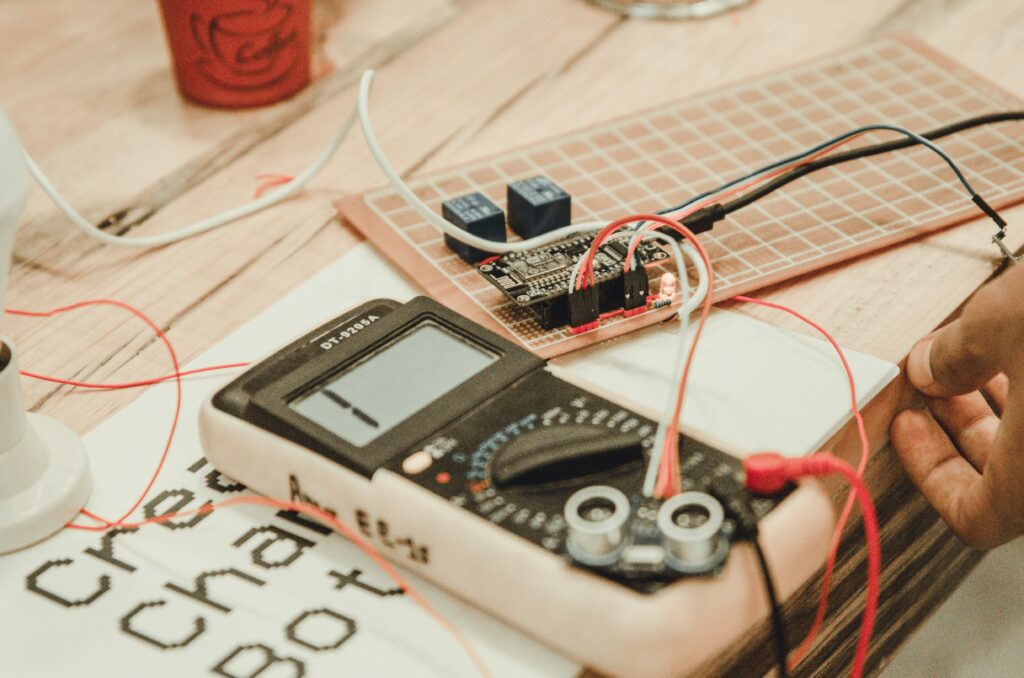
Audio is a particularly effective project theme. A microphone converts sound into an electrical signal. The signal must be conditioned before it can be sampled. A microcontroller turns the signal into data, software processes it, and a display or another output makes the result visible.
Within one understandable project, the student encounters circuits, signals, components, programming, measurement, and hardware-software integration.
The goal is not to teach a complete course in analog electronics or signal processing. It is to show that these are not isolated subjects. They are different parts of the same system, and that structural understanding is more valuable than completing many disconnected experiments.
How Does Early Project Experience Change the University Experience?
Across EIM Technology’s engineering education work, the same pattern shows up repeatedly: students with early project experience do not necessarily begin with more theoretical knowledge. They begin with a better structure for organizing it.
When they enter an analog electronics course, they can connect ideal models with behavior they have measured. When they study programming, they understand that code must interact with timing, memory, signals, and physical hardware. When they encounter advanced digital systems, they know that different architectures exist because different problems require different solutions.
The mathematics also gains purpose. Frequency response, sampling, differential equations, and signal analysis are no longer techniques that may become useful someday. They describe systems the student has already seen.
This changes how students use the university itself. They ask better questions, understand laboratory equipment more quickly, and are better prepared to join engineering teams, approach professors about research, select electives, and apply for early co-op opportunities.
The project may be small. Its leverage comes from changing how the student uses four years of courses, laboratories, faculty, libraries, and technical opportunities.
Why Does a Structured Starting Point Matter More Than Random Projects?
Not every hands-on project produces this result. A student can connect ready-made modules, copy finished code, and build something impressive without understanding the engineering underneath it.
Random projects create exposure, but not necessarily progression. A strong starting experience needs structure: it should introduce essential concepts in a deliberate order, connect them to a complete system, and give the student access to real measurement and debugging.
This is the purpose behind Fundamental EE Starter (FE11). FE11 provides a project-based introduction to circuit fundamentals, components, power, signals, basic analog electronics, an RP2040 microcontroller, MicroPython, and an integrated audio project. Students move from foundational experiments toward a system in which sound becomes an electrical signal, is measured and processed, and produces a visible result.
The objective is not to cover every branch of electronics engineering. It is to establish the first connected map.
Lab-on-the-Go can add the personal measurement environment needed to observe signals and debug circuits outside a scheduled university laboratory. Students can generate signals, examine waveforms, compare predictions with measurements, and investigate unexpected results.
Together, the curriculum, components, project hardware, programming environment, and instruments form a coherent starting point. The learner spends less time determining which boards, tools, and tutorials belong together, and more time actually learning engineering.
Random Projects vs. a Structured Pre-University Path: What Is the Difference?
| Question a student should ask | Random project or tutorial | Structured path (FE11) |
|---|---|---|
| Introduces concepts in a deliberate order? | No, depends on whichever tutorial is followed | Yes, a guided sequence from fundamentals to a complete system |
| Covers circuits, signals, software, and measurement together? | Sometimes, often incomplete | Yes, by design |
| Builds toward one complete, understandable system? | Not guaranteed | Yes, an integrated audio project |
| Includes real measurement and debugging practice? | Rarely, unless the student already owns instruments | Yes, extendable with Lab-on-the-Go |
Is a Summer Project Worth the Investment?
An engineering degree represents a major investment in tuition, time, and opportunity. Compared with that commitment, a structured summer electronics system is relatively small. Depending on the university and tuition category, the cost may be comparable to only a small number of academic credits.
But its value should not be measured only against the price of one course. The more important question is whether one summer project can make dozens of later courses more meaningful.
If the student understands how a signal moves through a system, circuit and signal courses become easier to organize. If code has already been connected to hardware, embedded programming becomes more purposeful. If a real waveform has already been measured, laboratory time becomes more productive.
If the student already knows how it feels when a system fails, they begin learning how to debug rather than waiting for someone else to identify the problem.
That is a high-leverage investment, not because it replaces university, but because it helps the student extract more value from university.
What Mistakes Should Students Avoid With a Pre-University Project?
- Racing through textbooks or collecting many disconnected tutorials. This creates fragments of exposure, not the structural understanding one complete project builds.
- Copying ready-made modules and finished code. Without tracing the underlying signal path, the build can look impressive while hiding most of the engineering.
- Skipping measurement and debugging. A working demo alone is not proof of understanding; the predict, build, measure, diagnose loop is where the learning happens.
- Expecting the project to replace first-year coursework. The goal is to prepare the student to get more out of university, not to get ahead in the syllabus.
- Starting too close to the semester. A project abandoned once classes begin delivers little of the intended benefit.

What Questions Do Students Ask About Pre-University Projects?
Should I build an electronics project before starting my engineering degree?
Yes, if it is one complete, well-chosen project rather than several rushed or disconnected ones. It builds a working mental model that makes first-year theory easier to place.
What kind of project should I build before university?
A project that carries a signal from a physical input to a visible output, ideally involving circuits, measurement, and code together. An audio-based project is a common, effective choice.
Will a pre-university project help me skip first-year courses?
No. The goal is not to get ahead in the syllabus. It is to make first-year theory land faster because the student has already seen the underlying system work.
How much time does a good pre-university project take?
A structured project can realistically be completed over one summer, working through a guided sequence rather than assembling an ad hoc build from scratch.
Do I need expensive equipment to start?
No. A guided starter kit with the core components, plus optional measurement instruments such as Lab-on-the-Go, is enough to expose the essential parts of a real electronic system.
What if I do not finish the project before classes start?
Partial progress still helps. Even an incomplete build that has been measured and debugged gives a student more of a working mental model than no hands-on experience at all.
Should You Build Something Before You Study?
Most students begin engineering by receiving answers to questions they have never had the opportunity to ask. One real project changes that.
Build a circuit. Write some code. Measure a signal. Make a mistake. Find the cause. See how hardware, software, signals, and instruments belong to the same problem. Then enter university with questions.
The student will still need to learn the mathematics, theory, models, and detailed engineering principles. The project does not make those subjects unnecessary or easy. It makes them relevant.
University provides the depth. A well-designed project provides the map. Build the map first, and the next four years begin to look very different.
Explore Fundamental EE Starter FE11 and Lab-on-the-Go, and begin your engineering degree with a real electronic system already in your hands.

EIM TECHNOLOGY
Founder & Engineering Education Innovator
Daniel Cao is the Founder of EIM Technology and holds a Master of Applied Science in Engineering. With experience in engineering research, product development, PCB design, and technical education, he is the author of several books on electronics engineering. His work focuses on developing practical learning systems that integrate engineering hardware, lab instruments, curriculum, and project-based learning. Through EIM Technology, Daniel aims to make electronics and computer engineering more accessible and engaging, helping students build real experience in designing, measuring, testing, and troubleshooting electronic systems.