Digital Logic,
FPGA & MCU.

The bridge between code and circuitry. Master the physical architecture of modern microcontrollers and high-speed logic systems.

Why Learn Digital Circuits?

The Decision Engine

While analog captures signals, digital defines the intelligence. It is the only way to process complex logic and turn raw data into precise system actions.

The Hardware Reality

Simulation isn't engineering. Mastering digital means understanding physical timing, I/O interfacing, and hardware debugging that pure coding or software tools cannot teach.

The Real Challenges in Digital Electronics

Signal Integrity Analysis

The Illusion of
Perfect Logic

Simulators treat "0" and "1" as perfect squares. In reality, without hands-on debug, you remain blind to propagation delays and noise that define high-performance hardware.

Hardware Abstraction Gap

The Software
Abstraction Wall

Modern courses prioritize coding over hardware intuition. When logic becomes just text, the fundamental understanding of how gates physically interact is lost.

System Integration Context

Lack of
Architecture Vision

Isolated logic puzzles don't build systems. Mastering digital requires system-level integration—understanding how MCUs and buses collaborate in a complete architecture.

The Methodology

Stop memorizing gates. Start building systems.

From Logic Gates to FSMs, and HDL to Programming—we connect the dots between silicon and code. It’s time for everything to finally make sense.

Our Effective Learning Path on Digital Circuits

Sensing & MCU Image]
Stage 01 // Perception

Sense & Control with
Microcontrollers.

Start your journey by capturing the real world. Using RP2040 and MicroPython, you'll master sensor interfacing, real-time interrupts, and the fundamental protocols that drive digital interaction.

RP2040 MicroPython Sensor Data
Digital Circuits Image
Stage 02 // Logic

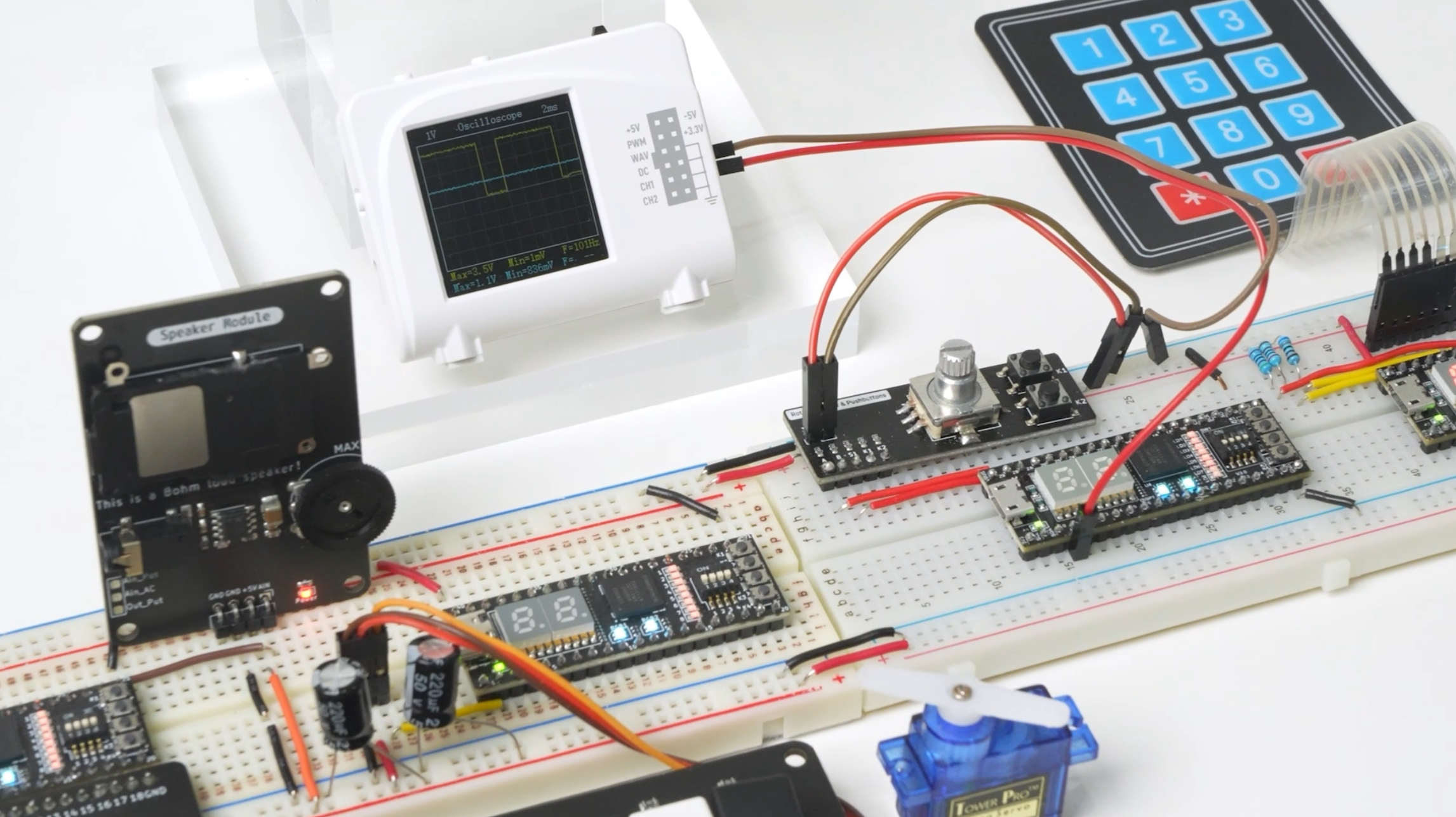
Digital Circuits
via FPGA & Verilog.

Move into pure hardware logic. Master Digital Circuit Design by architecting parallel systems with Verilog—learning to solve complex timing and concurrency challenges at the silicon level.

Verilog HDL FPGA Logic Concurrency
Coming Soon.
Stage 03 // Synthesis

Embedded Design:
The System.

The final integration. Build a complete Embedded Design System by combining high-speed ADC/DAC, memory buffering, and communication to create a functional Digital Oscilloscope.

SoC Integration ADC/DAC Oscilloscope
Build Your System
EIM Digital Mastery Collection
The Digital Collection

A complete path
without the noise.

From logic gates to a functional oscilloscope system. Secure the synchronized hardware and structured curriculum you need to master digital electronics.

Start Your Lab

Your Learning,
Systematically Managed.

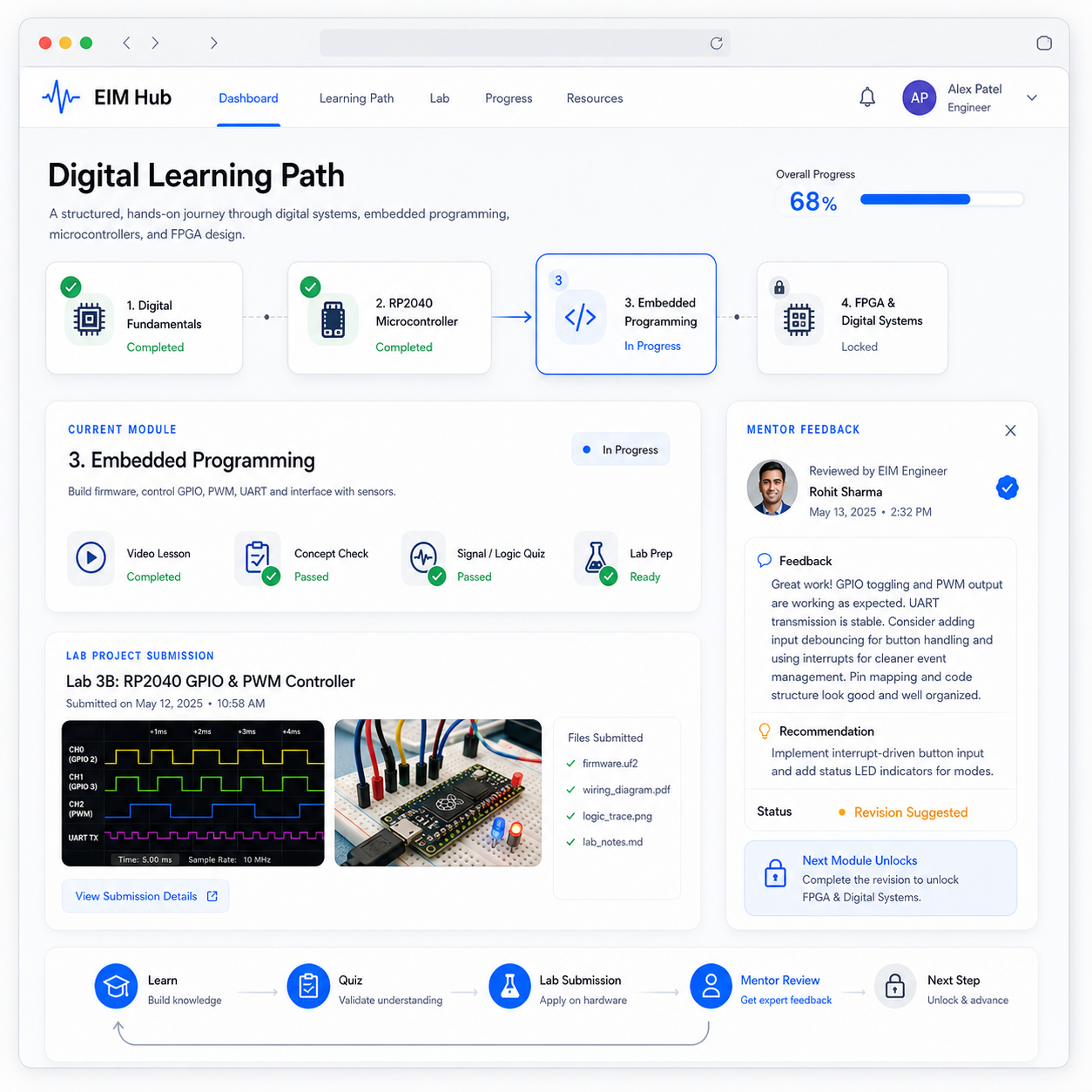
EIM Hub LMS System Interface Dashboard
Automated Workflow

Guided Learning Path

A structured sequence that unlocks as you grow. From documentation to video lectures, the system ensures your path is clear.

Instant Validation

Integrated Assessments

Get immediate feedback through system-graded quizzes. Validate your understanding of complex signals before you hit the bench.

Expert Oversight

Closing the Loop

While the system manages the pace, our engineers provide the final lab reviews for true system-level mastery.

The Open Ecosystem

Code that’s open.
Knowledge that’s free.

We believe in transparency. Access our comprehensive GitBook documentation and open-source repositories to explore every line of code, circuit diagram, and system architecture.

Explore EIM Documentation
# Stage 1: Sensor Acquisition
from machine import Pin, I2C

def read_sensor_data():
  i2c = I2C(0, scl=Pin(1), sda=Pin(0))
  // Fetching raw data from sensor...
  return i2c.readfrom(0x42, 16)

Build Real-World Systems

Move beyond simple blinking LEDs. Master the complexity of Digital Logic and Embedded Architecture through three high-level capstone projects.

PROJECT 01 / MCU & SENSING

Embedded Handheld
Game Console

Master peripheral integration and efficient UI rendering using MicroPython. Build a complete gaming system on the RP2040, managing button debouncing, frame buffers, and real-time game logic.

Embedded Handheld Game Console Project
PROJECT 02 / FPGA LOGIC

DDS Signal Synth
Electronic Piano

Harness the power of Verilog HDL. Design a Direct Digital Synthesis (DDS) engine to generate high-fidelity audio waveforms in real-time, creating a fully functional digital instrument from the ground up.

DDS Signal Synthesis Piano Project
PROJECT 03 / SYSTEM INTEGRATION

Dual-Channel
Digital Oscilloscope

The ultimate synthesis. Combine MCU control with FPGA acceleration to handle high-speed ADC sampling, memory buffering, and real-time waveform visualization in a dual-channel architecture.

Dual-Channel Digital Oscilloscope System Project

Designed for the Driven.

EE / CE Undergraduates

Future Systems Architects

Go beyond high-level coding. Master the RTL design and MCU-to-FPGA pathways that separate average students from top-tier hardware engineers at Silicon Valley giants.

The Pre-College Elite

Ambitious Minds

For high schoolers aiming for top-tier North American engineering programs. Build a portfolio of real FPGA and MCU projects that high school "STEM kits" simply can't touch.

Embedded Software Devs

Software-to-Hardware

CS majors or web devs looking to break the "abstraction barrier." Gain the hardware-level intuition needed to optimize code for silicon and build custom IoT ecosystems.

Everything You Need to Know
Before You Begin.

Clear answers for your digital engineering journey.

Do I need prior coding experience?

A basic understanding of logic (if/else, loops) is helpful. We start with MicroPython on the RP2040, which is the most intuitive way to learn embedded systems. For Verilog, we guide you through hardware description logic from the ground up—treating it as designing circuits with code rather than just writing software.

How does this differ from learning with Arduino?

While Arduino is excellent for rapid prototyping and high-level hobby projects, EIM focuses on Fundamental Mastery. We move beyond just calling libraries; you will understand hardware concurrency with FPGAs and low-level sensing with Microcontrollers. It’s the difference between using a tool and knowing how to build one.

Why learn FPGA and MCU together?

Modern high-performance systems—from signal processors to robotics—rely on the collaboration between Sequential processors (MCU) and Parallel logic (FPGA). Mastering this dual-architecture approach gives you a rare competitive edge in advanced hardware engineering and system design.

What if I get stuck on a Verilog bug?

Our 12-lab curriculum is built with progressive complexity. Every stage is supported by the EIM Hub, featuring step-by-step simulations and structured pedagogy. We focus on "Pedagogy"—ensuring you master the underlying silicon logic before moving to the next level of system integration.

Master the System.
Build the Future.

Professional digital engineering labs, curated for the modern student. From individual logic to integrated architectures.

EIM TECHNOLOGY // DIGITAL SERIES 2026

BECOME A PIONEER

Subscribe our monthly newsletter to gain access to exclusive hardware deep-dives and priority testing for new EIM innovations.

One high-value briefing per month. No spam, just pure engineering. Unsubscribe anytime.